How Hot Is Kyoto In July And August And How Do You Cope?
Kyoto's summer heat is real and measurable, and the Japan Meteorological Agency's own 1991-2020 normals for the Kyoto station give every number you need to plan around it.
Short answer
August is Kyoto's hottest month at a mean of 28.5 C and a mean daily maximum of 33.7 C, while July is the wettest at 223.6 mm. You cope by shifting sightseeing to early morning and evening, using the subway and air-conditioned museums at midday, and drinking constantly.
Kyoto sits in a basin, and in summer that basin behaves like a bowl left in the sun: heat pools at the bottom and the surrounding mountains slow the breeze. The result is a summer that is hotter and more humid than Tokyo's, a fact the city's own weather record makes plain. The Japan Meteorological Agency's 1991-2020 normals for the Kyoto station, block number 47759, put August's mean daily maximum at 33.7 C, and three of the six hottest days ever measured at the station fell in the summers of 2024, 2025 and 2026. None of that makes the city unvisitable. It makes it a city you visit differently in July and August, and this guide lays out exactly how.
How Hot Is Kyoto In July And August And How Do You Cope?
July averages 27.3 C with a mean daily maximum of 32.0 C and a mean nightly minimum of 23.6 C, while August is hotter still, averaging 28.5 C with a mean daily maximum of 33.7 C and nights that only fall to 24.7 C. You cope by front-loading outdoor sightseeing before 10:00, moving museums, tea ceremonies and other indoor hours into the 12:00 to 16:00 window, and reserving evenings for riverside dining and night illuminations.
The numbers deserve a moment, because they change how you plan. A mean daily minimum of 24.7 C in August means the city does not cool down overnight. Kyoto's old wooden houses and modern hotels alike hold the day's heat, so a room without air conditioning is not a charming experience here, it is a sleepless one. When you book, treat air conditioning as a requirement, not a bonus, and check that your accommodation actually lists it. Our guide to Kyoto's best hotels covers properties where this is standard.
Humidity is the other half of the story. The JMA normals show July carrying 223.6 mm of rain, the wettest month of the year, and August another 153.8 mm. That moisture sits in the air between downpours, which is why 32.0 C in Kyoto feels heavier than the same reading in a dry climate. The coping arithmetic is simple: sweat evaporates slowly, so you must drink more than feels natural, roughly a small bottle of water every couple of walking hours, and replace salt at meals, which Kyoto's food does well without asking.
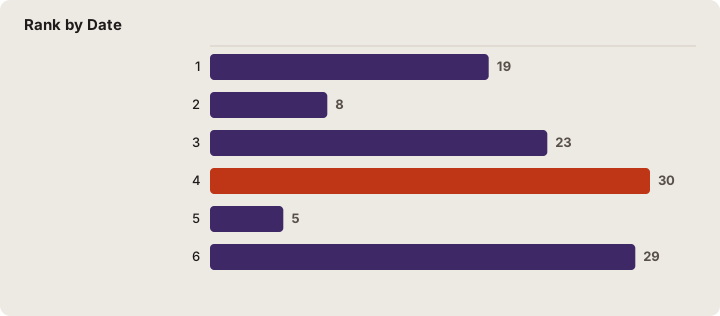
The record table below puts the current summer in context. The station's series runs from 1880, and the top of the daily maximum list has been rewritten recently.
| Rank | Daily maximum | Date |
|---|---|---|
| 1 | 39.8 C | 19 July 2018 |
| 2 | 39.8 C | 8 August 1994 |
| 3 | 39.7 C | 23 July 2026 |
| 4 | 39.6 C | 30 July 2025 |
| 5 | 39.5 C | 5 August 2018 |
| 6 | 39.4 C | 29 July 2024 |
Three of those six dates fall in the last three summers. The same record shows the hottest calendar months ever measured, and July and August 2025 both sit in the top five, at 30.3 C and 30.3 C monthly means respectively. Kyoto's summer heat is not an anomaly you can hope to miss. It is the baseline, and the rest of this guide is built around it.
Is July Or August The Better Month To Visit Kyoto?
August is hotter and sunnier, averaging 28.5 C with 182.7 hours of sunshine, while July is marginally cooler but wetter, carrying 223.6 mm of rain against August's 153.8 mm. August wins on stable weather and evening events, including Gozan no Okuribi on 16 August, while July wins on festival scale, because the entire Gion Matsuri runs from 1 to 31 July. The honest answer is that neither month is gentle, so choose by event, not by thermometer.
July's case rests on Gion Matsuri, the city's largest festival, which runs the whole month. The Yasaka Shrine's own event page gives the structure: the festival opens with Kippu-iri on 1 July and closes with Nagoshi-sai on 31 July, with the two Yamaboko Junko processions on 17 July and 24 July. The floats are the draw, towering wooden constructions hauled by hand through the grid streets, and the parade route is flat and shadeless, so the standard advice applies doubled: claim a spot early, bring water, and wear a hat with a brim. Our full Gion Matsuri guide covers viewing strategy.
August's case rests on the calendar's most dramatic single evening. Gozan no Okuribi, the lighting of five giant bonfires on the mountains surrounding the city, happens on 16 August every year, and the city's tourism association notes that entering the hills is prohibited that day. The fires are lit one after another, and the event closes Obon week, when many locals leave town and the city briefly breathes. The Gozan no Okuribi guide explains the viewing spots and the transport crush.
The rainfall difference matters more than most guides admit, because almost every guide gets it wrong. July is Kyoto's wettest month, not June. The JMA normals give June 199.7 mm and July 223.6 mm, a gap of nearly 24 mm, and the rainy-season peak slides into early July in many years rather than staying in June. If you see a guide telling you June is the wet month and July is dry, it was written from assumption rather than the station table.
| Month | Rain mm | Mean C | Mean daily max C | Mean daily min C | Sunshine h |
|---|---|---|---|---|---|
| June | 199.7 | 23.3 | 28.1 | 19.2 | 133.1 |
| July | 223.6 | 27.3 | 32.0 | 23.6 | 142.7 |
| August | 153.8 | 28.5 | 33.7 | 24.7 | 182.7 |
| September | 178.5 | 24.4 | 29.2 | 20.7 | 142.7 |
Typhoon season runs roughly July to October, which is a planning fact rather than a warning. Most typhoons that affect Kyoto arrive as heavy rain and cancelled trains for a day, not as a citywide shutdown, and the JR and subway networks post restoration notices quickly. Build one flexible day into any July-to-October itinerary and the risk is largely absorbed.
For a first visit in either month, the strongest summer strategy is a morning-and-evening city with an air-conditioned middle. The trio of indoor picks below covers exactly that shape: a tea ceremony in a temple tatami room, an observation deck, and a hands-on workshop, none of which asks you to stand in the sun.
What Should You Do In Kyoto When The Heat Peaks?
The best midday activities in a Kyoto summer are the air-conditioned and shaded ones: tea ceremonies in tatami rooms, museum galleries, the Kyoto Railway Museum, Nishiki Market's partly covered lane, and observation decks like Nidec Kyoto Tower. Temples with mountain forest settings, such as Kurama and Kibune north of the city, run several degrees cooler than the basin, and the Kamo River banks come alive in the evening with open-air riverside dining platforms.
The logic is thermal, and it is worth stating plainly. Between roughly 12:00 and 16:00, the mean daily maximum is being achieved, sun is direct, and the stone-paved temple districts of Higashiyama hold heat like a kiln. That is the window for indoor hours. A tea ceremony is the classic choice, and the Kyoto tea ceremony guide explains what the ritual involves and how to book a room. The Ju-An ceremony at Jotokuji Temple runs about 70 minutes, which is a well-sized cool break, and the temple setting is part of the point: you sit in a dim tatami room with a garden view while the day's worst heat passes outside.
Nidec Kyoto Tower's observation deck is the other obvious midday anchor, and the sponsor name is part of its official title. The deck runs 10:00 to 21:00 with last admission at 20:30, so it doubles as a sunset option, and the adult ticket is 900 yen with high school students at 700 and elementary and junior high at 600. From the deck you can see the whole basin that is causing your discomfort, which is oddly satisfying, and the base of the tower has food options that need no walking.
The Kyoto Railway Museum is a strong family pick for the same reason: it is indoors, it is large enough to fill three hours, and it is genuinely good. General admission for adults is 1,500 yen, and the museum is open 10:00 to 17:00 with last entry at 16:30, closed Wednesdays and over the New Year break. Our guide to Kyoto's museums ranks the full set, several of which are in the downtown core and easy to combine with a lunch stop.
For the afternoon you cannot avoid being outside, choose the mountains. The Kurama and Kibune area north of the city sits in forest, and the hike between the two villages is shaded almost end to end. Kibune's riverside restaurants build platforms over the stream in summer, a dining style called kawadoko, and it is the single most heat-aware meal in the region: your table is above flowing water, in tree shade, with the temperature measurably lower than downtown. Book ahead, because the platforms are popular in August.
How Does Rain Fit Into A Kyoto Summer Plan?
July is Kyoto's wettest month at 223.6 mm against June's 199.7 mm, and August adds 153.8 mm, so rain is a daily possibility rather than an occasional surprise. Most summer rain arrives in short, heavy bursts, often late afternoon or evening, and the city's covered arcades, museum cluster and subway network absorb a wet two hours without ending the day. Carry a compact umbrella rather than rain gear, and check the morning forecast, because typhoon remnants announce themselves a day ahead.
The pattern behind those totals is worth understanding. Summer rain in the Kyoto basin comes in two shapes: the rainy-season front, which lingers into July and delivers long grey soaks, and the convective downpour, a violent burst that leaves the streets steaming and then clears to blue sky. The second kind is more common in August, which is why August's rainfall total is lower but its sunshine total, 182.7 hours, is the year's highest. A morning that starts bright can still end in a squall.
Practically, the response is built into the city. The downtown core around Kawaramachi and Karasuma has covered shopping arcades, including Teramachi Street, where you can walk several blocks in shade and dry air, and our Kyoto shopping guide maps them. The subway is deep, cool and fast, and the Kyoto subway guide explains the fare zones, which run 220 to 360 yen for adults depending on distance. When the radar turns red, the move is simple: descend, shop, eat, resurface.
One caution belongs here, because it is a heat-and-rain interaction. Stone steps and temple paths, especially the steep approach to Fushimi Inari and the slopes of Higashiyama, become genuinely slippery within seconds of a downpour. Give them a few minutes to drain and they are fine again. The same applies to the bamboo path in Arashiyama, where the packed-earth surface holds a film of water briefly. Neither is dangerous if you slow down, and both are beautiful in the minutes after rain, when the heat drops and the greens deepen.
What Are Kyoto's Summer Festivals And Key Dates?
The summer calendar runs Gion Matsuri across the whole of July, with float processions on 17 July and 24 July, then Gozan no Okuribi on 16 August, the lighting of five mountain bonfires that closes Obon week. Around those two anchors sit the evening beer gardens on the Kamo River banks, temple night illuminations, and the Aoi Matsuri's spring cousin, Jidai Matsuri, which is an October event and not part of the summer at all. Plan around the two anchors, because both reshape the whole city.
Gion Matsuri is the month-long one. The Yasaka Shrine's own page gives the frame: 1 July to 31 July, with the saki-matsuri procession on 17 July starting at 9:00 and the ato-matsuri on 24 July starting at 9:30. Between the processions, the float streets fill each evening with food stalls and families, and the atmosphere is closer to a month-long street party than a single parade. Hotels book out months ahead for mid-July, so if the festival is your reason for travelling, lock accommodation early through the best hotels guide.
Gozan no Okuribi is the single evening. Five fires, shaped as characters and symbols, are lit on the mountains that ring the city, and the event is visible from many downtown rooftops and riverbanks. The city's tourism association confirms the date, 16 August, and confirms that entering the hills is prohibited that day. The crowds are dense and the buses are fuller than at any other point in the year, so pick a viewing spot within walking distance of your hotel and treat the evening as a slow one.
| Event | Date | What it is |
|---|---|---|
| Gion Matsuri | 1-31 July | Month-long festival centred on Yasaka Shrine |
| Yamaboko Junko, saki-matsuri | 17 July, 9:00 | First float procession |
| Yamaboko Junko, ato-matsuri | 24 July, 9:30 | Second float procession with Hanagasa |
| Gozan no Okuribi | 16 August | Five mountain bonfires closing Obon week |
| Kamo River dining platforms | July and August | Evening open-air dining on the riverbanks |
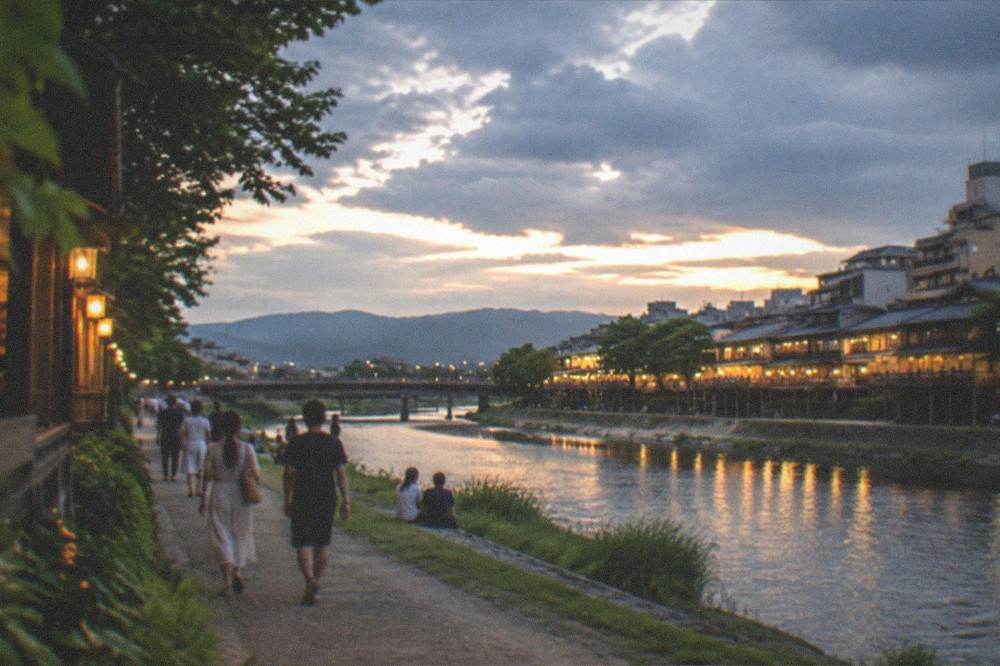
The Kamo River platforms deserve their line in that table, because they are how the city itself uses summer evenings. Restaurants along the west bank from Shijo northward build outdoor decks, and the whole stretch becomes a promenade after dark, which costs nothing to walk. Our things to do in Kyoto roundup places the river walk in the wider summer context.
How Do You Structure A Hot Day In Kyoto?
The proven summer shape is a 6:00 or 7:00 start at a major outdoor site, an indoor or shaded block from about 11:30 to 15:30, and a return outside after 16:00, with the evening given to the river, night illuminations or Gion. Kiyomizu-dera opens at 6:00, Fushimi Inari's paths have no closing time at all, and several temples run special evening illuminations in summer, so the day naturally brackets the heat rather than fighting it.
The early start is not a hardship trick, it is the schedule the sites themselves publish. Kiyomizu-dera's own FAQ gives 6:00 as the daily opening, and the temple's posted 2026 hours extend to 21:30 during the spring night-viewing window and again in mid-August, so the site is built to be visited at the day's edges. Fushimi Inari is even more flexible: the shrine charges no admission and publishes no closing time for its paths, so a 6:30 ascent of the torii tunnels is entirely legitimate and, in July, genuinely cooler. The Fushimi Inari guide covers the route and the crowd timing.
The middle block is where the earlier sections of this guide pay off. A tea ceremony at midday, the Railway Museum, the tower deck, or an arcade lunch crawl through Nishiki Market's covered lane all sit indoors or in shade, and the Kyoto food guide covers the lunch options around the market in detail. One note on Nishiki: the market's own guidance discourages eating while walking, so buy at the stall, eat at the stall, and move on. It is a rule worth following in summer anyway, because it slows you down.
The evening is summer's gift. Daylight runs past 19:00 in July, Kodai-ji runs its autumn illumination into the night season, and the Gion walks are at their best after sunset, when the lanterns are lit and the day-trippers have gone. A guided evening walk through Gion is one of the few tours that improves with heat, because it starts when the temperature is falling. The geisha districts guide explains what you are looking at, and the etiquette rules matter: the city's tourism association asks visitors not to touch, chase or photograph geiko and maiko without permission, and signs on Gion's private alleys threaten a 10,000 yen penalty for unauthorised entry or photography.
A sample summer day, costed:
| Time | Activity | Cost |
|---|---|---|
| 6:30-9:00 | Fushimi Inari torii paths, before the heat | Free |
| 9:30-11:30 | Kiyomizu-dera and the Higashiyama slopes | 500 yen |
| 12:00-15:00 | Nishiki Market lane, lunch, tea ceremony | 500 yen plus ceremony fee |
| 16:00-18:00 | Subway to Arashiyama, bamboo grove in low light | Free path |
| 19:00 onward | Kamo River bank walk and dinner | Dinner cost |
That day uses the subway for the long hops, which matters. The flat bus fare is 230 yen, but summer buses are packed, the city's own transport bureau has spent two years trying to move tourists off them, and the subway is air-conditioned from platform to platform. The Subway and Bus One-Day Pass at 1,100 yen covers both modes if you want the flexibility, and the Kyoto buses guide explains the express routes, including the EX100 tourist express at 500 yen a ride.
What Should You Pack And Wear For Kyoto In Summer?
Pack light, loose, breathable clothing with covered shoulders where temple visits are planned, a brimmed hat, sunscreen, a compact umbrella for the daily burst of rain, and more underwear and socks than you think you need, because a mean daily minimum of 24.7 C means laundry does not dry overnight. A small towel, the type locals carry, is the single most useful item, and a refillable bottle works with the vending machines and free water refills at many convenience stores.
The clothing advice is where local practice beats travel-forum theory. Kyoto residents in summer wear loose natural fabrics, often in pale colours, and the traditional summer kimono, ro, is woven specifically to let air through. Renting a kimono in summer is a popular activity and the lighter summer weaves are issued in July and August, though be aware that a full kimono in 33.7 C heat is a commitment, and the kimono rental guide explains the seasonal options honestly. A yukata, the unlined cotton version worn to summer festivals, is the cooler choice.
Footwear matters more than people expect. The city's sightseeing is done on stone, gravel and packed earth, and sandals that work on pavement fail on temple paths. Broken-in walking shoes, with socks, are the standard advice, and the socks-and-shoes combination is also what lets you step into temples' indoor areas without bare feet on hot wooden floors. The full index of guides sits on Kyoto Travel Guide.
The health notes are short and serious. Heat illness in Kyoto's summer is a real risk for visitors who attempt a full temple circuit at midday, and the city's hospitals see it every July. The prevention is unglamorous: water before you feel thirsty, salt at meals, shade between stops, and a hard stop on outdoor exertion if you stop sweating or feel confused, which are the signals to get indoors and cool immediately. Convenience stores, on every second corner, sell cold drinks, salt tablets and ice packs, and they are part of the summer infrastructure.
Where Should You Stay In Kyoto To Handle The Heat?
Stay somewhere with confirmed air conditioning, within walking distance of a subway station, and preferably north or east of the dead centre, because the Kamogawa corridor and the northern districts sit marginally higher and cooler than the basin floor. Downtown Kawaramachi puts you at the centre of the evening life but in the densest heat island, while the Kyoto Station area trades atmosphere for direct subway and rail access that cuts your time outdoors between stops.
The heat-island effect is real and measurable in Kyoto, as in any city, and the practical version is this: the blocks around Shijo and Kawaramachi, all stone and asphalt and air-conditioner exhaust, run noticeably hotter at 15:00 than the riverside or the northern residential streets. If your hotel is a 12-minute walk from the station in that district, you will feel it. The where to stay in Kyoto guide breaks the districts down properly, including the ryokan question.
The ryokan question deserves its own sentence, because it is where summer comfort and travel romance collide. A traditional ryokan with tatami rooms, wooden corridors and a garden is a wonderful summer experience, and the Kyoto ryokan guide covers the best of them, but confirm air conditioning before booking, because the aesthetic is built for cross-ventilation in an era before it. The good ones all have it now. The onsen question is simpler: a bath in summer sounds wrong until you try it, and the Kyoto onsen guide covers the bathhouses that locals use year-round.
What Are The Best Summer Day Trips From Kyoto?
The best summer day trips from Kyoto are the ones that gain altitude or reach water: Kurama and Kibune's forested valley to the north, Lake Biwa to the east for open water and breeze, and Ohara's mountain temples, all of which run cooler than the city basin. Nara, Osaka and Kobe are all reachable in under an hour, but they sit in the same heat, so treat them as evening or indoor-heavy trips rather than escapes from the temperature.
Kurama and Kibune is the strongest thermal escape on the rail map. The Eizan line runs north from Demachiyanagi into a valley that is forested end to end, the hike between the two villages is shaded, and Kibune's kawadoko dining puts your table over the stream. The Kurama and Kibune guide covers the route, the train, and the shrine at the top of the cable car. Ohara, similarly, is a mountain temple town that feels like a different climate zone, and the Ohara guide explains the bus access.
Lake Biwa is the water option, Japan's largest lake, with beaches and swimming areas on the western shore closest to Kyoto, covered in the Lake Biwa guide. The day trips from Kyoto guide ranks the full set, including Amanohashidate and Ine on the Sea of Japan coast, which is a longer trip but genuinely cooler in August.
How Do You Handle Kyoto's Summer Crowds?
Kyoto drew a record 62.79 million visitors in 2025, the city's own survey released in June 2026 reports, and summer is no longer the quiet season: the heat does little to thin the queues at Kiyomizu-dera or Fushimi Inari. You handle the crowds by arriving at major sites before 8:00, checking the city's Tourism Comfort Forecast, which predicts crowd levels by spot and time slot from smartphone location data, and spending midday in the less-visited north and east rather than the Higashiyama spine.
The survey numbers are worth reading once, because they calibrate expectations. The city's 2025 survey recorded 62.79 million visitors, up from 56.06 million in 2024, of whom 12.68 million were foreign. Overnight guests hit a record 16.59 million. What that means on the ground in July is that the famous sites are busy at every hour you would want to be outside, and the only reliable quiet is very early or genuinely obscure. The Kyoto crowds guide covers the dispersal strategy in depth, and the Kyoto hidden gems guide lists the sites that stay calm.
The city's own tools help more than visitors realise. The Kyoto Tourism Comfort Forecast, run by the city's tourism association, uses smartphone location data with weather and weekday patterns to predict a five-level comfort rating for major spots by time slot, and Fushimi Inari's own site links to it alongside its approach cameras. Checking it the night before costs a minute and can move your whole day.
What Does Summer In Kyoto Actually Cost?
A summer day in Kyoto costs about the same as any other season, because the temples do not price by temperature: Kinkaku-ji charges 500 yen, Kiyomizu-dera 500 yen, and subway fares run 220 to 360 yen a ride, with the Subway and Bus One-Day Pass at 1,100 yen.
The summer-specific costs are kawadoko riverside dining at a premium, plus the accommodation tax, which changed on 1 March 2026 and now reaches 1,000 yen per person per night on rooms from 20,000 to under 50,000 yen.
The accommodation tax change is the one most visitors miss, because most competing guides still quote the old tiers. From 1 March 2026, the city's own ordinance sets five bands: 200 yen on rooms under 6,000 yen, 400 yen from 6,000 to under 20,000, 1,000 yen from 20,000 to under 50,000, 4,000 yen from 50,000 to under 100,000, and 10,000 yen at 100,000 and up, all per person per night on the room-only charge. The Kyoto trip cost guide has the full budget breakdown, and the Kyoto on a budget guide covers the cheap end of the range.
| Summer daily cost | Item | Typical figure |
|---|---|---|
| Temple admission | Kinkaku-ji | 500 yen |
| Temple admission | Kiyomizu-dera | 500 yen |
| Transport | Subway single ride | 220-360 yen |
| Transport | One-day pass, subway and bus | 1,100 yen |
| Cold drinks | Vending machines and convenience stores citywide | A few coins a bottle |
| Accommodation tax | Room 20,000 to under 50,000 yen | 1,000 yen per person per night |
Note one fee that moved in 2026, because it is the kind of detail a copied guide gets wrong. Ginkaku-ji doubled its admission on 1 April 2026, from 500 to 1,000 yen for adults, its first change in 32 years, so the Silver Pavilion now costs twice Kinkaku-ji's 500. For a summer visit, that matters in one specific way: Ginkaku-ji's Philosopher's Path stretch is a morning walk with little shade at midday, so if you are choosing between the two pavilions on a hot afternoon, Kinkaku-ji is the shorter outdoor exposure.
What Indoor Kyoto Activities Work Best In A Heatwave?
The best indoor summer hours in Kyoto are tea ceremonies in temple tatami rooms, hands-on workshops like chopsticks making and samurai sword experiences, cooking classes in air-conditioned kitchens, museum galleries, and the observation decks. These are not consolation activities: the tea ceremony at Jotokuji Temple runs about 70 minutes in a dim room with a garden view, the samurai experience fills nearly two hours with uniform, sword technique and a photo stop, and a ramen-making class teaches a skill you take home.
The samurai experience deserves its own paragraph, because it is the indoor activity that most reliably absorbs a whole afternoon. It runs an hour and three quarters, it is indoors, and it covers the sword-drawing technique, the uniform and the philosophy behind it, with a session structure that suits both adults and teenagers. It pairs naturally with the chopsticks-making class in Gion, which is a shorter, quieter hour of hands-on craft, and with a cooking class, of which the Kyoto cooking class guide ranks the best, including a washoku bento class in a small group.
The tea ceremony remains the anchor, though, and the reason is thermal as much as cultural. A tatami room in an old temple building is cool by design: deep eaves, no direct sun, stone foundations and a garden that the room frames. The Ju-An ceremony at Jotokuji Temple, rated 4.9 from 3,758 reviews, runs 70 minutes, which is long enough to feel like a real break and short enough to fit between a morning temple and an evening walk. The matcha guide covers the wider tea landscape if you want to build a full matcha day.
Is Kyoto In Summer Worth It At All?
Yes, if you plan around the heat rather than against it: summer Kyoto offers Gion Matsuri, the country's biggest festival, Gozan no Okuribi's mountain fires, riverside evening dining, night illuminations, deep green temple gardens and thinner crowds at the famous sites before 8:00, all at the cost of a mean daily maximum of 33.7 C in August. Travellers who start at 6:00, hide indoors at midday and come out at dusk consistently report better trips than shoulder-season visitors who arrive unprepared.
The honest counterweight is discomfort. You will sweat, your photographs will be hazy with humidity on some afternoons, and the nights will be warm. The compensations are specific to the season: the gardens are at their deepest green, the maple canopies that shade the Philosopher's Path are in full leaf, the kaiseki menus shift to cold preparations, and the evening city, from the Kamo River platforms to the lantern-lit lanes of Gion, is at its most alive. Summer is when Kyoto's residents use their own city outdoors, and joining them is the point.
For the practical layers, the Kyoto weather guide carries the full monthly normals table, the best time to visit guide compares all four seasons honestly, and the Kyoto in winter guide covers the opposite extreme, a season the station's own record of -11.9 C and 41 cm of snow depth firmly proves exists.
Before the practical questions, the picks below cover the three indoor anchors this guide keeps returning to, all bookable for a midday slot.
Common Questions About Kyoto In Summer
How Hot Is Kyoto In July And August And How Do You Cope?
July averages 27.3 C with a mean daily maximum of 32.0 C, and August averages 28.5 C with a mean daily maximum of 33.7 C, per the JMA 1991-2020 normals for the Kyoto station. You cope by sightseeing before 10:00, going indoors from midday to late afternoon, drinking water constantly, and using the evenings for the river banks and night illuminations.
Is July Or August Hotter In Kyoto?
August is hotter. Its monthly mean of 28.5 C and mean daily maximum of 33.7 C both exceed July's 27.3 C and 32.0 C, and August is also the sunniest month at 182.7 hours. July, however, is the wettest month at 223.6 mm, so it can feel more humid between downpours.
What Is The Hottest Temperature Ever Recorded In Kyoto?
The station's record daily maximum is 39.8 C, recorded on 19 July 2018 and equalled on 8 August 1994. Three of the six hottest days on record, 39.7 C on 23 July 2026, 39.6 C on 30 July 2025 and 39.4 C on 29 July 2024, fall within the last three summers.
Does It Rain A Lot In Kyoto In Summer?
Yes. July is the wettest month of the year at 223.6 mm, ahead of June's 199.7 mm, and August adds 153.8 mm. Most summer rain arrives in short, heavy bursts rather than all-day soaks, and the covered arcades, museums and subway absorb a wet hour or two without ending the day.
Are Kyoto's Temples Open In Summer?
Yes, and the hours suit the heat. Kiyomizu-dera opens at 6:00 daily, Fushimi Inari's paths have no closing time and no admission fee, and Kinkaku-ji runs 9:00 to 17:00. Several temples, including Kiyomizu-dera and Kodai-ji, add special night illuminations in summer, extending visiting into the cooler evening.
What Should I Wear In Kyoto In Summer?
Loose, light, breathable fabrics, a brimmed hat, sunscreen and broken-in walking shoes with socks, because temple paths are stone, gravel and packed earth. Carry a compact umbrella for the daily downpour risk and a small towel, the item locals carry all summer. Confirm air conditioning when booking accommodation, since August nights average a minimum of 24.7 C.
Kyoto in summer is a city that rewards the visitor who reads its own numbers and plans accordingly. The heat is measured, the festivals are dated, and every coping strategy in this guide is already how the city works for the people who live in it.