How Long Does The Full Fushimi Inari Loop To Mount Inari Take?
Fushimi Inari Taisha charges nothing, keeps no closing time on its mountain paths, and draws a share of the 62.79 million visitors Kyoto recorded in 2025. Here is what the full loop to the top of Inariyama involves, using only what the shrine and the city actually publish.
Short answer
The shrine publishes no official walking time for the loop, and the mountain it climbs, Inariyama, stands 233 m tall. The full circuit runs from the main shrine halls up through the Senbon Torii, past the Yotsutsuji intersection to the summit shrines and back down, mostly on stone steps. Entry is free and the paths have no closing time.
How Long Does The Full Fushimi Inari Loop To Mount Inari Take?
Fushimi Inari Taisha sits at the base of Inariyama, a 233 m hill on the south side of Kyoto, and it is the head shrine of a network the shrine itself says numbers about 30,000 Inari shrines across Japan. Entry costs nothing. The shrine publishes no fee anywhere on its site, and while it prints desk and prayer hours for its offices, it sets no closing time for the mountain paths behind the main halls. The result is one of the few major sights in a city of 62.79 million annual visitors, a record the city's own 2025 tourism survey confirmed in June 2026, that cannot be priced, timed or gated. This page is part of the coverage at Kyoto Travel Guide.
The question of how long the full loop takes is the one the shrine's own materials do not answer directly, and it is worth getting right, because the answer changes what you carry, when you start and what you expect from the climb. This page works through the route as the shrine describes it, the physical reality of the mountain, the timing and crowd questions, and the meaning of the gates themselves, using the shrine's own pages, the city's transport bureau and the Japan Meteorological Agency as its sources. For a shorter version focused only on the ascent, see how long it takes to walk up Fushimi Inari.
How Long Does The Full Fushimi Inari Loop To Mount Inari Take?
The shrine publishes no official walking time for the full loop, and no guide that gives one precise figure is quoting the shrine. Inariyama stands 233 m tall, and the circuit runs from the main halls through the Senbon Torii, up past the Yotsutsuji intersection to the summit shrine cluster, then back down the far side to the entrance. Almost the entire climb is stone steps through cedar forest. Plan it as a substantial walk with rest stops, not a stroll between two photo spots.
The honest starting point is that the shrine's English FAQ answers questions about fees, torii and etiquette, but not about duration. What it does give is the physical frame: a mountain of 233 m, paths with no closing time, and "about 10,000 torii of all sizes" spread across the whole mountain, a phrase that matters because the famous dense tunnel, the Senbon Torii, is only one section of that count. The near-universal guide error is to place all 10,000 gates in the tunnel; the shrine's own wording says otherwise.
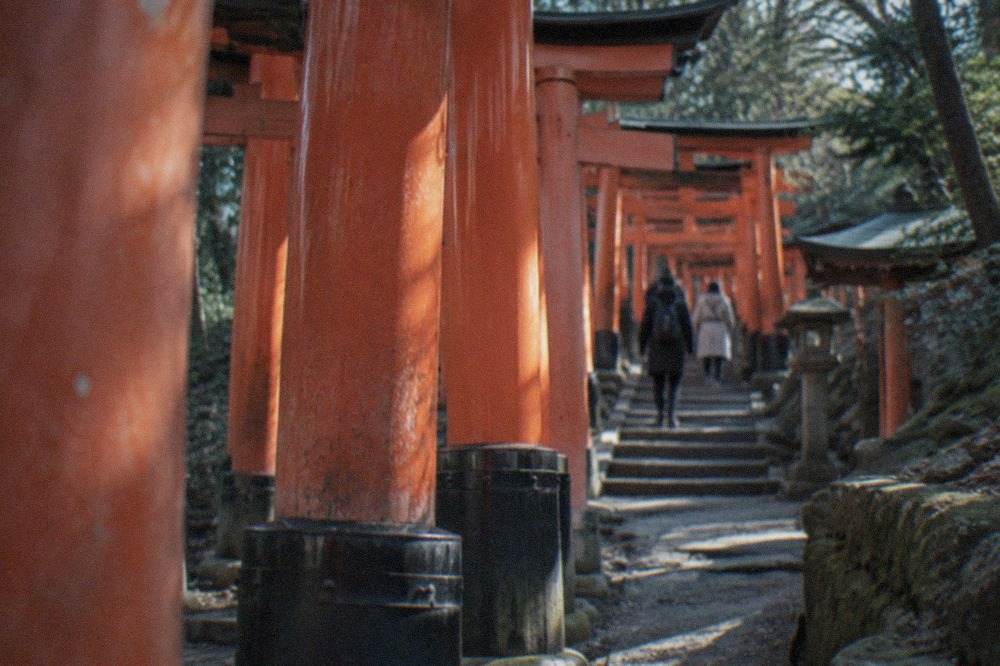
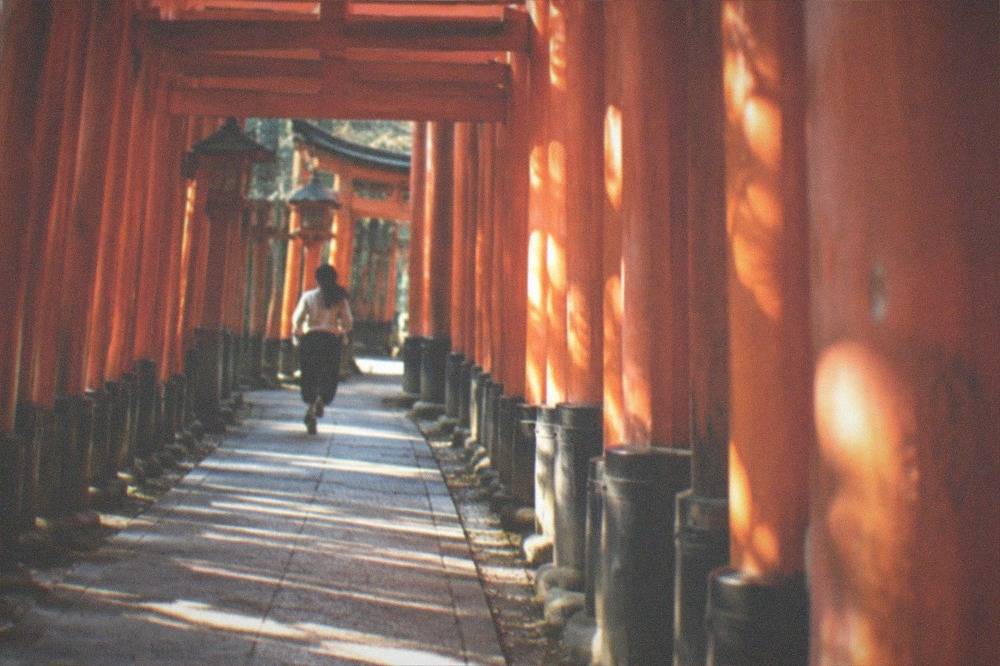
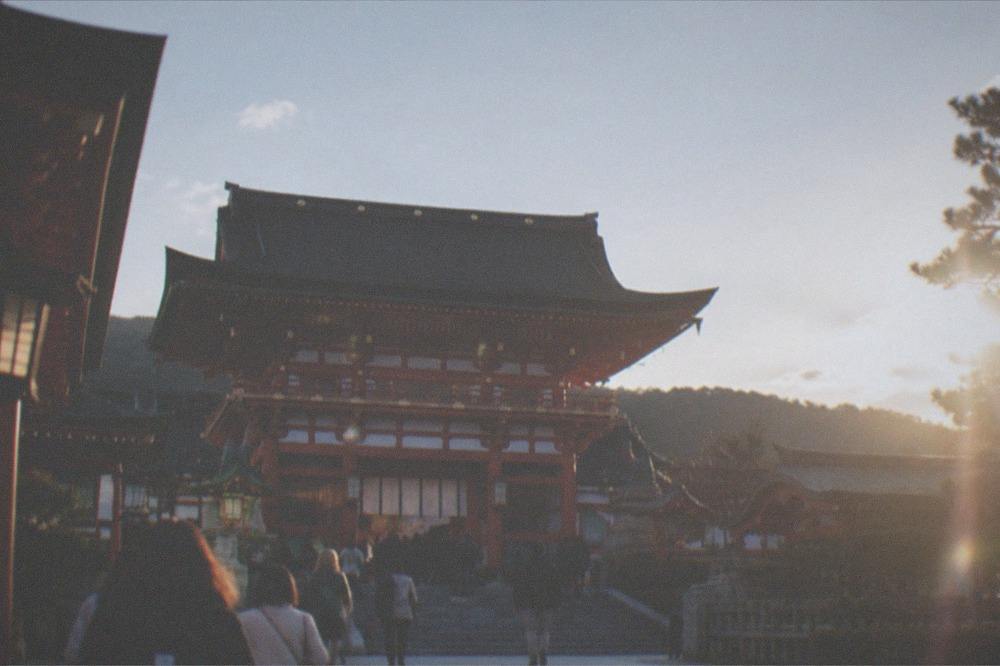
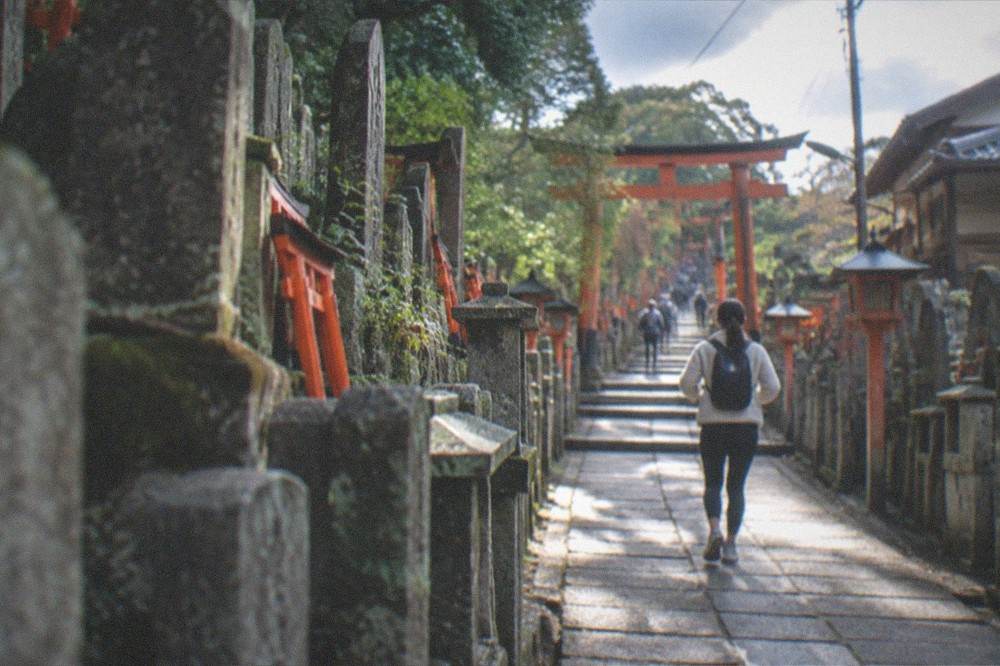
Structurally the loop is simple. From the Romon gate, the two-story entrance gate, the route passes the main halls, splits into the two parallel corridors of the Senbon Torii that rejoin at the Okusha Hohaisho, the inner shrine terrace, and then climbs a single winding stone stairway through the forest. Roughly two-thirds of the way up, the Yotsutsuji intersection offers the first view back over southern Kyoto and a fork where many walkers turn around. Above it the path continues past a dense field of otsuka, worship stones bearing the names of Inari's deities, to the summit shrines, then descends on the far side of the ridge and rejoins the lower route near the Okusha.
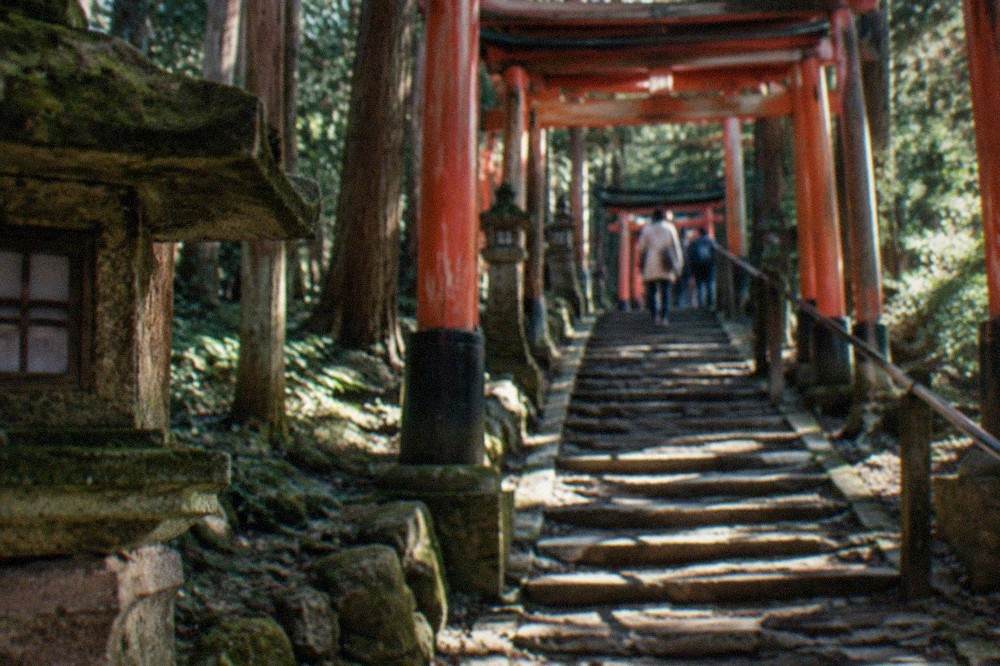
Three things stretch the time beyond what the distance suggests. First, the steps: this is a stair climb, not a path walk, and the shrine's own approach cameras, which it links from its homepage alongside the city's crowd forecast, exist precisely because the flow of people up those stairs is constant. Second, the stops: the otsuka fields, the teahouses on the upper slopes and the Yotsutsuji viewpoint each pull walkers to a halt. Third, the crowds: on peak days the Senbon Torii corridors move at the speed of the slowest photographer, and the city's 2025 survey recorded 62.79 million visitors to Kyoto overall, 12.68 million of them foreign.
What this means in practice is a loop best planned around conditions rather than a clock figure. The shrine's homepage links to the Kyoto Tourism Comfort Forecast, a five-level crowd tool the city's tourism association runs using smartphone location data, weather and time of day. Checking it the morning you go tells you more about your actual pace than any published duration would.
How Hard Is The Fushimi Inari Climb?
The climb is a steady stone stair ascent of 233 m and back down, continuous rather than technical, with no scrambling and no exposure. The surface is stepped and well maintained, but the upper sections are steep enough that pace drops noticeably. Reasonable footwear matters more than fitness: the steps are worn smooth in places and the forest canopy keeps them damp after rain. There is no admission, no reservation and no closing time on the paths.
The physical demands are ordinary for a hill walk but real in summer. The JMA 1991-2020 normals for Kyoto station show July averaging a mean daily maximum of 32.0 C and August 33.7 C, and the record table tells a sharper story: three of Kyoto's six hottest days on record fell in the summers of 2024, 2025 and 2026, with 39.7 C measured on 23 July 2026. Climbing Inariyama in that weather is a water-and-shade exercise, and the teahouses on the mountain's mid slopes, which serve drinks and light food, are placed where walkers need them.
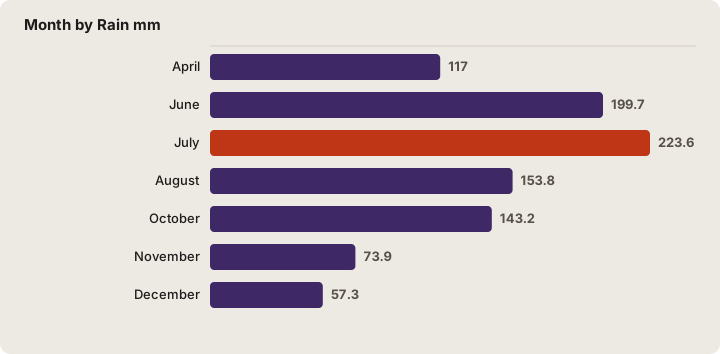
Rain changes the picture differently. July is Kyoto's wettest month at 223.6 mm against June's 199.7 mm in the JMA normals, a fact that surprises visitors who plan around a June rainy season and arrive in a wetter July. The cedar canopy drips long after rain stops, and the stone steps hold a film of water. The mountain is walkable in almost any weather, but the descent is where care is needed.
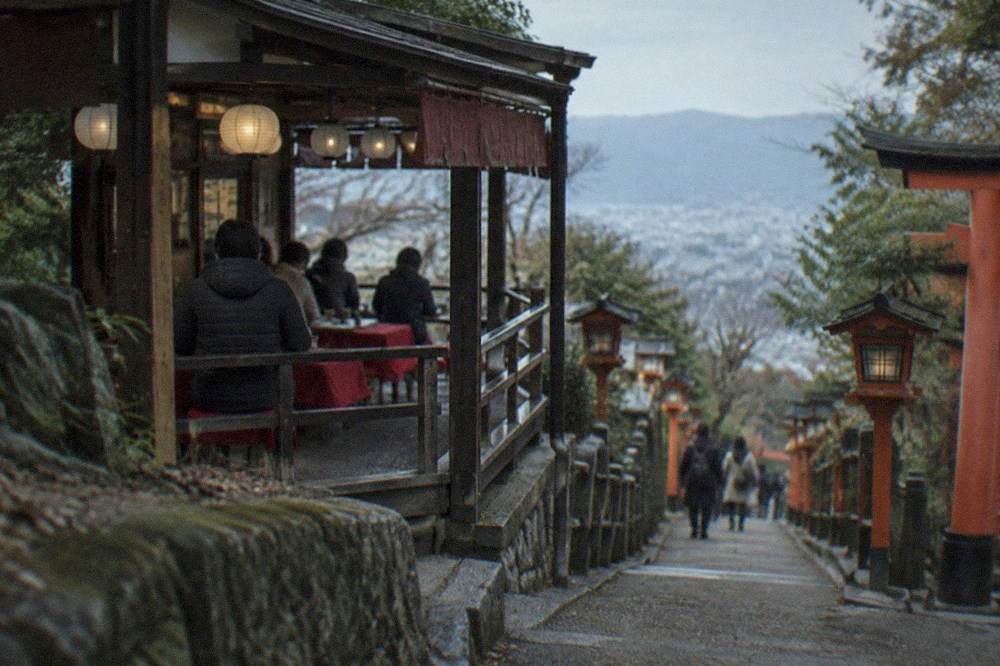
For walkers who want the mountain but doubt the full circuit, the Yotsutsuji intersection is the natural turnaround. It delivers the view, the sense of the climb and the upper forest, then returns by the same stairs. The otsuka field above it and the summit shrines are the reward for continuing, and the descent on the far side is quieter than anything below. A guide to Kyoto's crowds covers how the mountain's load varies with season and hour; the short version is that the lower gates are busiest midday and the upper slopes thin out fast.
If a self-guided climb feels thin on context, guided options exist. The Fushimi Inari hidden hike is a three-hour rated 5.0 walk with a private option, and it is one of the few tours built around the mountain's quieter paths rather than the tunnel alone.
For comparison, the shrine's own framing of its scale is worth setting against other Kyoto walks. The table below gathers what the various sites themselves publish about admission and hours, which is the honest basis for planning a day around the mountain.
| Site | Admission (adult) | Hours as published |
|---|---|---|
| Fushimi Inari Taisha | Free, no fee printed anywhere | Paths have no closing time; desk and prayer hours only |
| Kiyomizu-dera | 500 yen, single source, not printed by the temple | Opens 6:00 daily, closing varies by season |
| Kinkaku-ji | 500 yen | 9:00-17:00 |
| Ginkaku-ji | 1,000 yen from 1 April 2026, doubled from 500 | 8:30-17:00 in season, 9:00-16:30 in winter |
| Sanjusangen-do | 600 yen | 8:30-17:00 in season, 9:00-16:00 in winter, open daily |
| Tofuku-ji (Tsutenkyo) | 600 yen, rising to 1,000 in the 2026 foliage period | Varies by sub-temple |
The contrast is the point. In a city where the major temples charge between 500 and 1,000 yen and two of them changed their fees in 2026, the head shrine of about 30,000 Inari shrines charges nothing and never closes its paths. That combination is rare enough to shape a whole day's plan.
When Is The Best Time Of Day To Walk Fushimi Inari?
Early morning is the strongest window, and the reason is arithmetic rather than opinion: the paths have no closing time, so the hours before the tour buses arrive are the only ones when the Senbon Torii is quiet. The shrine's approach cameras and the city's five-level Comfort Forecast both exist to manage exactly this. Evening is the second-best choice, since the paths stay open and the lower gates empty after the day-trippers leave.
The shrine's own tools are the best planning aids. Its homepage links the Kyoto Tourism Comfort Forecast, which the city's tourism association runs continuously and which grades spots, areas and time slots on five levels using location data, weather and weekday patterns. It is the closest thing to a live answer to "how busy is it right now", and the shrine pairs it with its own cameras trained on the approach road.
The city's 2025 survey explains why the timing question matters more here than anywhere. Kyoto recorded 62.79 million visitors in 2025, of whom 46.20 million were day visitors, the segment most concentrated in the midday hours. Fushimi Inari, being free, next to a JR station two stops from Kyoto Station and unclosed at night, absorbs a large share of that flow. The 2025 figures also show 12.68 million foreign visitors, and the shrine's international fame, driven in part by its film appearances, makes it a first stop for many of them.
Seasonally, the JMA phenology record gives a rough calendar. Cherry flowering in Kyoto averaged 26 March and full bloom 4 April across the 1991-2020 normals; in 2026 flowering came on 23 March and full bloom on 30 March, both early. The maple marker, the observatory's specimen tree, averages 5 December, later than most guide's "mid-November peak" claims, because the official date is the tree turning, not the Arashiyama display. The mountain itself is evergreen cedar, so it does not trade on either bloom, but the crowd patterns of the city do.
For photographers, the Kyoto photo spots guide covers the mountain's angles; the practical note from the shrine's own materials is that the two Senbon corridors run parallel, and the quieter of the two is usually the one walking down.
A guided early start is one way to buy the quiet hours without doing the logistics alone. The early morning tour above runs five to six hours with an English-speaking guide, and its whole premise is being at the gates before the crowds build.
What Do The Torii Gates At Fushimi Inari Actually Mean?
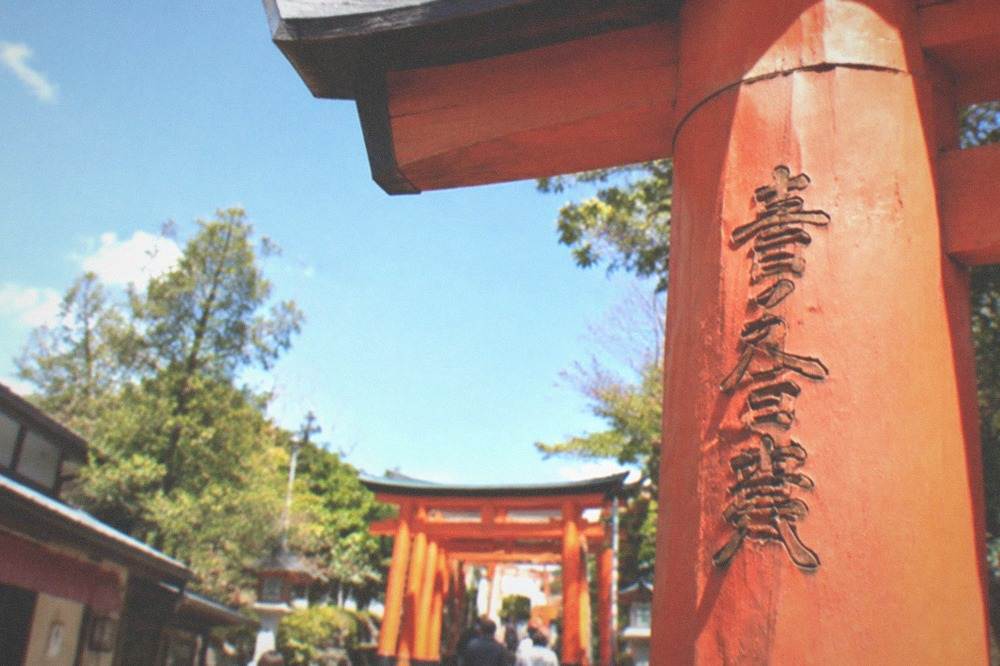
The gates are donations. Each torii at Fushimi Inari was given by a business or an individual, and the shrine counts about 10,000 of them of all sizes across the whole mountain, not 10,000 in the famous tunnel. The custom follows the shrine's core identity: Inari Okami is the deity of rice, harvest and prosperity, and companies have long donated gates as thanks or in hope for commercial success. The black characters on each gate name the donor.
The shrine's history page carries a dated chronology that explains how a rice deity's mountain filled with corporate gates. Inari Okami was enshrined on Inariyama, the shrine says, on the first Day of the Horse of the second month of 711, by Irogu no Hatanokimi, an ancestor of the Hata clan, acting on an imperial order from Empress Genmei. The shrine counted 2011 as the 1300th anniversary, and it hedges its own account with "is said to be", so the honest phrasing is "enshrined in 711", never "built in 711".
The later record, printable as the shrine prints it:
| Year | Event, as the shrine's history page states it |
|---|---|
| 711 | Inari Okami enshrined on Inariyama by Irogu no Hatanokimi under imperial order from Empress Genmei |
| 827 | Timber granted for Toji; the shrine granted the junior fifth rank |
| 908 | Repairs carried out under Fujiwara Tokihira |
| 927 | Listed in the Engishiki, the official register of shrines |
| 942 | Granted the highest shrine rank |
| Around 1000 | Sei Shonagon records climbing the mountain in the Pillow Book |
| 2011 | The shrine counts its 1300th anniversary |
The fox statues that line the paths are not the deity. They are messengers, and the keys, rice sheaves and scrolls in their mouths are the shrine's own iconography, repeated across the network of about 30,000 affiliated Inari shrines nationwide, of which this is the head shrine. The otsuka stones higher up the mountain carry deity names, not people; the question who is buried at Fushimi Inari has a flat answer, nobody, because this is a Shinto shrine and the mountain holds no graves.
For walkers who want the mountain's stories told while climbing, a guided hike is the efficient route. The Kurama and Kibune hike above is a full-day rated 5.0 walk in Kyoto's northern mountains, a different landscape but the same tradition of shrine trails, and it pairs well with a self-guided Fushimi Inari visit on another day.
Why Is Fushimi Inari Free When Other Kyoto Sites Charge?
Because it is a Shinto shrine, not a temple or a museum, and its mountain paths are the worship route itself. The shrine prints no fee anywhere on its site, and unlike the temples, whose admission fees are published and in two cases changed in 2026, it has no gate to charge at. The free entry is structural, not promotional, and it holds for the whole mountain including the summit shrines.
The contrast across the city is sharp and, for budget planning, useful. Ginkaku-ji doubled its fee to 1,000 yen on 1 April 2026, its first change in 32 years. Tofuku-ji revises on 1 November 2026, with the Tsutenkyo bridge ticket rising from 600 to 1,000 yen during the autumn foliage period and a new 1,000 yen combined ticket. Kinkaku-ji holds at 500 yen. Against that, the free list is short but strong: Fushimi Inari, the Kyoto Imperial Palace, which states it is open to all with no advance application, Shugakuin Imperial Villa and the Sento Imperial Palace, both free but guided and restricted to visitors 18 and over, Nishiki Market, the Arashiyama bamboo path and the walking districts of Gion, Pontocho and the Philosopher's Path.
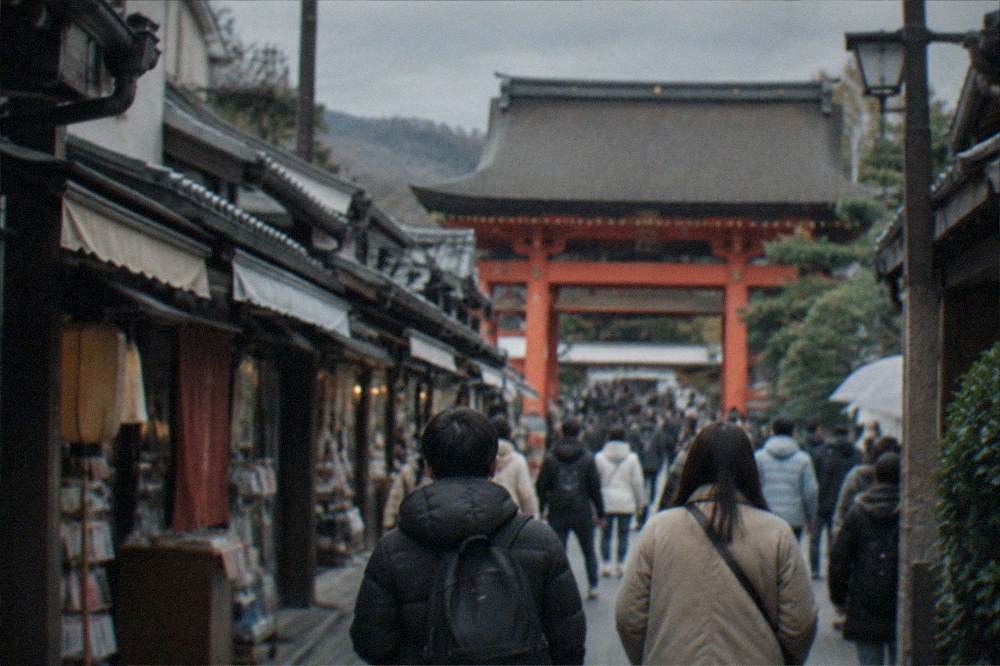
The free things to do in Kyoto guide expands that list; the budget guide at Kyoto on a budget prices a full day around it. The honest caveat on the shrine is the one the shrine itself would make: free entry does not mean free of costs elsewhere. The JR Nara Line station named Inari sits directly opposite the Romon gate, and the walk from Kyoto Station takes roughly five minutes on a local train, which makes the mountain one of the cheapest major sights in Japan to reach as well as to enter.
What Else Is Near Fushimi Inari?
The shrine sits at the southern edge of the Higashiyama district, two JR stops from Kyoto Station, with the Fushimi sake district and the town of Uji within easy reach southward. The immediate area around the shrine is residential and thin on sights beyond the mountain itself, so the standard pairing is Fushimi Inari in the early morning followed by a day built south or back toward central Kyoto.
South of the shrine, the Fushimi sake district holds the breweries and canal-side streets of one of Japan's best-known brewing towns, covered in the Fushimi area guide. Further along the Keihan and JR lines, Uji offers Byodo-in, whose garden and museum entry is 700 yen with the Phoenix Hall interior at 300 yen more, plus the matcha culture the town is famous for. A morning on Inariyama and an afternoon in Uji is a well-shaped day that the transport network supports directly.
Northward, the mountain connects back into the temple corridor of eastern Kyoto. The Kyoto shrines guide places Fushimi Inari in its context among the city's major shrines, and the wider question of why Fushimi Inari is so famous covers the film and pop-culture history behind its foreign visitor numbers. For a first visit that includes the mountain, the one day in Kyoto itinerary sequences it with Kiyomizu-dera and Gion, which is the natural order given the shrine's southern position.
What Should You Know Before The Fushimi Inari Loop?
Four practical rules cover most of it: the paths have no closing time but the shrine offices do, so plan around daylight rather than posted hours; wear real shoes, because the stone steps are worn smooth; carry water in summer, when Kyoto's mean daily maximum reaches 33.7 C in August; and treat the mountain as a shrine, keeping noise down on the upper paths where worship stones stand in dense rows.
Etiquette on the mountain is the part that changes with altitude. The lower gates are a public thoroughfare and behave like one; the otsuka fields near the summit are a continuous devotional landscape, and the shrine asks visitors to treat them as such. The fox statues are messengers of the deity, not mascots, and climbing on them or posing against them reads as disrespect. Photography is unrestricted, but the city's tourism association publishes four conduct guidelines for the wider district, and the geisha-related rules in Gion, where signs on private alleys threaten a 10,000 yen penalty set by the district council, are a reminder that Kyoto's rules are local and specific.
Weather planning deserves the JMA record rather than folklore. The table below pulls the months that matter most for a stair climb in the open air.
| Month | Rain mm | Mean daily max C | Mean daily min C | Sunshine h |
|---|---|---|---|---|
| April | 117.0 | 20.1 | 9.2 | 177.3 |
| June | 199.7 | 28.1 | 19.2 | 133.1 |
| July | 223.6 | 32.0 | 23.6 | 142.7 |
| August | 153.8 | 33.7 | 24.7 | 182.7 |
| October | 143.2 | 23.4 | 14.4 | 156.0 |
| November | 73.9 | 17.3 | 8.4 | 140.7 |
| December | 57.3 | 11.6 | 3.5 | 134.4 |
July, not June, is Kyoto's wettest month at 223.6 mm, and August is both the hottest and the sunniest, at a mean of 28.5 C and 182.7 hours of sunshine. The mountain in rain is still open, still free and often nearly empty, which some walkers count as its best state. In winter the mean daily minimum drops to 1.5 C in January, and the summit shrines in snow are one of the city's quieter sights. The Kyoto weather guide carries the full monthly table.
For transport, the shrine's position opposite Inari Station on the JR Nara Line makes it the rare major Kyoto sight with no bus dependency, which matters because the city abolished its bus-only one-day pass, with sales ending in September 2023 and use ending 31 March 2024, and now sells the Subway and Bus One-Day Pass at 1,100 yen. The first-time visitors itinerary places the mountain inside a full arrival plan.
The last word goes to scale. The loop to the top of Inariyama and back is a walk through the head shrine of a network of about 30,000 sites, on paths that predate every fee table in this city, past gates donated by centuries of businesses and stones dedicated by their successors. Walk it early, walk it slowly, and the time it takes becomes the least interesting fact about it.
Common Questions About Fushimi Inari
How Long Does The Full Fushimi Inari Loop To Mount Inari Take?
The shrine publishes no official time. The loop climbs Inariyama, which stands 233 m, on stone steps from the main halls through the Senbon Torii and the Yotsutsuji intersection to the summit shrines and back. Most of the walk is stairs through cedar forest, so plan for a substantial circuit with rest stops rather than a fixed figure.
Is Fushimi Inari free to enter?
Yes. The shrine prints no fee anywhere on its site, and entry to the mountain paths, including the summit shrines, costs nothing. This contrasts with Kyoto's major temples, which charge between 500 and 1,000 yen and in two cases changed their fees in 2026.
Is Fushimi Inari open 24 hours?
The shrine publishes desk and prayer hours only, and it sets no closing time for the mountain paths. The honest phrasing is that the paths have no closing time, not that the site is "open 24 hours", which is a phrase the shrine itself does not use.
How many torii gates are at Fushimi Inari?
The shrine says there are about 10,000 torii of all sizes across the whole mountain. The famous Senbon Torii tunnel is one section of that count, and guides that place all 10,000 gates in the tunnel are misquoting the shrine.
Who is buried at Fushimi Inari?
Nobody. It is a Shinto shrine, and the dense stones on the upper slopes, the otsuka, are worship stones bearing the names of Inari's deities, not graves.
When was Fushimi Inari founded?
The shrine dates the enshrinement of Inari Okami on Inariyama to the first Day of the Horse of the second month of 711, by Irogu no Hatanokimi under an imperial order from Empress Genmei. The shrine hedges its own account with "is said to be", and it counted 2011 as the 1300th anniversary.