When Are Kyoto's Five Gozan no Okuribi Fires Lit On 16 August?
Every 16 August, five bonfires are lit one after another on the mountains surrounding Kyoto, closing the Obon season in a single hour of flame. The date is fixed, the event is free to watch, and the hills themselves are closed to walkers that day.
Short answer
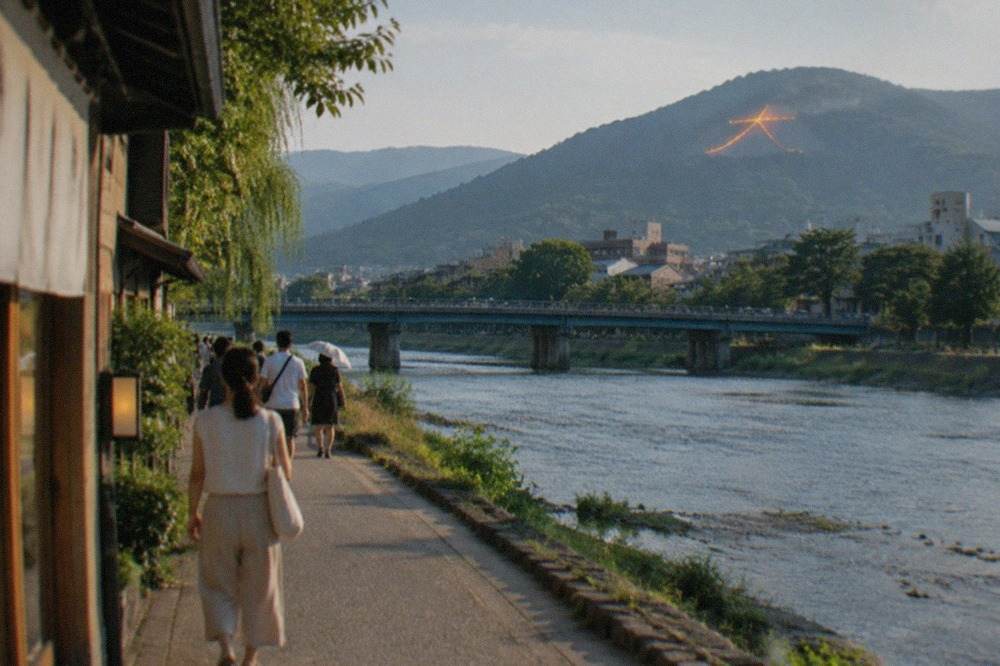
Gozan no Okuribi is held on 16 August every year, with five fires lit one after another on mountains around Kyoto. The Kyoto City Tourism Association confirms the date and that entering the hills is prohibited that day; the commonly cited first lighting around 20:00 is not an officially published time, so plan for dusk rather than a precise minute.
Every 16 August, Kyoto ends its Obon season with fire. Five giant bonfires are laid out on the mountains that ring the city, and on the appointed evening they are lit one after another, their shapes readable from the streets, bridges and temple grounds below. The Kyoto City Tourism Association's own event page confirms the essentials: the festival falls on 16 August, the five mountains are lit in sequence, and entering the hills is prohibited on the day itself. That last detail matters more than most visitors realise, because the fires are a viewing event, never a climbing one.
This page lays out what is verified and what is not. The date is fixed and official. The exact first-lighting minute is not, and this guide will not invent it. Around those two facts sits everything a visitor actually needs: where the fires sit on the skyline, where to stand, what the mid-August heat and rain do to an evening outdoors, how to move through a city that drew a record 62.79 million visitors in 2025 according to the city's own survey release, and what the surrounding Obon week offers once the embers cool. For the wider summer picture, start with Kyoto in summer and the Kyoto weather guide, then fold the fire night into a Kyoto itinerary.
When Are The Five Gozan no Okuribi Fires Lit On 16 August?
Gozan no Okuribi falls on 16 August every year, with the five mountain fires lit one after another in a fixed sequence across Kyoto's northern and eastern skyline. The Kyoto City Tourism Association confirms the date, the five-mountain format and the rule that entering the hills is prohibited that day. The widely repeated first-lighting time of 20:00 is not printed on the official page, so treat dusk as your planning anchor rather than a precise minute.
The date is the one part of the evening nobody has to guess about. Obon, the season when spirits of the dead are welcomed home and then sent back, reaches its Kyoto climax on the 16th, and the fires are the send-off: okuribi literally means "sending fire". The event is also called Daimonji, after the largest and most famous of the five fires, the great character blazing on the mountain above Ginkaku-ji.
What the official source does and does not say is worth spelling out, because most guides blur the two. The Kyoto City Tourism Association page states the date, the five-mountain sequence and the hill-entry prohibition. It does not print a start time. Search results and years of visitor reports give 20:00 for the first lighting, but that figure rests on secondary repetition rather than a published schedule, so this guide will not present it as fact. In practice the fires burn for roughly half an hour to an hour in total, and the sky is dark enough by then that the shapes read clearly. Arrive at your viewing spot well before dusk, because the crowd builds through the evening.
One more fixed rule deserves emphasis. Entering the hills is prohibited on the day of the fires. Every year people try to climb toward the Daimonji character for a closer look, and every year the restriction exists precisely to stop them. The fires are tended by the neighbourhood groups who lay the fuel beds, and the mountainsides are closed to everyone else. Watch from below, and if you want to stand on those ridgelines at any other time of year, do it on another day entirely.
What Do The Five Bonfires Spell Across Kyoto's Mountains?
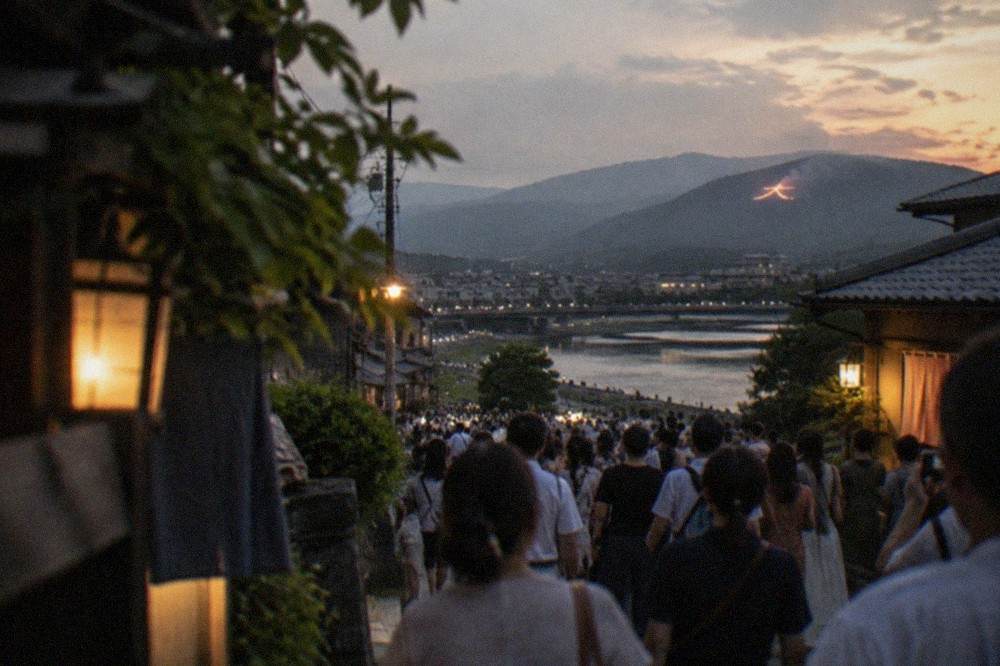
The five fires form distinct shapes on five separate mountains: the great character meaning "large" above the Silver Pavilion, the characters for "wondrous law" on a second slope, a boat shape, a second character mirrored on the west side of the city, and a torii gate outline. Each is built from burning fuel beds laid out in advance by local neighbourhood groups. The shapes are read from the city below, which is why the event works as a single skyline composition rather than five separate fires.
The Daimonji character is the anchor. It sits on Nyoigatake, the slope above Ginkaku-ji, and its single stroke pattern is the one most photographs capture, simply because it faces the downtown grid and reads from almost anywhere in the north of the city. The second fire spells out two characters, read as "myoho", wondrous law, on a ridge further east at Matsugasaki. The third is a boat shape, funagata, on Nishigamo's hillside to the northwest. The fourth is a second large character, the "left Daimonji", mirrored on the western flank at Kinkaku-ji's side of town. The fifth is the outline of a shrine gate, a torii, on the far southern slope of Mandara-yama.
Each fire is a piece of engineering rather than a pile of wood. The shapes are assembled from bundled fuel arranged along the slope's contours, and the neighbourhood associations who tend them have done so for generations, with the event's documented history running back centuries in various forms. The fires are lit by torch, in sequence, and the sequence is part of the spectacle: the mountains answer one another across the valley.
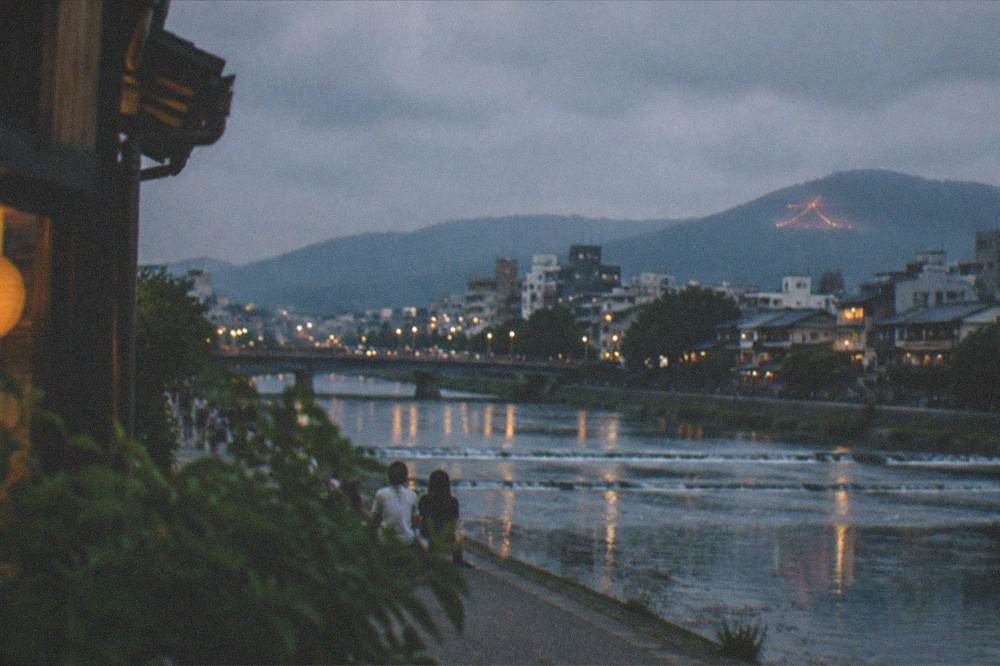
For visitors, the practical reading is this. You cannot see all five well from a single point, because they wrap around the city on different bearings. The classic compromise is a spot with a clear northern view, which catches the Daimonji and myoho fires, or a riverbank position downtown where the reflections double the effect. The things to do in Kyoto page covers the rest of the city's calendar if you are building a trip around the night.
Where To Watch Gozan no Okuribi in Kyoto Without The Worst Crowds?
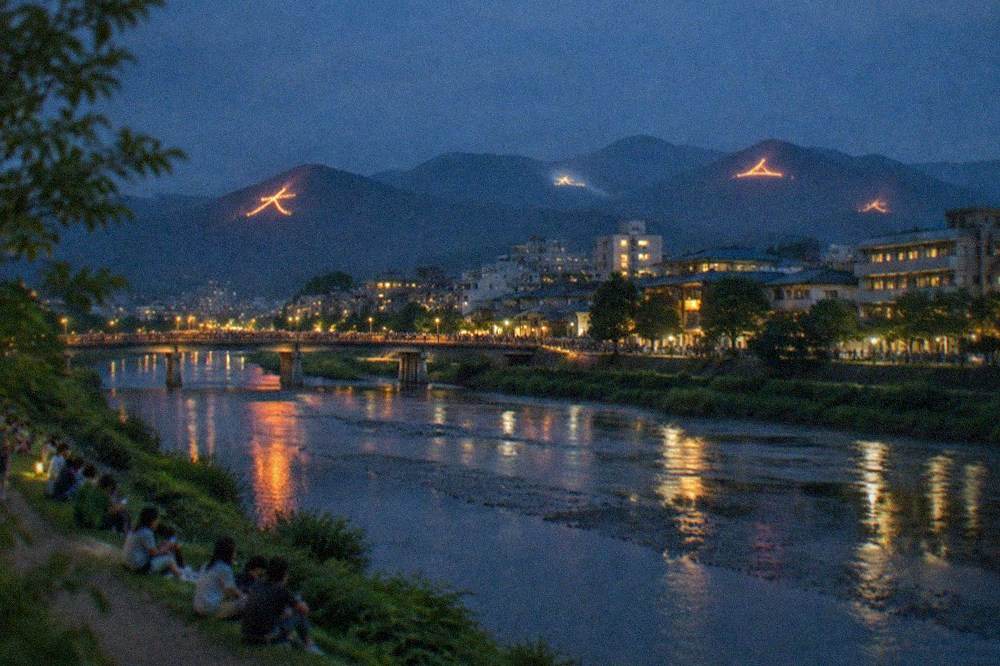
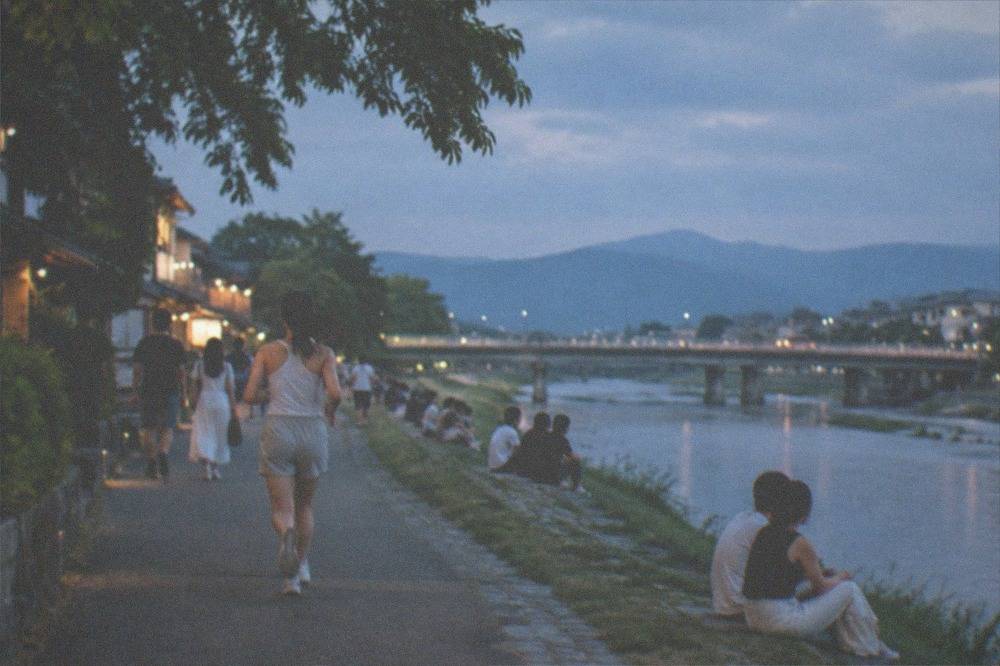
The strongest open viewing is along the Kamo River banks in the downtown reach, where the Daimonji fire reads clearly and the riverside gives standing room; the banks around Maruyama Park and the slopes near Ginkaku-ji put you closer to the main fire but into the densest crowds. Expect the city's peak-night congestion: the 2025 tourism survey recorded 62.79 million visitors across the year, and mid-August is high season on top of Obon domestic travel.
The honest hierarchy of spots, from most convenient to most atmospheric:
| Viewing area | What you see | Trade-off |
|---|---|---|
| Kamo River banks, downtown reach | Daimonji and myoho fires clearly, reflections on the water | Long walk-in crowds, arrive early |
| Around Ginkaku-ji and the northern hills | Daimonji at its largest and closest | Densest crowds, road closures nearby |
| Bridges over the Kamo | Wide skyline, several fires visible | Railings fill an hour before dusk |
| Hotel or temple vantage points with elevation | Multiple fires depending on aspect | Limited capacity, often booked far ahead |
The single biggest mistake is planning a tight schedule around the fires. Kyoto on 16 August is one of the most crowded nights of the Japanese calendar year in the city, layered on Obon domestic travel and summer holidays. The city's own crowd management work, including its tourism comfort forecasting that rates spots by expected congestion, exists precisely because of nights like this. Build slack into the evening, pick your spot two hours before dark, and treat the walk itself as part of the event.
The second mistake is trying to hop between viewing areas. The fires burn once, in one sequence, and transit on the night is slow. Choose one bearing and hold it.
If you want the mountains themselves rather than the fires, the ridgelines around the city reward a daytime visit on any other date. A guided option that covers the terrain properly is the full-day Kurama-Kibune hike, an 8-hour walk through the forested mountains north of the city, rated 5 from 82 reviews and running from $210 per person. It has nothing to do with the fire night itself, but it is the honest way to be on a Kyoto mountain.
The same logic applies to the other two options below: none of them touches the fire night, and all of them fill the daylight hours around it better than another temple queue in 33 C heat. The river run cools you down, the tea ceremony slows the afternoon down, and the hike earns the evening meal.
How Hot Is Kyoto In Mid-August And What Should You Wear?
August is Kyoto's hottest month, with a mean temperature of 28.5 C and a mean daily maximum of 33.7 C in the JMA 1991-2020 normals for station 47759, and August is also the sunniest month at 182.7 hours. The fire night itself is usually the most bearable hour of the day, but the hours you spend waiting for it are not. Plan for heat, humidity and a long evening on your feet.
The climate record is unambiguous. The Japan Meteorological Agency's normals for the Kyoto station give August a mean of 28.5 C against July's 27.3 C, a mean daily maximum of 33.7 C, and a mean daily minimum that never falls below 24.7 C. In other words, Kyoto nights in mid-August are warmer than many cities' afternoons. The record table is starker still: three of Kyoto's six hottest days on record fell in the summers of 2024, 2025 and 2026, and July and August 2025 both rank among the five hottest months ever measured here.
| Month | Rain mm | Mean C | Mean daily max C | Sunshine h |
|---|---|---|---|---|
| June | 199.7 | 23.3 | 28.1 | 133.1 |
| July | 223.6 | 27.3 | 32.0 | 142.7 |
| August | 153.8 | 28.5 | 33.7 | 182.7 |
| September | 178.5 | 24.4 | 29.2 | 142.7 |
Two details in that table shape the evening. July, not June, is Kyoto's wettest month at 223.6 mm, but August still averages 153.8 mm of rain, so a wet fire night is a real possibility, not a freak one. And August's sunshine total, 182.7 hours, is the highest of the year, which means the days leading up to the fires are typically brutal. Carry water through the afternoon, use the shade, and treat the sunset cool-down as the reward.
Clothing is simple: loose, light, and broken-in footwear above all, because the viewing strategy is standing in one place for an hour or more after a long walk in. A folding fan or a damp towel is standard local practice. If rain threatens, a light umbrella works, but note that a rain date does not exist: the fires go ahead on the 16th.
For a fuller month-by-month breakdown, see the Kyoto weather guide, which carries the complete JMA normals table and the station records.
Is Gozan no Okuribi Free To Watch?
Yes, the fires themselves cost nothing to watch: they are a public event on the mountains, and no ticket, pass or booking exists for them. The only costs are the ordinary ones of getting there and staying fed, a city bus ride at 230 yen, a subway trip between 220 and 360 yen, or a Subway and Bus One-Day Pass at 1,100 yen if you plan to move around during the day.
This matters because the festival attracts manufactured offers. Gozan no Okuribi is not a ticketed product, and no tour, pass or package can sell you the fires. What money buys is position and comfort: a hotel room with the right aspect, a restaurant seat with a window, or a guided activity earlier in the day that ends near your chosen viewing spot. The fires are free, and anything suggesting otherwise deserves suspicion.
| Item | Price | Note |
|---|---|---|
| City bus, flat fare | 230 yen adult, 120 yen child | Children 6 to 11 |
| Subway, by zone | 220 to 360 yen adult | Child fares 110 to 180 yen |
| Subway and Bus One-Day Pass | 1,100 yen adult, 550 yen child | The current combined product |
| Bus-only one-day pass | No longer sold | Sales ended September 2023, use ended March 2024 |
That last row catches out a lot of older guides. The bus-only pass is gone; the product that replaced it is the Subway and Bus One-Day Pass at 1,100 yen, which the city's transport bureau prices and confirms. On the fire night itself, buses run but crawl, and the subway is the more reliable spine for getting back to your base afterward. If your accommodation sits along a subway line, that fact alone will shape how pleasant the night is.
One further cost is easy to miss: the accommodation tax changed on 1 March 2026. The top tier went from 1,000 to 10,000 yen per person per night for rooms of 100,000 yen and up, and the mid tiers rose too, with a 20,000 to 50,000 yen room now carrying 1,000 yen per person per night. Mid-August is peak pricing season, so the tax tier you land in is higher than it would be in January. The where to stay in Kyoto and best hotels in Kyoto pages cover the neighbourhood choices in detail.
What Else Is Happening In Kyoto During Obon Week?
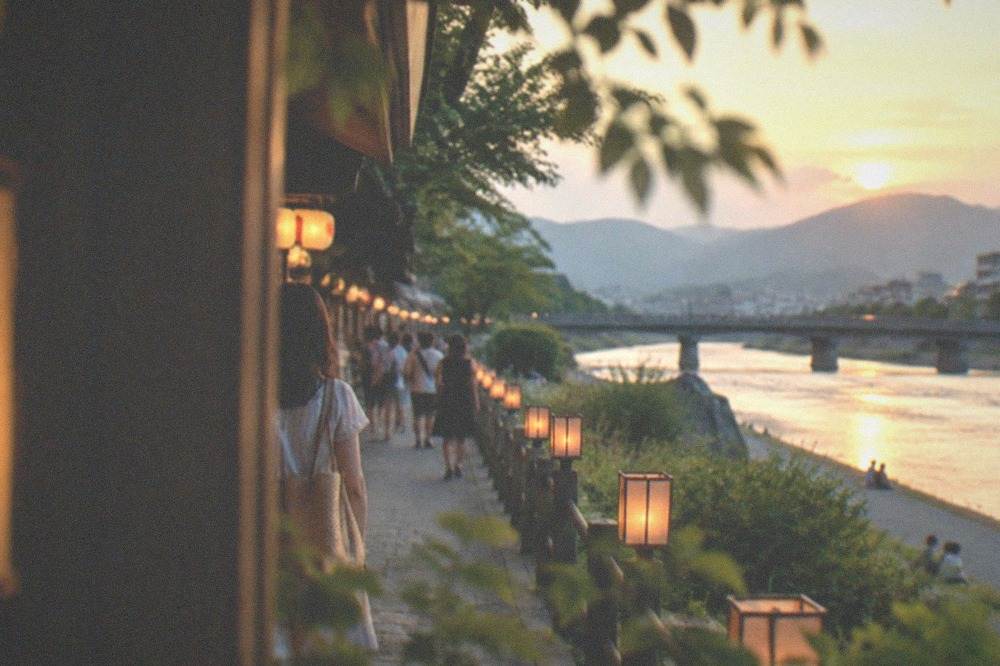
The days around the fires carry the full Obon atmosphere: lanterns along the riverbanks, temple grounds open late, and the summer festival rhythm that runs through the city, though the large Higashiyama Hanatoro lantern event of past years is no longer running. Gozan no Okuribi is the climax, not the whole show, and the surrounding evenings are often more pleasant simply because the crowds are thinner.
Obon week in Kyoto is a working holiday for the city. Households light welcoming fires, temple districts fill with the smell of incense, and the riverside becomes the default evening promenade. The fires on the 16th close the season, and the following days feel noticeably quieter as domestic Obon travel unwinds.
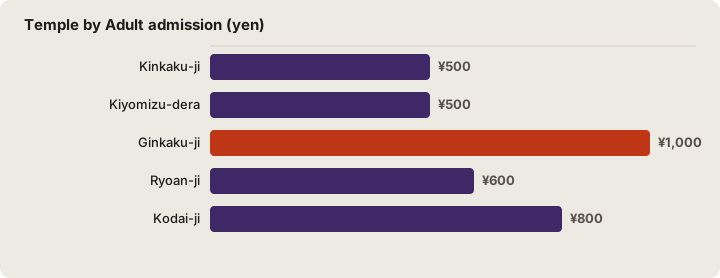
A few fixed points help structure the week. The Kamo River banks are the connective tissue between everything. The temple calendar continues as normal through mid-August: Kiyomizu-dera, for instance, runs extended summer hours into the evening on its published 2026 schedule, with night viewing windows in spring and autumn and later closing in July and August. Temple admission prices are stable and modest, as the table below shows.
| Temple | Adult admission | Note |
|---|---|---|
| Kinkaku-ji | 500 yen | Unchanged since April 2023 |
| Kiyomizu-dera | 500 yen | Single-source figure, widely consistent |
| Ginkaku-ji | 1,000 yen | Doubled from 500 on 1 April 2026 |
| Ryoan-ji | 600 yen | Hours shorten December to February |
| Kodai-ji | 800 yen | Night illumination runs to 22:00 in season |
That Ginkaku-ji figure deserves a second look, because it is one of the 2026 changes most guides still get wrong. The temple doubled its adult admission from 500 to 1,000 yen effective 1 April 2026, its first revision in 32 years, with children rising from 300 to 500 yen. Any guide quoting 500 is a year out of date. Tofuku-ji revises its own fees on 1 November 2026, with a new combined ticket at 1,000 yen, so autumn visitors should recheck that page closer to the date.
For food in the heat, the Kyoto food guide covers the full range, and the best restaurants in Kyoto page handles the sit-down end. Reserve ahead for the fire night itself: restaurants with a view of the mountains book out far in advance, and walk-in tables near the good viewing spots vanish by late afternoon.
How Do You Get Around Kyoto On Okuribi Night?
The subway is the reliable spine on the night itself, with adult fares of 220 to 360 yen by zone, while city buses run at the flat 230 yen fare but face severe congestion; the tourist express buses EX100 and EX101 charge 500 yen for an adult single ride and are aimed squarely at moving visitors between Kyoto Station and the eastern sights. Walking is often faster than any of them within the downtown grid.
The night has a rhythm to its transport. Before dusk, everything moves, slowly but normally. Between dusk and the end of the fires, the streets around the prime viewing areas become pedestrian-dense to the point of standing-room, and buses queue in ways that make walking genuinely quicker for any distance under two kilometres. After the fires die, the surge toward stations is the single most congested movement of the night: allow an hour of patience to get onto a train, and longer for a bus.
The EX100 and EX101 express buses are the city's own answer to tourist congestion, running between Kyoto Station and the Kiyomizu, Gion and Ginkaku-ji corridor with fewer stops than regular routes. The city's transport pages price an adult ride at 500 yen, child 250, payable in cash or by IC card, and the routes run primarily on weekends and holidays with extra service at peak periods. Check the operating-day pattern before relying on them for a specific night.
IC cards remain the simplest payment across everything: an ICOCA costs 2,000 yen including a 500 yen deposit, and works on subway, bus and rail alike. For the full transport picture, including the airport connections that bookend a trip, the Kyoto airport guide covers the routes in from Kansai and Itami.
One warning that is specific to this night: do not plan a tight onward connection. If you are leaving Kyoto the next morning, or catching an evening train after the fires, the post-event crush at Kyoto Station adds real time to any transfer. Build the buffer in.
What If It Rains Or The Fires Are Obscured?
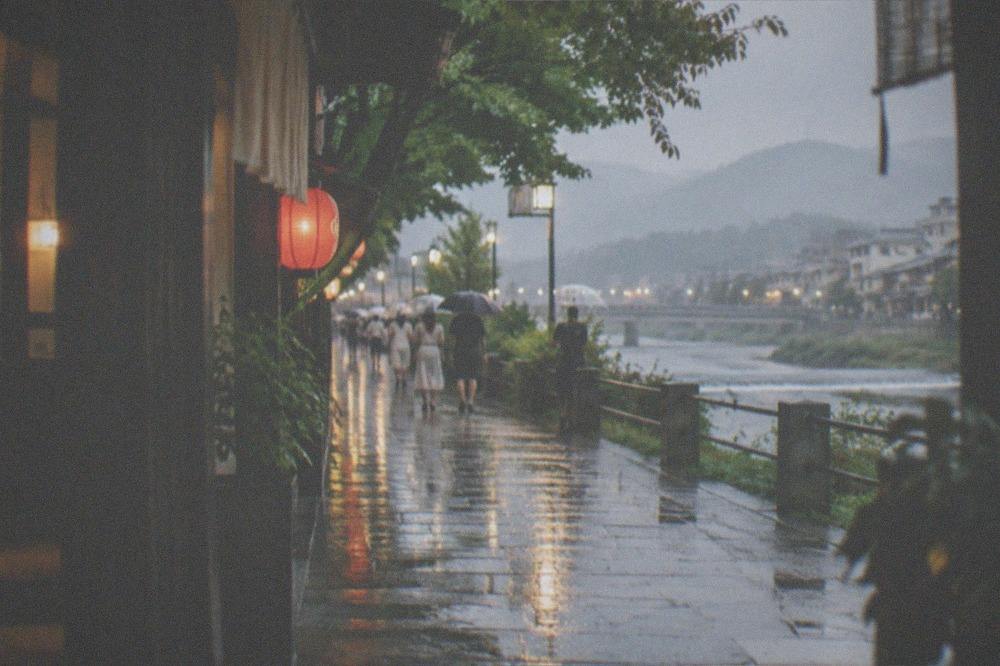
The fires go ahead on 16 August regardless of weather, and no rain date or alternate schedule exists; August averages 153.8 mm of rain across the month, so a wet night is a realistic scenario rather than a rare one. Light rain does not stop the fires, which are visible through drizzle, but heavy cloud or mist on the mountainsides can partially obscure the more distant shapes.
The honest planning response is positional. The Daimonji fire, being the largest and closest to the downtown grid, reads through more weather than the smaller shapes on the far slopes. If the forecast is poor, weight your spot choice toward the northern view rather than trying to catch all five. A second response is temporal: the fires burn long enough that a passing shower often clears mid-burn, and the crowd thins noticeably once the first shapes are lit.
There is no refund logic to apply, because there is no ticket. The event costs nothing and cannot be rescheduled, which also means there is nothing to cancel. What you can control is the rest of the evening: a riverside position with restaurants and covered arcades nearby lets you retreat and return without abandoning the night.
For those who prefer a plan B entirely, the same evening offers alternatives that do not depend on mountain visibility. A Gion night walking tour, rated 4.9 from 4,616 reviews and running about 1 hour 40 minutes from $22 per person, works in any weather and covers the geisha district's lanes and stories with a guide.
And for the mornings around the festival, when the city is hot but the crowds have not yet built, an e-bike loop through the quieter northern districts covers ground that would take hours on foot: the hidden Kyoto e-biking tour, rated 5 from 2,089 reviews, runs 3 hours 45 minutes from $115 per person.
How Does Gozan no Okuribi Fit Into A Longer Kyoto Trip?
The fire night anchors the back half of a summer itinerary well: five days lets you place the 16th in the middle, with temple-heavy days before it and cooler day trips after, and the surrounding region, from Kurama's mountains to Miyama's thatched village, fills the days the fires do not. Mid-August is peak season, so book accommodation months ahead and expect the higher accommodation-tax tiers to apply.
A five-day frame around the fires works like this. Day one, the eastern temple corridor and the Gion side, ending on the Kamo banks to scout your viewing position. Day two, the golden and silver pavilions with their very different 500 and 1,000 yen admissions, and the northern hills in the late afternoon. Day three, the fires themselves, with a deliberately slow morning. Day four, a day trip out of the heat: the mountains north of the city, or further afield to the Miyama thatched village. Day five, the downtown grid, markets and museums, at whatever pace the August temperatures allow.
The five days in Kyoto itinerary page carries the full version of this plan. The essential rule for August specifically: one major sight per morning, shade and water through midday, and the evening as the main event. Kyoto in August punishes the ambitious.
For the day trips, the honest hierarchy in summer runs toward altitude and water. The Kurama-Kibune mountains to the north are the classic escape, and the guided hike mentioned earlier covers them properly. West of the city, the Hozugawa river offers a half-day white-water rafting run, rated 4.9 from 355 reviews and operating on the regular timetable from March into December, a genuinely cooling alternative to a temple afternoon.
Common Questions About Gozan no Okuribi In Kyoto
When Are The Five Gozan no Okuribi Fires Lit On 16 August?
Gozan no Okuribi is held on 16 August every year, with the five mountain fires lit one after another. The Kyoto City Tourism Association confirms the date and the hill-entry prohibition but does not publish a start time; the commonly cited 20:00 first lighting is not an officially printed figure, so plan around dusk and arrive early.
Is Gozan no Okuribi free to watch?
Yes. The fires are a public event on the mountains around Kyoto and no ticket, pass or booking exists for them. Your only costs are ordinary transport, such as the 230 yen flat bus fare or the 220 to 360 yen subway fare by zone.
Can you climb the mountain to see the Daimonji fire up close?
No. Entering the hills is prohibited on the day of the fires, per the Kyoto City Tourism Association's event page. The fires are tended by local neighbourhood groups, and the mountainsides are closed to everyone else. Watch from the city below.
Where is the best place to watch the fires in Kyoto?
The Kamo River banks in the downtown reach give the best combination of clear sightlines to the Daimonji and myoho fires, standing room and escape routes into restaurants and arcades. The area around Ginkaku-ji is closer to the main fire but far more crowded.
What happens if it rains on 16 August?
The fires go ahead regardless of weather, and no rain date exists. Light rain does not stop them, and August averages 153.8 mm of rain for the month, so a damp night is realistic. Heavy mist on the slopes can partially obscure the more distant shapes, so favour a northern view if the forecast is poor.
How hot is Kyoto in mid-August?
August is Kyoto's hottest month, with a JMA 1991-2020 mean of 28.5 C and a mean daily maximum of 33.7 C, plus the highest sunshine total of the year at 182.7 hours. Nights stay warm too, with a mean daily minimum of 24.7 C.
The Short Version For Fire Night
Pick one spot before dusk and hold it, because the date is fixed, the fires are free, the hills are closed, and the only real decisions are where to stand and how to get home afterward. Bring water for the wait, wear shoes that can handle an hour of standing and a slow walk back to a station, and treat the post-fire crush as part of the price of admission to one of the few great city spectacles that still costs nothing to attend.
The rest of the evening writes itself. The mountains answer one another across the valley for roughly half an hour, the crowd exhales, and the walk home along the river is often the calmest part of the night. For everything around the fires themselves, from the wider summer season to the itineraries that place the 16th in a full week, the rest of this Kyoto Travel Guide carries the detail, verified figure by verified figure.