What Does The Heian Shrine Garden Cost And Is The Shrine Itself Free?
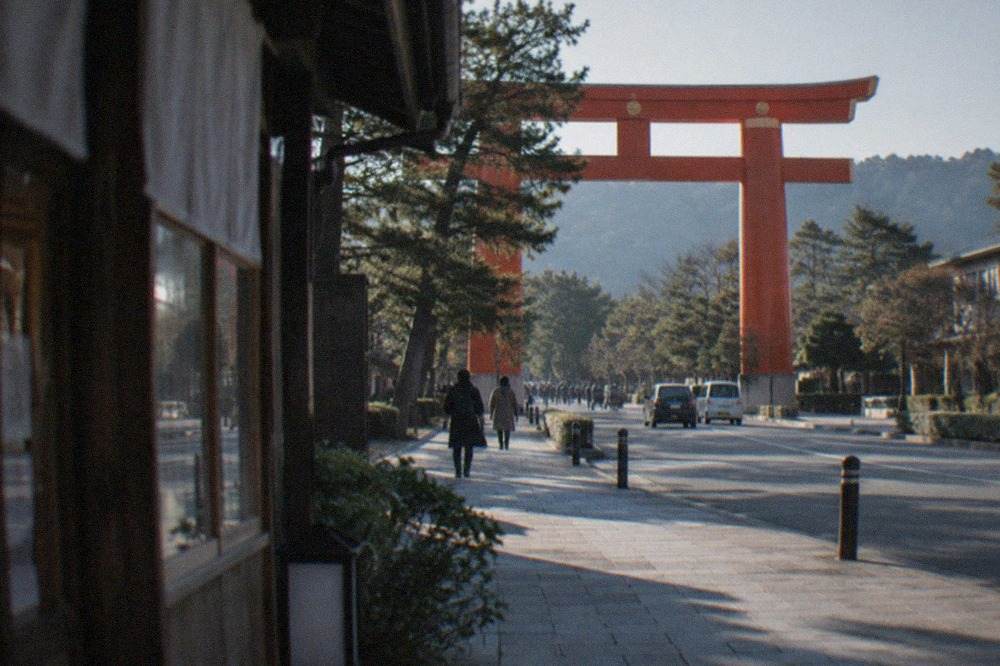
Heian Shrine was built to mark 1,100 years since Kyoto became Japan's capital, and its giant torii on Jingu-michi is one of the city's most recognisable entrances. The outer grounds cost nothing to walk, the inner garden charges, and every October the shrine is the destination of the Jidai Matsuri procession.
Short answer
The Heian Shrine grounds and main worship hall are free to enter; the Shin-en garden behind the main hall charges admission, though the current figure is not printed on a primary page this site could verify, so check the shrine's own notice at the gate.
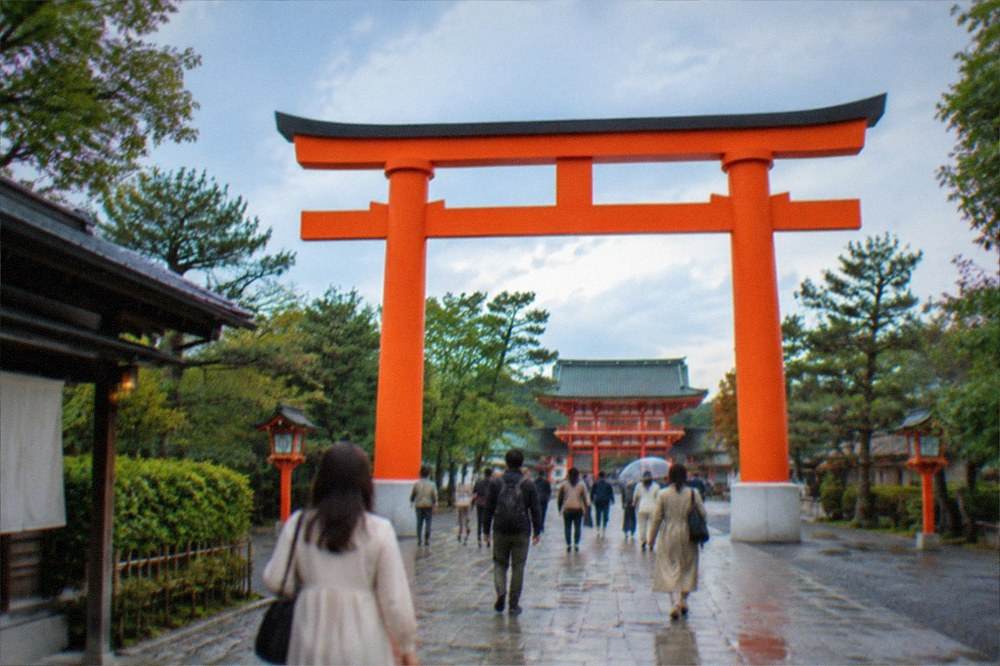
The red torii of Heian Shrine stands taller than any gateway you will pass in Kyoto, and you can see it from several streets away, which is fitting for a shrine that was always meant to be seen. Kyoto built it to mark 1,100 years since the city became the capital, as a two-thirds-scale replica of the Imperial Palace's main hall from the Heian period. The city's tourism association now lists it among the flagship sights of the Okazaki district, beside the museum, the zoo and the canal. This page answers what a visit costs, what there is to see once you pass the torii, and how the shrine fits into a Kyoto itinerary.
What Does The Heian Shrine Garden Cost And Is The Shrine Itself Free?
The shrine itself is free: the outer grounds, the enormous courtyard and the main worship hall cost nothing to enter, and the shrine's English pages list no admission for them. The Shin-en, the strolling garden behind the hall, is the part that charges. Its current fee is not printed on a primary page this site could verify, so treat the figure at the garden gate as the authority rather than any number in an older guide, and note that the garden's hours are shorter than the grounds'.
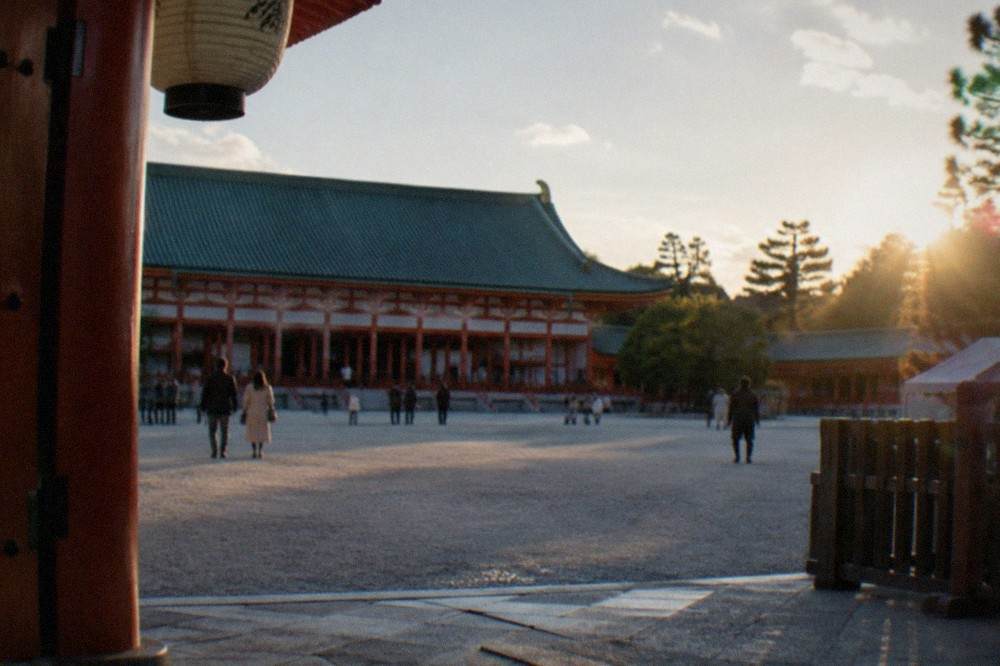
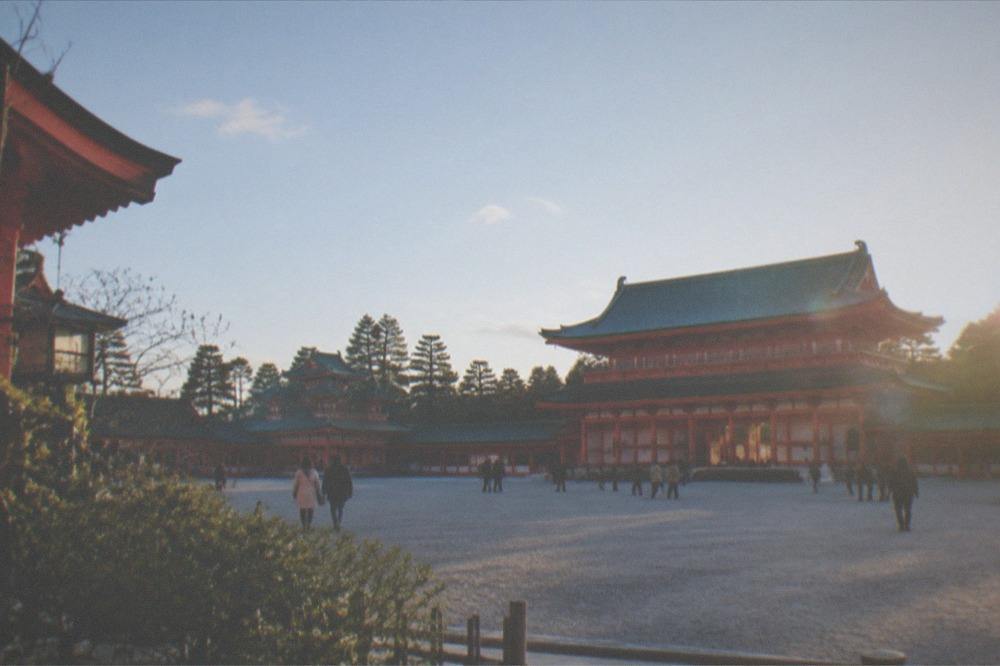
That split, free grounds and paid garden, is the same pattern Kyoto uses at Nanzen-ji, where the temple grounds cost nothing and the Hojo garden charges 600 yen. What makes Heian Shrine different is scale. The courtyard in front of the Daigoku-den, the replica palace hall, is one of the largest open gravel spaces of any shrine in the city, and the approach through the torii is wide enough that it never feels as compressed as the lanes of Okazaki's neighbours. The practical consequence for planning: you can give the shrine thirty free minutes on any Okazaki walk, or pay for the garden and turn it into a full morning.
Two cautions on any fee figure you read elsewhere. First, Kyoto's temple and shrine admissions moved in 2026: Ginkaku-ji doubled to 1,000 yen from 1 April, and Tofuku-ji revises its tickets on 1 November. A Heian Shrine garden price copied from a 2024 guide is therefore suspect on principle, not because the shrine has announced a change, but because the city around it has. Second, the garden's seasonal displays, the spring cherry blossoms along the garden's ponds and the autumn maples, sometimes carry extended viewing hours, and those event periods can change the terms of entry. The shrine's own notice board at the garden entrance is the only source that reflects the day you are standing there.
Why Was Heian Shrine Built And How Old Is It Really?
Heian Shrine is one of Kyoto's younger major shrines despite its ancient styling. It was constructed for the 1,100th anniversary of Emperor Kanmu moving the capital to Kyoto, and its main hall is a reduced-scale reproduction of the Heian-period Imperial Palace's state hall. The deities enshrined are Emperor Kanmu and Emperor Komei, the first and last emperors to reign from Kyoto.
That last detail is the one most visitors miss. Komei was the final emperor resident in Kyoto before the court moved to Tokyo in the Meiji era, so the shrine deliberately bookends the entire imperial history of the city. The founding date also explains the architecture: the buildings are faithful Heian forms but young structures, and the bright vermilion paint, refreshed regularly, is cypress-and-cinnabar traditional colouring rather than weathered age. Anyone expecting the moss and patina of Ryoan-ji should adjust expectations; anyone wanting to understand what the Heian capital looked like in outline will get more from this single courtyard than from any textbook diagram.
The shrine's youth has a practical upside. It was laid out as part of a planned district, with the torii, the approach, the grounds and the garden designed as one composition, and the whole ensemble faces the Okazaki canal area that was developed in the same national industrial-exposition era. The shrine, in other words, was born as a tourist and civic monument, and it still works as one: it is the anchor at the north end of the museum-and-canal strip, easy to combine with the sites within walking distance.
What Can You See Inside The Heian Shrine Grounds And Garden?
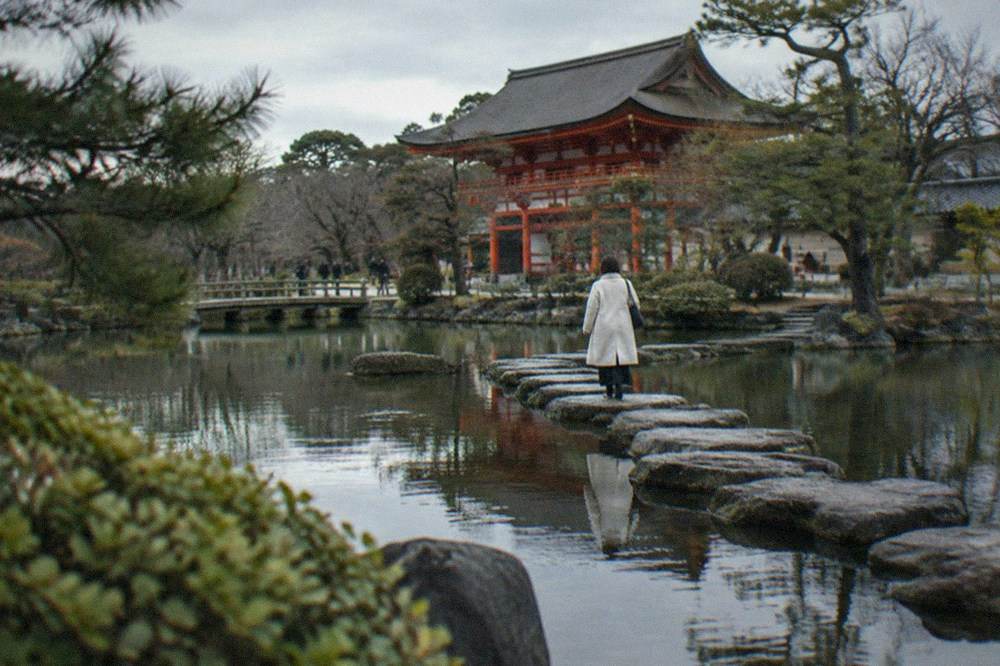
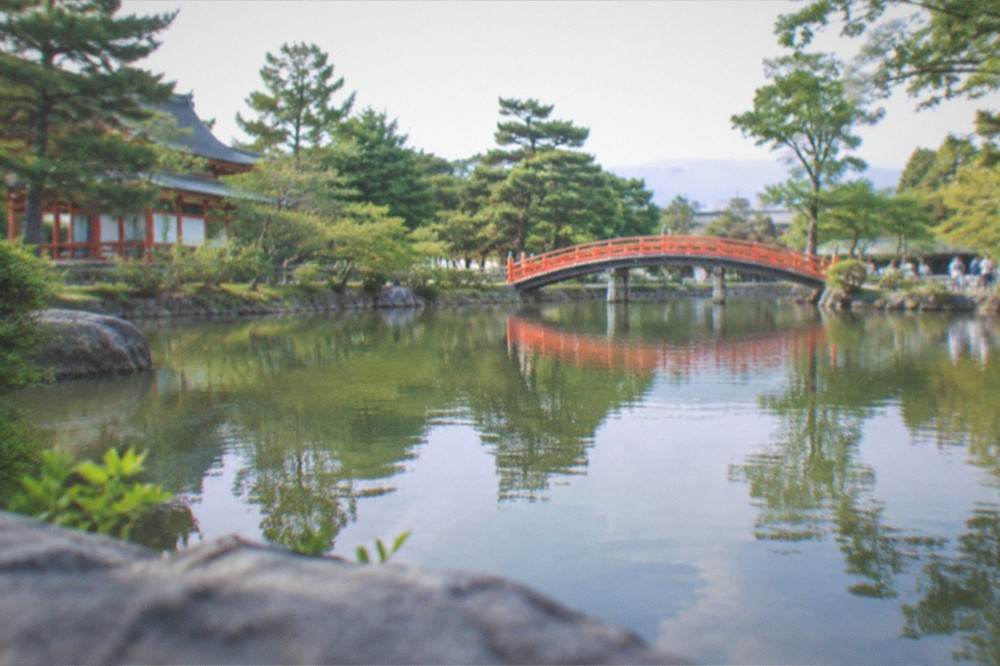
The free grounds hold the giant torii, the wide ceremonial courtyard, the Daigoku-den main hall where you can pray, and the side halls flanking it. The paid Shin-en garden, about three hectares of ponds, bridges, stepping stones and planted pines, sits behind the hall and is widely considered one of Kyoto's better Meiji-era stroll gardens. The garden's resident feature is the colony of spotted koi in its ponds, some of them decades old.
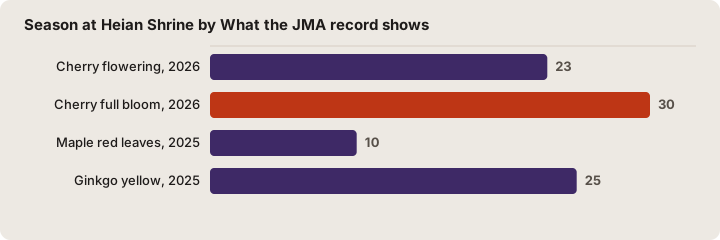
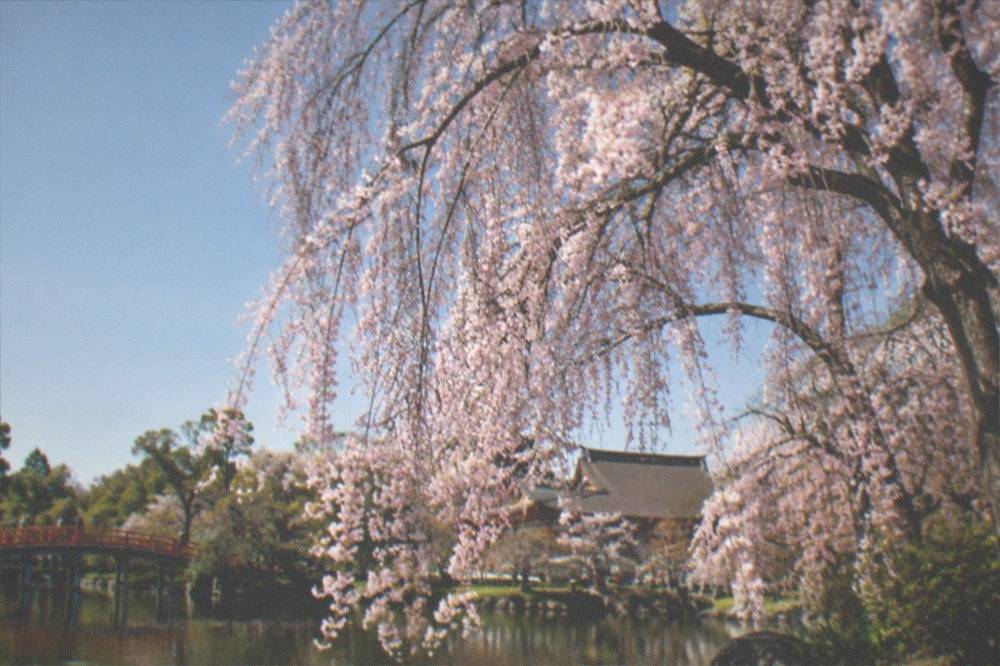
The garden is the reason to pay rather than simply pass through. Designed by the landscape gardener Ogawa Jihei VII, the man who also shaped the Maruyama Park area and the canal-side scenery of Okazaki, it draws water from the Lake Biwa Canal, the same engineering project that powered the district's development. The stepping-stone bridge across the main pond is the garden's signature view, and in late March and early April the weeping cherries around the water are among the most photographed in the city outside the Philosopher's Path. The JMA's Kyoto observatory records the 1991 to 2020 normal full-bloom date for cherry blossoms as 4 April, and in 2026 the trees actually reached full bloom on 30 March, so the garden's cherry peak usually lands in the last days of March.
Autumn works too, differently. The JMA normal for the observatory's maple specimen turning red is 5 December, but that is the official marker tree, not the garden's garden-grown maples, which colour earlier; private forecasts for the Arashiyama side of the city in 2026 pointed to peak colour around late November. The garden is a short, flat walk, suitable for most visitors, and the shrine's grounds are among the more accessible large sites in the city, a point covered in more detail in the Kyoto accessibility guide.
| Season at Heian Shrine | What the JMA record shows | What it means for the garden |
|---|---|---|
| Cherry flowering, 2026 | 23 March, against a normal of 26 March | first blooms open on the garden's weeping cherries |
| Cherry full bloom, 2026 | 30 March, against a normal of 4 April | the garden's peak week usually starts late March |
| Maple red leaves, 2025 | 10 December observed, normal 5 December | the official marker runs later than the garden's display |
| Ginkgo yellow, 2025 | 25 November observed, normal 24 November | reliable golden colour on the district's canal-side trees |
How Do You Get To Heian Shrine In Kyoto?
The nearest stations are Higashiyama on the Kyoto Municipal Subway's Tozai Line, about a 10 to 12 minute walk to the torii, and Sanjo Keihan on the Keihan line, about 20 minutes on foot. From Kyoto Station, the subway Karasuma Line to Karasuma Oike then the Tozai Line to Higashiyama costs 260 yen and takes roughly 20 minutes; the city bus flat fare is 230 yen. The tourist express EX100 also stops in the Okazaki area on its route between Kyoto Station and Ginkaku-ji.
The EX100 deserves a line of explanation because it exists precisely for this trip. The city transport bureau runs it, at 500 yen for adults and 250 for children, as a limited-stop service aimed at visitors, connecting Kyoto Station with the Gojo-zaka side of Kiyomizu, Gion, the Okazaki and Heian Shrine area, and Ginkaku-ji. It runs primarily on weekends and holidays, so check the bureau's page for the operating calendar. The Subway and Bus One-Day Pass at 1,100 yen covers ordinary buses and subways; whether it beats single fares depends on how many rides you stack, and the arithmetic is laid out in the Kyoto bus and subway pass guide.
Cycling is the third option and arguably the best one for Okazaki. The district is flat, the canal path is pleasant, and the shrine's torii is a landmark you cannot miss. Bike tours that cover northern Kyoto, including the Okazaki stretch, are listed on this site, and the Kyoto bike rental guide covers doing it yourself. If you are walking, the classic route is south to north along the canal from Nanzen-ji, which takes about 15 minutes and passes the aqueduct, one of the most photographed pieces of Meiji engineering in the city, before you reach the shrine's outer edge.
| Route to Heian Shrine | Fare | Time |
|---|---|---|
| Kyoto Station to Higashiyama Station (Karasuma + Tozai subway) | 260 yen | about 20 minutes plus a 10 to 12 minute walk |
| City bus, any single ride, flat fare | 230 yen adult / 120 yen child | depends on traffic, often 30 to 40 minutes |
| EX100 tourist express, Kyoto Station toward Ginkaku-ji | 500 yen adult / 250 yen child | limited stops, weekends and holidays mainly |
| Keihan line to Sanjo, then walk | varies by origin | about 20 minutes on foot from Sanjo Keihan |
| On foot from Nanzen-ji along the canal | free | about 15 minutes |
When Is The Best Time Of Year To Visit Heian Shrine?
Late March to early April is the strongest window, when the garden's weeping cherries bloom against the ponds, and the JMA normals put full bloom at 4 April with 2026's actual date at 30 March. Early to mid-October brings the Jidai Matsuri on the 22nd, one of Kyoto's three great festivals. Late November delivers the garden's maples. Summer visits are hot, with July averaging a mean daily maximum of 32.0 C in the JMA 1991 to 2020 normals, so the morning is the better half of the day.
The cherry season needs one honest caveat about crowds. The city's own 2025 tourism survey, released in June 2026, counted a record 62.79 million visitors to Kyoto in the year, up from 56.06 million in 2024, and the Okazaki cherry corridor is one of the places that increase shows up first. The shrine's courtyard absorbs people well because of its size, but the garden's stepping stones are a bottleneck in peak week. The shrine is at its calmest in the first hour after the garden opens and on weekday mornings outside the festival dates.
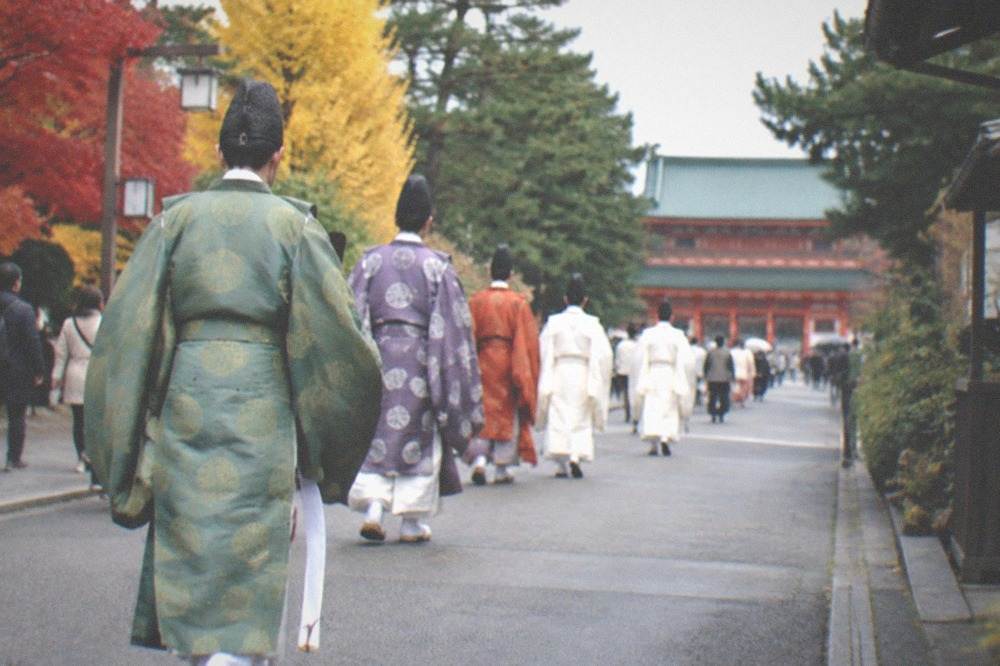
The Jidai Matsuri on 22 October is the one day when the shrine is not calm at all, and that is the point. The two-kilometre procession of some 2,000 costumed participants departs the Kyoto Imperial Palace in the morning and arrives at Heian Shrine in the early afternoon, where the shrine rites conclude the festival. Arriving by mid-morning to hold a spot along the route, then following the tail of the procession into the shrine grounds, is the pattern regulars use. The Jidai Matsuri guide covers the full schedule.
How Does Heian Shrine Compare To Kyoto's Other Major Shrines?
Heian Shrine is Kyoto's grand civic shrine: young, imperial in theme, huge in scale and free to enter the grounds, with a paid garden. Yasaka Shrine in Gion is older, more woven into daily neighbourhood life and entirely free, with no garden to charge for. Fushimi Inari Taisha is the head shrine of about 30,000 Inari shrines nationwide, free to enter, with hiking paths that have no closing time. Each answers a different question, and a Kyoto trip can hold all three.
The comparison matters because first-time visitors often ask which shrine to skip, and the honest answer is that they do not substitute for one another. Fushimi Inari's mountain, with its roughly 10,000 torii of all sizes spread across the whole mountain according to the shrine's own FAQ, is a hike with a shrine attached; Heian Shrine is architecture and garden; Yasaka is a working district shrine that happens to sit at the centre of the city's best evening streets. If you want depth on the Inari side, the Fushimi Inari shrine guide covers the trails, and a guided hike such as the hidden-route Fushimi Inari tour listed on this site adds the mountain's quieter paths and the shrine's founding story, which the shrine itself hedges as tradition recorded in an ancient text.
For garden lovers the real comparison is not with another shrine but with the temples. Heian Shrine's Shin-en competes with the stroll gardens at Tenryu-ji in Arashiyama and the pond garden at Kodai-ji, and the honest ranking depends on season: Tenryu-ji's borrowed scenery of the Arashiyama hills wins in most weeks of the year, while Heian's weeping cherries win their two weeks in spring outright. The fee structures differ too, as the table below shows.
| Site | Grounds | Paid highlight | Verified fee |
|---|---|---|---|
| Heian Shrine | free | Shin-en garden | figure not verified on a primary page, check the gate |
| Fushimi Inari Taisha | free, paths have no closing time | none, no fee anywhere on the shrine's site | free |
| Yasaka Shrine | free | none | free |
| Tenryu-ji | grounds within garden ticket | garden, plus 300 yen for buildings, 500 yen for the Hatto ceiling | garden 500 yen |
| Nanzen-ji | free grounds | Hojo garden 600 yen, Sanmon gate 600 yen separately | 600 yen each |
| Kodai-ji | ticketed entry | main entry, or 1,200 yen combined with Entoku-in | 800 yen |
Is Heian Shrine Good For Families And Short Kyoto Visits?
Yes, and for reasons that are structural rather than scenic: the grounds are flat and free, the courtyard gives children room that Kyoto's narrow temple lanes never do, and the Okazaki district around it stacks the zoo, the canal, the National Museum of Modern Art and the shrine into one walkable package. For a short visit, thirty free minutes at the shrine plus a paid garden loop makes a half-day in the district.
The family case is best made by contrast. The approach lanes at Kiyomizu-dera and the bamboo path in Arashiyama are single-file in high season, and the city's etiquette guidance for Gion asks visitors not to crowd or chase; Heian Shrine's gravel expanse is the opposite environment, a place where a child can run in a straight line without disturbing anyone. The garden's stepping stones are a genuine attraction for children, with the usual supervision caveat that the stones sit over water. The Kyoto with kids guide places the shrine in a full family itinerary.
For visitors on a tight schedule, the shrine earns its slot as the anchor of east-side itineraries because of the geography. Nanzen-ji, the Philosopher's Path and Ginkaku-ji line up north of it; the museum and the zoo sit beside it; Gion and Yasaka Shrine lie 20 minutes south on foot. A one-day east-side plan that starts at Nanzen-ji in the morning, walks the canal to Heian Shrine for midday, then continues south into Gion for the evening is one of the most efficient days the city offers, and the one day in Kyoto itinerary builds exactly that spine.
What Should You Know About Etiquette And Rules At Heian Shrine?
The standard shrine etiquette applies: bow at the torii, keep to the sides of the approach, purify hands at the water pavilion, and photograph freely in the open grounds, since Heian Shrine publishes no photography ban on its general areas. The rules that differ from most Kyoto sites concern events: during Jidai Matsuri the shrine becomes a festival venue with processional priority, and the city's broader 2025 to 2026 visitor measures, including etiquette patrols in the busiest districts, apply to the Okazaki area in peak season.
One rule worth stating plainly because it is widely misreported elsewhere in the city: the Gion private-alley photography ban and its 10,000 yen penalty are district-council signage in Gion, not a city ordinance, and they have nothing to do with Heian Shrine. Here the constraints are ordinary ones. Drones are a different matter at shrines generally; Kamigamo Shrine, for instance, requires advance permission for any drone flight or photography of rites, and treating every shrine as drone-restricted unless stated otherwise is the safe assumption.
The garden has its own quiet expectations: stay on paths, do not climb the stepping stones' railings, and expect the pond-edge areas to be one-way in peak bloom. The shrine's role as a wedding venue also means you may encounter a Shinto wedding party crossing the courtyard, which is a spectacle worth pausing for and photographing only from a respectful distance. For the broader picture of temple and shrine conduct, the Kyoto etiquette guide covers the whole city.
Should You Combine Heian Shrine With The Rest Of Okazaki?
Yes, and the combination is the district's whole design: the shrine, the Kyoto National Museum of Modern Art, the city zoo, the canal and the concert hall were laid out together in the late 19th century's exposition era, and all sit within a 10 minute walk of the torii. A half day covers the shrine and garden plus one museum; a full day adds the zoo and a canal-side walk north toward Nanzen-ji and the Philosopher's Path.
The district's history explains why it works. The Lake Biwa Canal brought water and power to this stretch of eastern Kyoto, and the national industrial exposition of the shrine's founding year fixed the pattern of cultural institutions along the water. In cherry season the canal banks themselves are a destination, and in autumn the Kyoto autumn leaves itinerary routes the district into a larger east-side circuit.
For a longer Kyoto stay, the shrine slots naturally into day three or four, after the headline temples have been absorbed, because it is the site that explains the city to itself: a monument to Kyoto's 1,100 years as capital, built in the decade the city had to argue for its own relevance after the court left. Visitors who see it last tend to rate it highest, and the three days in Kyoto itinerary sequences it that way.
Common Questions About Heian Shrine
What Does The Heian Shrine Garden Cost And Is The Shrine Itself Free?
The shrine grounds, courtyard and main worship hall are free. The Shin-en garden charges admission, but the current figure is not printed on a primary page this site could verify, so rely on the notice at the garden gate rather than a number in an older guide.
How Old Is Heian Shrine?
It was built to mark the 1,100th anniversary of Kyoto becoming the capital. The main hall is a two-thirds-scale reproduction of the Heian-period Imperial Palace's state hall, and the enshrined deities are Emperor Kanmu and Emperor Komei, the first and last emperors to reign from Kyoto.
How Do I Get To Heian Shrine From Kyoto Station?
Take the Karasuma Line subway to Karasuma Oike, transfer to the Tozai Line to Higashiyama Station, then walk 10 to 12 minutes, about 260 yen in total. The city bus flat fare is 230 yen, and the EX100 tourist express, 500 yen, stops in the Okazaki area on weekends and holidays.
When Is Jidai Matsuri And Does It End At Heian Shrine?
Jidai Matsuri is held on 22 October every year, with a rain postponement, the Heian Shrine's own ritual pages state. The costume procession leaves the Kyoto Imperial Palace in the morning and arrives at Heian Shrine in the early afternoon for the concluding rites.
Is Heian Shrine Worth Visiting In Cherry Blossom Season?
Yes, the garden's weeping cherries are among the city's best. The JMA 1991 to 2020 normal for full bloom is 4 April, and 2026's actual full bloom was 30 March, so the last week of March into the first days of April is the usual peak.
Can You See A Shinto Wedding At Heian Shrine?
Weddings are held at the shrine regularly, and a procession crossing the vast courtyard is a common sight on weekend mornings. Watch from a respectful distance and do not block the path of the party.
Heian Shrine rewards the visitor who arrives with the right expectations: not ancient patina but civic grandeur, not a hidden corner but a deliberately built stage for the city's own story. Walk in free under the big torii, pay for the garden if the season is right, and let the Kyoto Travel Guide place the shrine inside the rest of what the city holds.