What Are Kyoto's Three Great Festivals: Aoi, Gion And Jidai?
Kyoto's three great festivals anchor the city's year: Aoi Matsuri on 15 May, Gion Matsuri across the whole of July, and Jidai Matsuri on 22 October. Here is what each one actually involves, with verified dates, crowd figures and the rules that catch visitors out.
Short answer
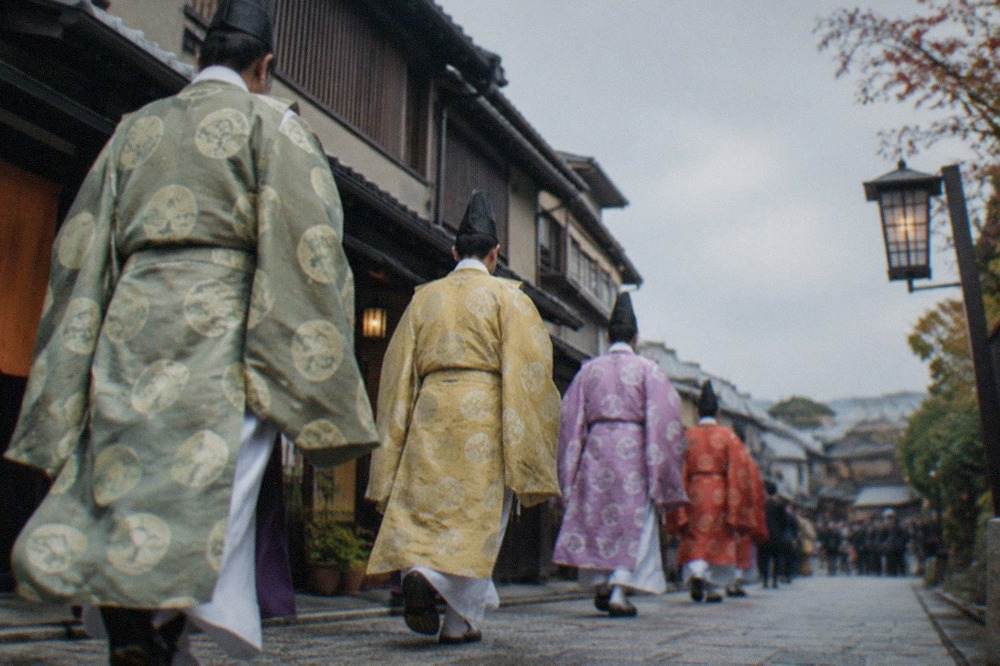
Kyoto's three great festivals are Aoi Matsuri (15 May), Gion Matsuri (all of July, with parade processions on 17 and 24 July) and Jidai Matsuri (22 October). Gozan no Okuribi on 16 August is the other fixed date worth building a trip around. None of them is ticketed through this site; all are public street and shrine events.
Kyoto's festival year is fixed by centuries of practice, not by tourism boards. The city's own shrine and temple pages print the same dates every year: Aoi Matsuri on 15 May, Gion Matsuri running the length of July, Jidai Matsuri on 22 October, and Gozan no Okuribi closing the summer on 16 August. The city drew a record 62.79 million visitors in 2025, its survey released in June 2026 reports, and festival days compress much of that flow into a handful of streets. This guide on Kyoto Travel Guide sets out what each festival involves, what the rules actually are, and how to plan around them. For the wider picture, start with things to do in Kyoto.
What Is Aoi Matsuri And When Is It Held In Kyoto?
Aoi Matsuri is held on 15 May every year, and Kamigamo Shrine, one of its two host shrines, is the source that fixes the date. If rain falls on the 15th, the procession moves to the 16th the following day. It is a parade of Heian-period court costume, horseback riders and ox carts, and of the three great festivals it is the quietest to watch, moving through green space and residential streets rather than packed downtown blocks.
The festival's Japanese name, Aoi, refers to the hollyhock leaves that decorate the costumes, carts and shrine buildings. Kamigamo Shrine's own site lists the festival among its rites, and the shrine separately requires advance permission for photographing rites and for any drone flight, a rule worth knowing before you arrive with a camera plan. The procession is long and slow by design. Spectators line the route hours ahead for the best spots near the shrine gates, but the tail sections draw thin crowds, and many families simply pick a spot along the middle of the route and wait.
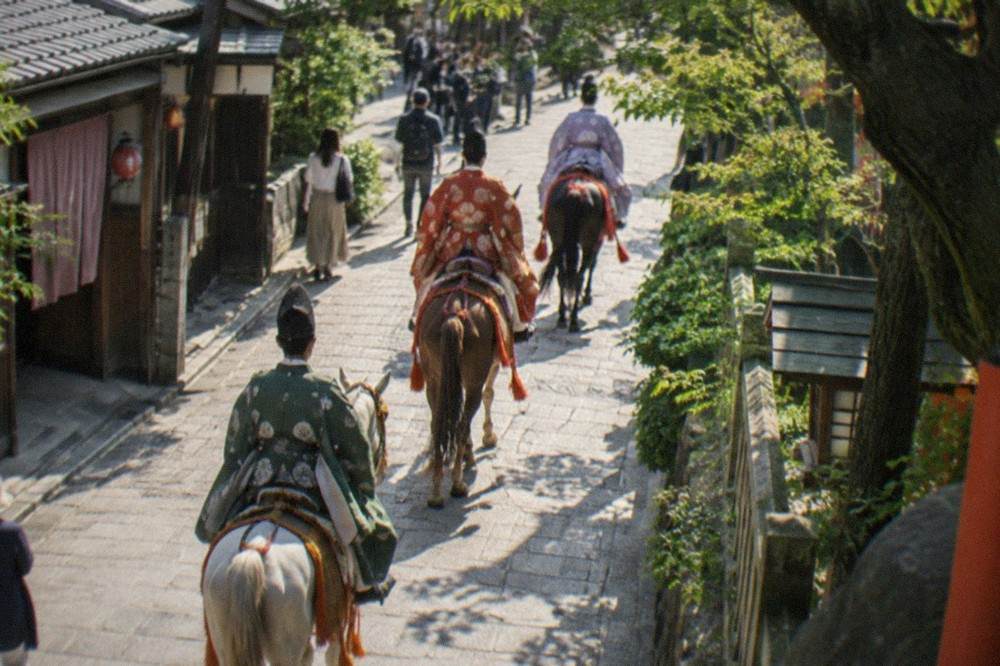
Mid-May is one of the most comfortable times to stand outdoors in Kyoto all year. The JMA 1991-2020 normals for the city give May a mean of 19.5 C and a mean daily high of 25.1 C, with 151.4 mm of rain across the month. That is more rain than April but well short of the summer peak, and the rain-date provision for the 15th exists precisely because a wet procession day is a real possibility rather than a rarity.
| Festival | Date | Main venue | Character |
|---|---|---|---|
| Aoi Matsuri | 15 May (16 May if rain) | Kamigamo and Shimogamo shrines | Heian court procession, quietest of the three |
| Gion Matsuri | 1 to 31 July | Yasaka Shrine and downtown Kyoto | Month-long, two giant parades, street stalls |
| Jidai Matsuri | 22 October (postponed in rain) | Heian Shrine to the Kyoto Imperial Palace area | Historical costume procession, 9:00 departure |
| Gozan no Okuribi | 16 August | Five mountains around the city | Bonfire finale, hills closed to entry |
Our dedicated Aoi Matsuri guide covers the route and viewing spots in detail.
What Happens During Gion Matsuri In Kyoto?
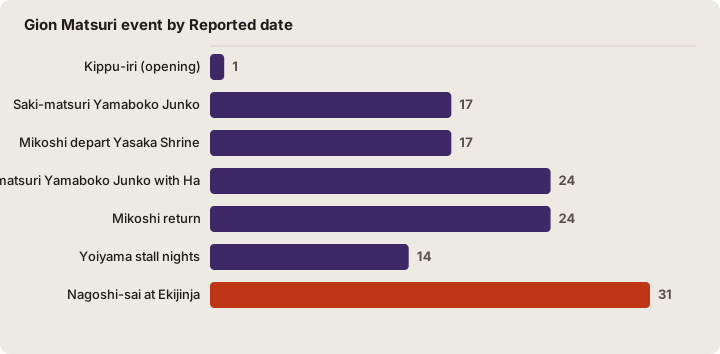
Gion Matsuri runs the whole of July, from Kippu-iri on 1 July to Nagoshi-sai at Ekijinja on 31 July. Its two great processions, the Yamaboko Junko, roll on 17 July for the saki-matsuri and 24 July for the ato-matsuri, which closes with the Hanagasa procession. The mikoshi leave Yasaka Shrine on the evening of the 17th and return late on the 24th, and Yasaka Shrine's own event page sets the full sequence.
The month between those bookends is the part most visitors miss. Floats are pulled through the streets in the days before each parade, and the evenings before the processions, reported as the 14th to 16th and 21st to 23rd, turn central Kyoto into a pedestrian zone of food stalls and open-fronted houses. Those Yoiyama nights rest on secondary reporting rather than the shrine's page, so check the current year's programme before committing an evening to them. The parades themselves are the spectacle: dozens of hoko and yama floats, some weighing several tonnes, hauled by teams of rope pullers through the grid of downtown streets.
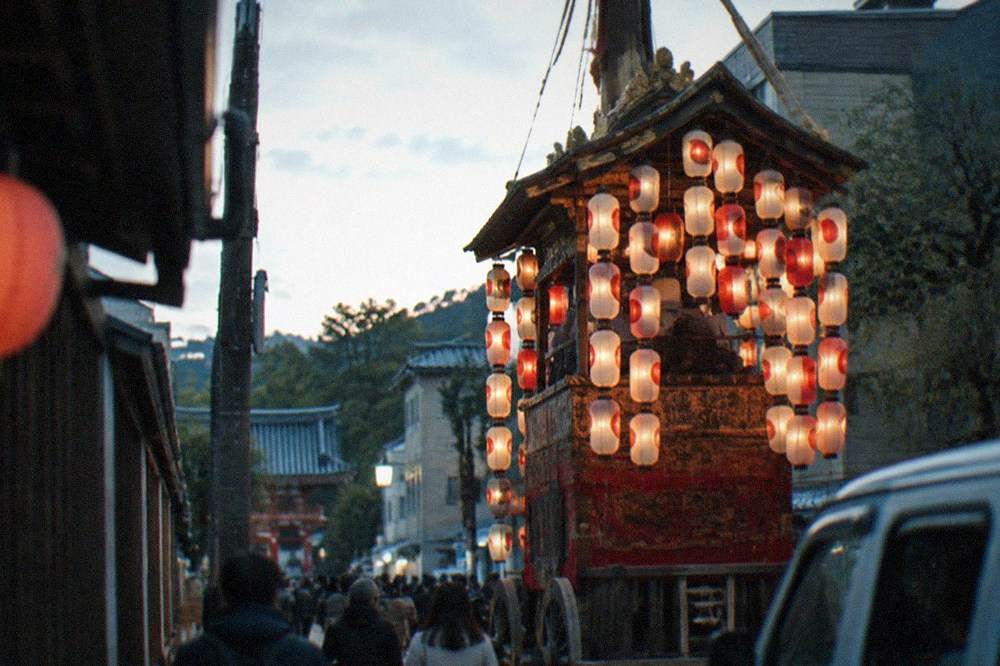
July is a demanding month to stand in a crowd. The JMA normals give it a mean of 27.3 C, a mean daily high of 32.0 C, and 223.6 mm of rain, which makes it Kyoto's wettest month, ahead of June at 199.7 mm. Three of the city's six hottest days on record fell in the summers of 2024, 2025 and 2026, and July and August 2025 both ranked among the five hottest months ever measured at the station. Water, shade breaks and an early start are not optional.
| Gion Matsuri event | Reported date | Status of the source |
|---|---|---|
| Kippu-iri (opening) | 1 July | Shrine's own event page |
| Saki-matsuri Yamaboko Junko | 17 July, morning | Shrine's own event page |
| Mikoshi depart Yasaka Shrine | Evening of 17 July | Shrine's own event page |
| Ato-matsuri Yamaboko Junko with Hanagasa | 24 July | Shrine's own event page |
| Mikoshi return | Late on 24 July | Shrine's own event page |
| Yoiyama stall nights | 14-16 and 21-23 July | Secondary reporting, verify per year |
| Nagoshi-sai at Ekijinja | 31 July | Shrine's own event page |
The full month is mapped out in our Gion Matsuri guide, and for the evenings around the parades, a Gion Magical Night walking tour of the geisha district gives the festival's home neighbourhood its context. Check availability on the operator's live listing if you want a guide for those nights.
What Is Jidai Matsuri's Procession In Kyoto?
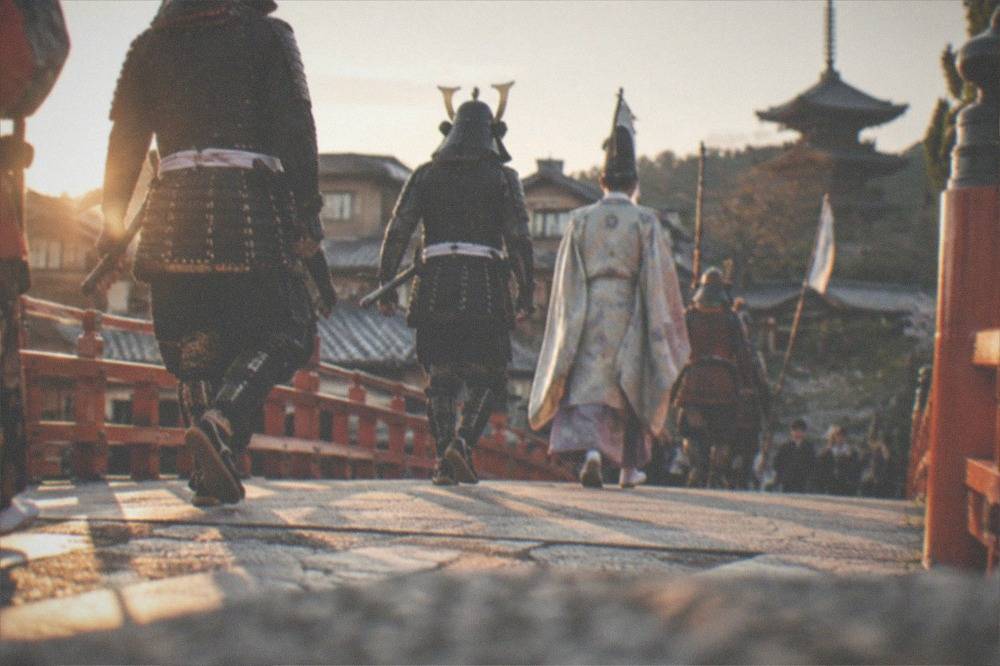
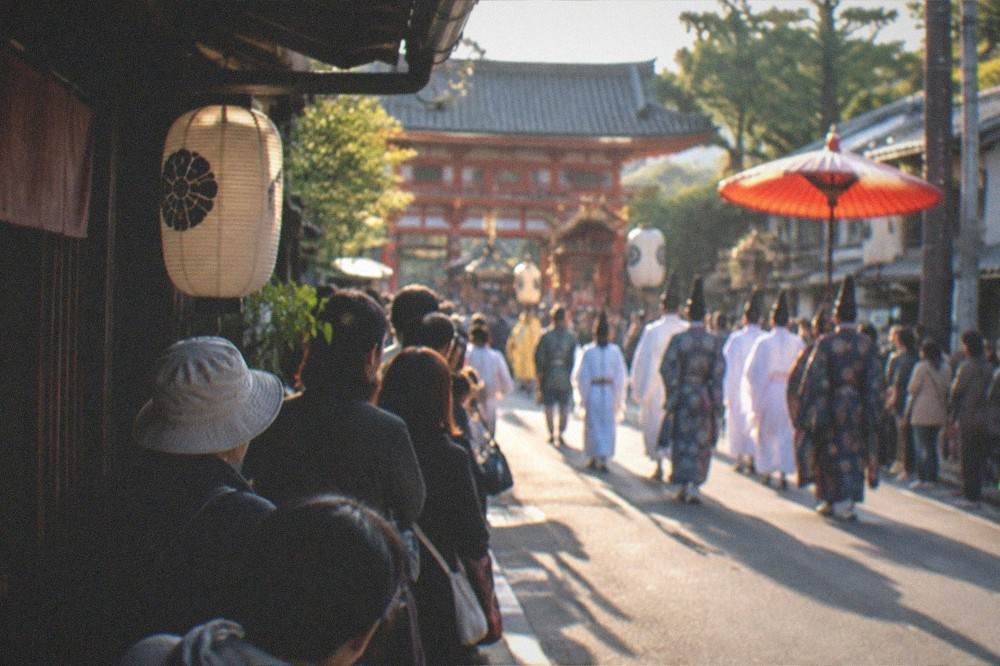
Jidai Matsuri is held on 22 October every year, and it is postponed if it rains. The eve rite falls at 10:00 on the 21st; on the day itself the festival rite is at 7:00, the Shinko-sai at 8:00, and the procession leaves at 9:00. Heian Shrine publishes the full ritual schedule on its own page, and the procession is a walking chronicle of Japanese historical costume, from court nobles to modern eras.
The festival was created as a celebration of the city's history, and the procession's order runs backwards through the centuries, ending with the Enryaku-era courtiers at the front. Watching it well is a matter of picking a stretch of the route and settling in before 9:00, because the whole column takes hours to pass any single point. October is close to ideal for it: the JMA normals give the month a mean of 18.4 C, a mean daily high of 23.4 C and 143.2 mm of rain, and the shrine's rain-postponement rule exists because a wet 22nd does happen.
Jidai Matsuri is also the festival most easily combined with sightseeing, since the route passes near several of the sites covered in our three days in Kyoto itinerary. The dedicated Jidai Matsuri guide has the route map and timing detail. If the parade day fills up, the evening is well spent over a proper dinner from the best restaurants in Kyoto list, or learning to cook the city's food yourself.
A guided evening walk is the one part of a festival trip that benefits from booking ahead, because the good guides fill their calendars around the July parade dates first. The night walk through Gion pairs naturally with the parade evenings, when the district's lantern-lit streets are at their busiest and a guide who knows the private-alley boundaries is worth having.
What Is Gozan no Okuribi In Kyoto?
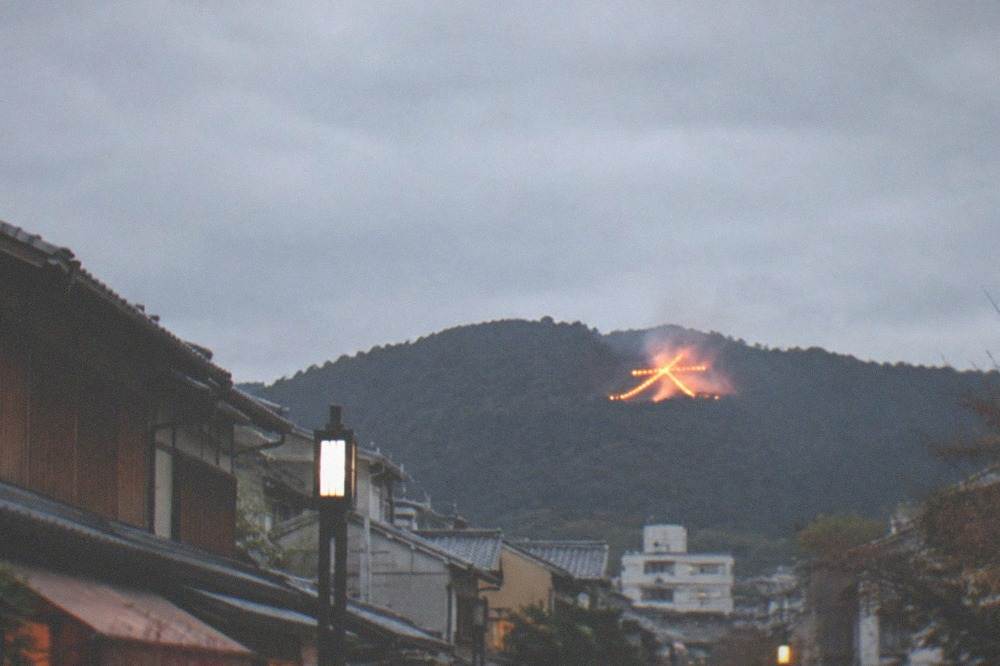
Gozan no Okuribi lights five mountains one after another on 16 August, and entering the hills is prohibited that day, a rule the Kyoto City Tourism Association states plainly on its own page. The fires are shaped characters on the mountainsides, lit as the finale of the Obon season. The first lighting is widely reported at 20:00, but that time rests on secondary reporting rather than the page itself, so plan for the evening as a whole rather than a single minute.
The five mountains ring the city, which means the viewing question is really a geography question: the northern fires are best seen from the Kamo River banks and downtown rooftops, while others read better from the west of the city. The hills are closed to entry because the bonfire sites sit on steep, guarded ground, and the prohibition is enforced rather than advisory. August is the hottest month in the JMA normals, mean 28.5 C and mean daily high 33.7 C, so an evening spent waiting for a fire on a riverbank is at least an evening spent after the worst of the heat.
What Smaller Kyoto Events Fill The Rest Of The Calendar?
Kyoto's calendar holds far more than the three great festivals. Cherry flowering reached 23 March in 2026 against a 1991-2020 normal of 26 March, the JMA observatory reports, and its maple red-leaf marker stands at a normal of 5 December, later than most guides claim. Arashiyama's December lantern event continues, while the Higashiyama version of the same event ended after 2022, so do not plan a trip around the latter.
The seasonal markers matter because they are what the crowd calendar actually follows. The 2026 cherry full bloom came on 30 March, six days ahead of the 4 April normal, and the 2025 maple red leaves were observed on 10 December, five days late. Foliage forecasts for 2026 point to peak colour in the Arashiyama area around late November, though the JMA's own marker date is the observatory's specimen tree, not a district peak, so treat it as an official marker rather than the best week.
| Seasonal marker | 2026 | 2025 | 1991-2020 normal |
|---|---|---|---|
| Cherry flowering | 23 March | 27 March | 26 March |
| Cherry full bloom | 30 March | 5 April | 4 April |
| Maple red leaves | Not yet observed | 10 December | 5 December |
| Ginkgo yellow leaves | Not yet observed | 25 November | 24 November |
| Plum flowering | 22 February | 11 March | 22 February |
Food events fill the gaps between the shrine rites. A Nishiki Market brunch walking tour with seven tastings works as a morning before an afternoon festival, and the market itself is covered in our Kyoto food context through the signature-dish question. Check availability for the brunch walk before locking in a festival morning.
How Do Crowds And Rules Affect A Kyoto Festival Visit?
Kyoto recorded a record 62.79 million visitors in 2025, the city's own survey released in June 2026 reports, including 12.68 million foreign visitors, and festival days concentrate that flow sharply. The city runs a Tourism Comfort Forecast that grades crowding at major spots by time slot, using smartphone location data, weather and machine learning. During Gion Matsuri it adds express buses and promotes off-peak visits, and the busiest evenings cluster around the two parade dates.
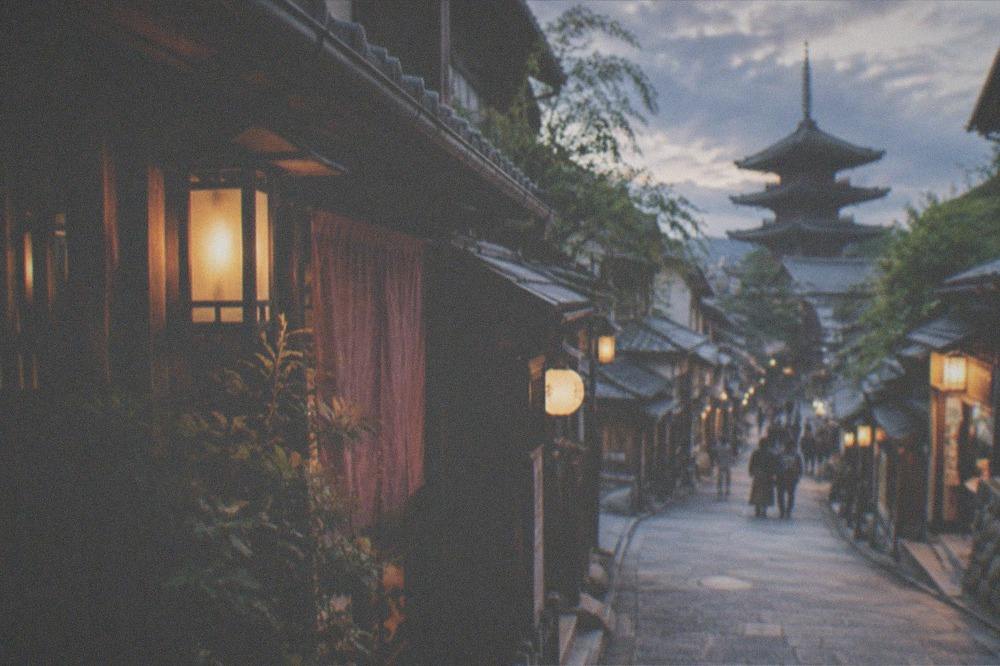
The rules that catch visitors out are mostly about Gion, the district that gives the July festival its name. The Kyoto City Tourism Association's guidance is about conduct: do not touch, chase or photograph geiko and maiko without permission, and do not enter private property or photograph it where that is prohibited. Separately, on the private alleys off Hanamikoji, signs put up by the Gion South Side district council threaten a 10,000 yen penalty for unauthorized photography. That is council signage on private roads, not a city fine, and the distinction matters: Hanamikoji's main street is public and photographable, the alleys off it are not. Our Gion area guide covers the district, and the is Gion worth visiting answer addresses the question directly.
| Measure | 2025 | 2024 |
|---|---|---|
| Total visitors | 62.79 million, record | 56.06 million |
| Foreign visitors | 12.68 million | Lower |
| Overnight guests | 16.59 million, record | 16.30 million |
| Day visitors | 46.20 million | 39.76 million |
| Tourism spending | 2.0474 trillion yen, record | 1.8839 trillion yen |
Practical crowd tactics work everywhere in the city, not just at festivals. Arrive before 8:00 at any headline site, use the city's comfort forecast to pick your time slot, and take the subway rather than the bus on peak days; the city explicitly promotes dispersal to mornings, evenings and lesser-known areas, and its hands-free luggage delivery scheme exists to keep suitcases off crowded buses.
How Should You Plan A Trip Around Kyoto's Festivals?
Plan around fixed dates, not vague seasons: Aoi Matsuri is 15 May, Gion Matsuri fills July, Gozan no Okuribi is 16 August and Jidai Matsuri is 22 October. July is Kyoto's wettest month at 223.6 mm against June's 199.7 mm in the JMA 1991-2020 normals, and the accommodation tax changed on 1 March 2026, so a room charged at 20,000 yen now carries 1,000 yen per person per night rather than 500.
The tax change is the line most competing guides still get wrong. The city's five-tier schedule, effective for stays from 1 March 2026, charges 200 yen per person per night on rooms under 6,000 yen, 400 yen from 6,000 to under 20,000, 1,000 yen from 20,000 to under 50,000, 4,000 yen from 50,000 to under 100,000, and 10,000 yen at 100,000 and up, with the top tier having risen tenfold. The base is the room-only charge excluding meals and consumption tax. Our where to stay in Kyoto and best hotels in Kyoto guides fold that in.
| Festival month | Rain mm | Mean C | Mean daily high C | Planning note |
|---|---|---|---|---|
| May (Aoi Matsuri) | 151.4 | 19.5 | 25.1 | Most comfortable standing weather of the four |
| July (Gion Matsuri) | 223.6 | 27.3 | 32.0 | Wettest and hottest festival month |
| August (Okuribi) | 153.8 | 28.5 | 33.7 | Evening event, heat breaks by nightfall |
| October (Jidai Matsuri) | 143.2 | 18.4 | 23.4 | Mild, rain postponement possible |
A festival trip still needs a backbone beyond the parade day. The Kyoto itinerary and one day in Kyoto pages give the structure, and the Philosopher's Path makes a quiet counterpoint to the downtown crush on festival mornings. For eating around the events, a ramen making class in the city centre is a reliable rainy-afternoon fill-in.
Common Questions About Kyoto Festivals
What Are Kyoto's Three Great Festivals: Aoi, Gion And Jidai?
Aoi Matsuri on 15 May, Gion Matsuri across the whole of July with its parades on 17 and 24 July, and Jidai Matsuri on 22 October. Each is anchored at a shrine that publishes its own dates: Kamigamo Shrine for Aoi, Yasaka Shrine for Gion, and Heian Shrine for Jidai.
Do Kyoto Festivals Cost Money To Watch?
No. All three great festivals and Gozan no Okuribi are public street and shrine events with no entry fee and no ticket. Some paid seating or related performances may exist around the parades, but the processions themselves are watched free from the pavement. None of them is bookable through this site.
When Is The Best Month For Festivals In Kyoto?
May for Aoi Matsuri if you want mild weather and a stately procession, July for Gion Matsuri if you want the biggest spectacle and can handle heat and rain, and October for Jidai Matsuri at the most comfortable temperatures. August adds Gozan no Okuribi on the 16th for the fire finale.
Can You Photograph Geiko And Maiko During Gion Matsuri?
Not without permission. The Kyoto City Tourism Association's guidance is to not touch, chase or photograph geiko and maiko without consent. On the private alleys off Hanamikoji, signs put up by the Gion South Side district council threaten a 10,000 yen penalty for unauthorized photography; that is council signage on private roads, not a city fine, and Hanamikoji's main street remains public.
What Happens If It Rains On A Festival Day?
Aoi Matsuri moves to 16 May if the 15th is wet, and Jidai Matsuri is postponed in rain, per the shrines' own pages. Gion Matsuri runs the month regardless, though individual floats and events can shift. Gozan no Okuribi goes ahead on 16 August; the hills are closed to entry either way.
How Early Should You Arrive For A Festival Parade In Kyoto?
For the Yamaboko Junko parades, an hour or more before the 9:00 starts for a downtown kerb spot, earlier for the shrine-gate sections. For Jidai Matsuri, pick a route stretch before the 9:00 departure and settle in, since the column takes hours to pass. The city's comfort forecast is the best tool for choosing a less crowded stretch.
The fixed dates make Kyoto's festival year unusually plannable: pick the month, book around the parade days early, and let the shrines' own pages, not a secondhand guide, confirm the current year's schedule. That habit, more than any single festival, is what separates a trip that catches the procession from one that catches only the crowd.