What Does The Kyoto Tower Observation Deck Cost And How High Is It?
The Nidec Kyoto Tower observation deck charges 900 yen for adults, 700 for high school students and 600 for elementary and junior high, and stays open until 21:00. Here is what the fare card covers, how the tower fits a Kyoto day, and what it does not.
Short answer
Adults pay 900 yen, high school students 700, elementary and junior high 600, children from age 3 pay 200 and under-3s enter free. The deck opens at 10:00 and takes its last admission at 20:30, closing at 21:00.
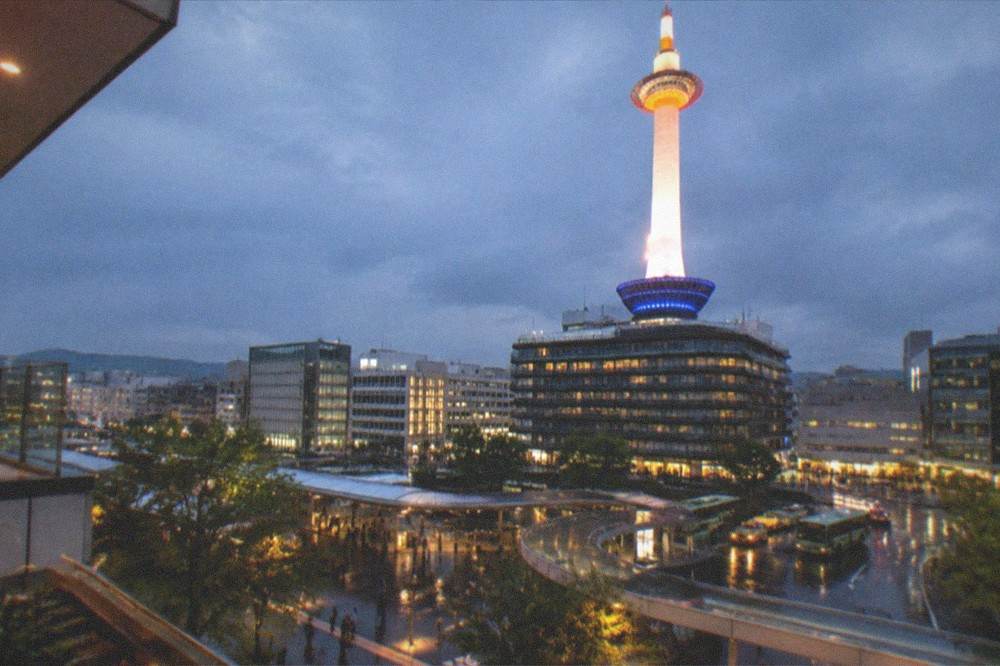
Kyoto's skyline is famously horizontal, which is exactly why the white shaft standing opposite Kyoto Station reads so strangely against it. Nidec Kyoto Tower, and the sponsor name is part of the official title, opened as the city's modern landmark beside the station and has spent decades as the one place in central Kyoto where you can look down on the whole grid of temple roofs at once. The city's own 2025 tourism survey, released in June 2026, counted a record 62.79 million visitors, and a large share of them arrive through the station this tower watches over. This page sets out the verified fare card, the hours, and an honest judgement about where the deck fits in a city whose best views are usually free.
What Does The Kyoto Tower Observation Deck Cost And How High Is It?
The operator's own fee page sets the observation deck at 900 yen for adults, 700 yen for high school students, 600 yen for elementary and junior high students, 200 yen from age 3 and free under 3. The deck opens at 10:00, takes its last admission at 20:30 and closes at 21:00. The tower's height in metres is not printed on the fee page this site verified, so this guide quotes the fare card rather than a figure copied from elsewhere.
That last sentence is deliberate. Height claims for the tower circulate freely in travel copy, but the operator's fee page, the one source this site read directly, publishes prices, hours and age bands, not a metre count. What the page does establish is the pricing structure, and it is a structure that rewards nobody for guessing: a family of two adults and two school-age children pays 3,000 yen for roughly an hour of view, which is more than Kinkaku-ji charges the same family, and Kinkaku-ji is a World Heritage Site.
The honest framing is this. The tower is a modern structure standing directly across Karasuma-dori from Kyoto Station, in the one district of the city with high-rise hotels and office blocks. The deck looks north over the low temple quarters toward the northern hills, and on clear days the view reaches the mountains that frame the city on three sides. It is a view of the city's shape, not of its detail, and the deck's real value depends on whether you will use it as an orientation tool at the start of a trip or as a nightcap at the end of a day.
| Age band | Deck price | Note |
|---|---|---|
| Adult | 900 yen | Groups of 30 or more pay 700 |
| High school | 700 yen | Group rate 550 |
| Elementary and junior high | 600 yen | Group rate 450 |
| Age 3 and up | 200 yen | Under 3 free |
| Observation deck hours | 10:00-21:00 | Last admission 20:30 |
The group rates matter to school trips more than to families, but they explain something about the tower's business: it is one of Kyoto's most heavily booked group stops, which is why the deck feels busiest in the middle of the day and empties toward the last admission at 20:30. The evening slot, after 19:00, is the quieter one, and the city's own crowd-management campaigns for 2025 and 2026 have been pushing visitors toward exactly these off-peak hours across all the major sites.
When Is The Best Time Of Day To Visit Kyoto Tower?
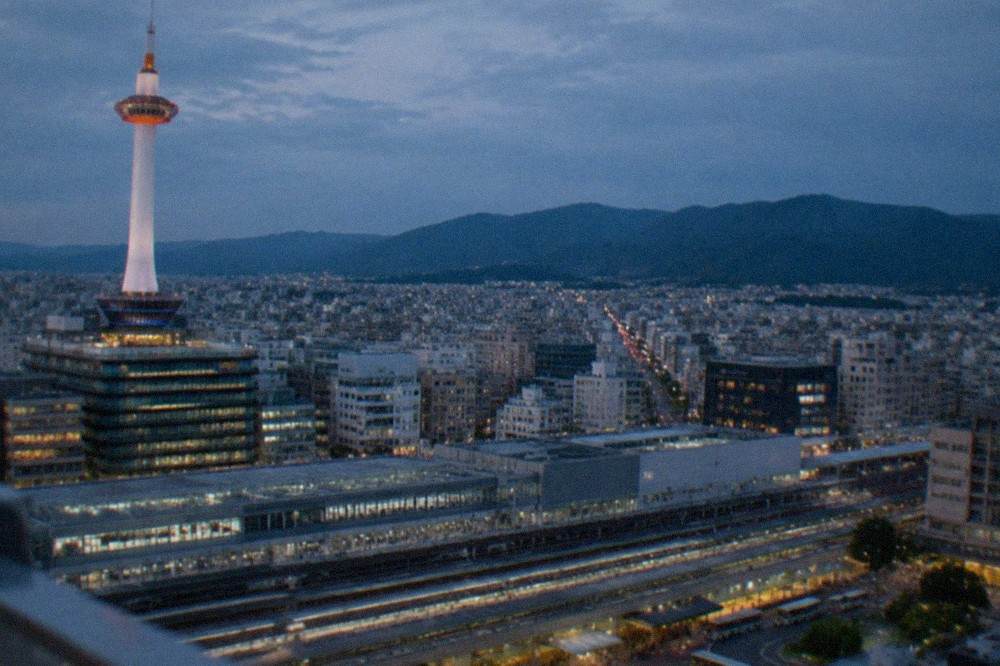
The deck's quietest verified window is after 19:00, when the last admission at 20:30 approaches and the day-trip crowds have left the station district. The deck closes at 21:00, so the final hour offers a night view of the city lights with the shortest queues. By contrast, midday brings the tour groups that arrive with the station's peak traffic, and the small deck floor fills quickly.
The tower's location is its crowd engine. It stands opposite the station that receives the HARUKA from Kansai Airport, the shinkansen from Tokyo, and the JR and Kintetsu lines from Osaka and Nara, so its natural rhythm follows arrival patterns. People land, drop bags, and walk across the street. The city's hands-free tourism program, which promotes station-counter luggage delivery and lockers to keep bags off the buses, is aimed at exactly this arrival-hour congestion, and the Kyoto luggage storage guide covers the current options at the station itself.
A practical pattern that works with the tower's own hours: arrive in the morning, store or deliver the bags, spend the day in the temple quarters, and return to the station district for a 19:00 or later deck visit. The tower then becomes the day's closing scene rather than its opening one, and you see the city lit rather than hazy. The trade is real, though. Night views flatten the mountain detail that makes daytime photographs work, so photographers should prefer the late afternoon, when the western light hits the hills and the temple roofs pick out in gold.
One more timing note worth having in advance: the tower sits in the station district, not beside any temple, so the seasonal crowd peaks that wreck Kiyomizu-dera and the Higashiyama lanes in late March and late November hit the tower only indirectly. The deck's own peak pressure comes in summer, when the station district fills with festival traffic, and during Gozan no Okuribi on 16 August, when the whole city moves at night.
Is Kyoto Tower Worth The Ticket Price Compared With Kyoto's Temples?
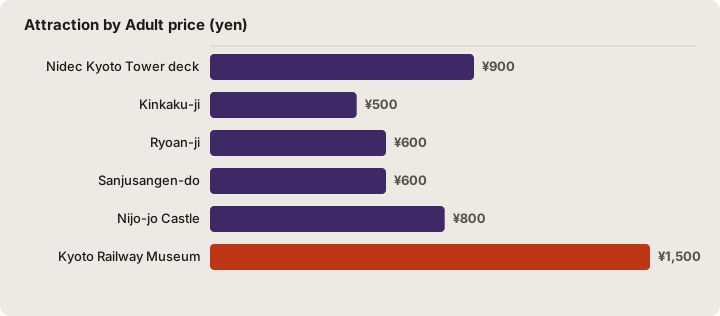
For a first visit to Kyoto, no: the temples are the reason you came, and several of them charge less. Kinkaku-ji costs 500 yen, Ryoan-ji 600, Sanjusangen-do 600. The tower's 900 yen adult fare buys a modern view, not a World Heritage interior. The stronger case is for a second visit, a rainy day, or a final evening when the temples have closed and the deck is still open until 21:00.
This is a judgement, and it is grounded in the verified fee table. Kyoto's temples charge admission, and two of them changed their fees in 2026, so a fee copied from an older guide is wrong for at least one site. Ginkaku-ji doubled its adult admission from 500 to 1,000 yen effective 1 April 2026, the first change in 32 years, and Tofuku-ji revises on 1 November 2026 with a new 1,000 yen combined ticket. Set against that, the tower's 900 yen is no longer the outlier it once was, but the comparison is still not flattering, because the temples give you a thousand years and the tower gives you an hour of glass.
The cases where the tower wins are specific. If your day is already station-heavy, an arrival evening or a departure morning, the tower is the only paid viewpoint in the district and it is open when nothing else is. If you are travelling with children who have hit their temple limit, the deck is a reset button. And if the weather has closed in, the deck's indoor floor beats a wet garden, though the view itself suffers in rain, so check the forecast rather than hoping.
| Attraction | Adult price | Hours | What you get |
|---|---|---|---|
| Nidec Kyoto Tower deck | 900 yen | 10:00-21:00 | City panorama from the station district |
| Kinkaku-ji | 500 yen | 9:00-17:00 | Golden Pavilion and garden |
| Ryoan-ji | 600 yen | 8:00-17:00 (Mar-Nov) | The rock garden |
| Sanjusangen-do | 600 yen | 8:30-17:00 (Apr-Nov) | 1,001 Kannon statues |
| Nijo-jo Castle | 800 yen | 8:45-16:00 admission | Shogunal palace and grounds |
| Kyoto Railway Museum | 1,500 yen | 10:00-17:00 | Trains, closed Wednesdays |
Note the museum in that table, because it is the tower's real family competitor. The Kyoto Railway Museum costs 1,500 yen for adults, 1,300 for university and high school, 200 from age 3, and it is a genuinely deep half-day. If the choice is tower versus museum with children, the museum usually wins on content per yen; the tower wins on time efficiency and evening availability. The museum closes at 17:00 with last entry at 16:30 and is closed Wednesdays, while the deck runs to 21:00 every day.
The Samurai Ninja Museum, whose basic skip-the-lines ticket starts from 23 dollars per person and carries a 4.6 traveller rating from 729 reviews, is a third station-district option in the same family category, and it pairs naturally with a tower visit since both work in the evening hours when the temples have shut.
How Do You Get To Kyoto Tower From The Station?
You walk. The tower stands directly across Karasuma-dori from Kyoto Station's central exit, roughly a two-minute walk from the ticket gates, which makes it the most accessible paid attraction in the city for anyone arriving by rail. No bus, subway or taxi leg is needed, and the station's underground mall connects toward it in wet weather.
This sounds like a trivial point, but in a city where the transport question eats real planning time, it is the tower's strongest practical argument. Every other major sight in Kyoto requires a bus, a subway ride or both, and the city's buses run flat-fare at 230 yen for adults with well-documented crowding. The subway runs 220 to 360 yen by zone, and the Subway and Bus One-Day Pass costs 1,100 yen. The tower requires none of it. Step off the shinkansen, walk out the Karasuma central exit, and the tower is in front of you.
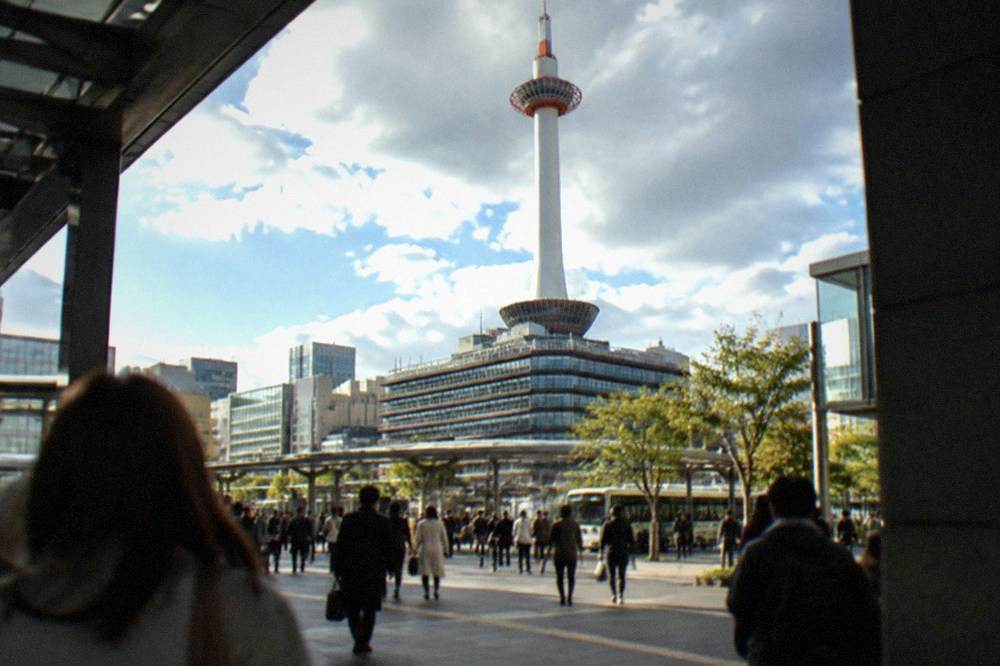
For travellers connecting from the airports, the tower is effectively the first thing you see. The HARUKA express brings Kansai Airport arrivals to Kyoto Station, with the JR West visitor one-way ticket at 2,200 yen for adults, and the limousine bus from Itami Airport costs 1,500 yen and takes about 50 to 55 minutes to the station's Hachijo exit. Either way, the tower is the landmark you use to orient yourself before you have bought a single transport ticket, which is a fair reason to climb it on day one even if the temples matter more to you.
The station district itself deserves more attention than most itineraries give it, and the things to do in Kyoto roundup places it in context against the temple quarters. Within walking range of the tower you have the Railway Museum to the west, the Kyoto Aquarium beside it, and the International Manga Museum a short subway hop north, a cluster that makes the district a genuinely full day for families who would otherwise commute to Higashiyama and back twice.
What Can You Actually See From The Kyoto Tower Deck?
The deck looks north across Kyoto's low-rise grid toward the northern hills, with the temple roofs of the eastern and western quarters spread between, and on clear days the mountain ranges that frame the city on three sides. You can pick out the To-ji pagoda to the southwest, the Higashiyama ridgeline to the east, and the station's own glass facade immediately below. Night converts the view into a city-lights panorama.
What the deck does not give you is intimacy. Kyoto's beauty is horizontal and close: a lane in Ninenzaka, a garden wall, a stretch of the Kamo River. From the deck these become texture. The view is the city's shape, the way the grid holds firm for kilometres and then surrenders to mountains in every direction, and it is a genuinely useful shape to have in your head before you start walking it. First-time visitors who climb on day one consistently navigate better afterwards, because the deck is the only place that shows you how Higashiyama, the station district and Arashiyama relate to each other. The full index of guides sits on Kyoto Travel Guide.
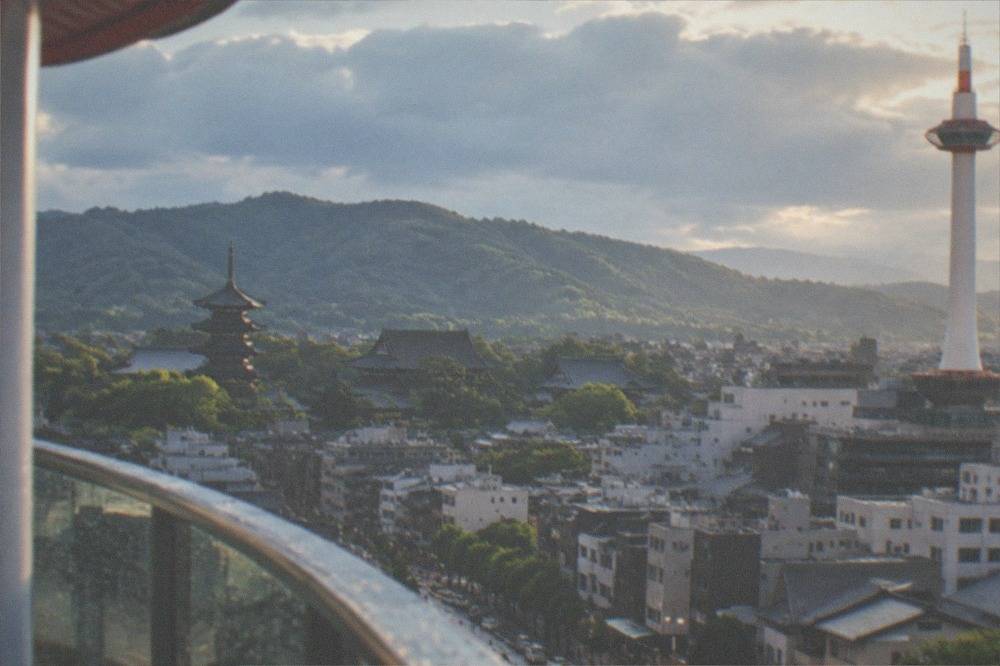
The seasonal layer matters too. In late March the cherry blossom turns the riverbanks and temple grounds pink from above, and the JMA's Kyoto observatory recorded full bloom on 30 March in 2026 against a 1991-2020 normal of 4 April, so the deck view in the final week of March is the city at its most photogenic from any angle. In late November the maples do the same in red, though the official marker for the turning, the JMA specimen tree, reads 5 December on the 1991-2020 normals, later than most guide claims of a mid-November peak, so the deck's foliage window runs later than the crowds do.
Weather is the deck's weak point, and it should shape your timing more than the clock does. Summer haze, which the JMA normals show as a real feature of July and August, the months with 223.6 mm and 153.8 mm of rain respectively, can reduce the view to a grey wash. Winter days after a cold front are the clearest, and January is both the coldest and the driest month on the 1991-2020 normals, 4.8 C mean and 53.3 mm of rain, which makes a clear winter evening the deck's best-kept secret.
Is Kyoto Tower Good For Families With Kids?
Yes, within limits. Children from age 3 pay just 200 yen and under-3s enter free, so the deck is one of the cheapest paid activities in Kyoto for small children, and the station district around it stacks the aquarium and the Railway Museum within walking range. The constraint is the deck floor itself, which is compact, so a visit runs 30 to 60 minutes rather than a half day.
The family arithmetic works out well. Two adults and two elementary-school children pay 3,000 yen total for the deck, and the surrounding district supplies the rest of the day at a reasonable rate. The tower also sits above a basement food hall and is attached to the station's retail, so the meal logistics that sink family afternoons elsewhere are solved here. The Kyoto with kids angle is covered in its own guide, but the station district is the base case for it.
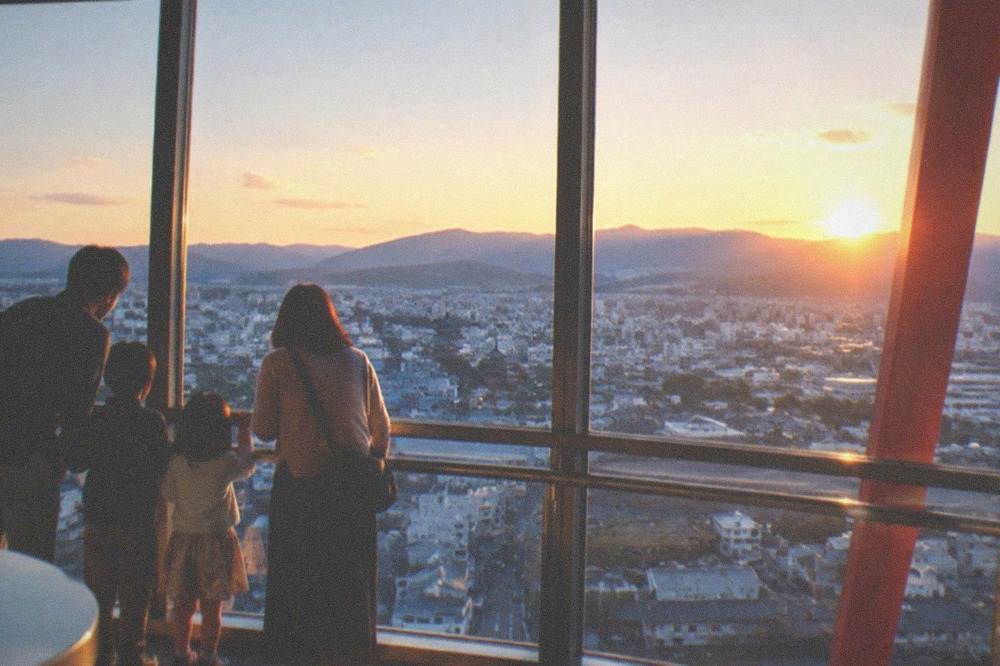
For older children the deck is a harder sell, and the honest alternatives in the same district are stronger. The Railway Museum's 1,500 yen adult and 200 yen child-from-3 pricing buys a full-scale collection with real rolling stock, and the Samurai Ninja Museum's hands-on exhibits, bookable from 23 dollars per person, give school-age kids something to do rather than something to look at. A tower visit slots best as the evening bookend to a museum afternoon, since the deck's 21:00 close outlasts everything child-friendly in the district.
| Station-district stop | Adult price | Child price | Hours |
|---|---|---|---|
| Kyoto Tower deck | 900 yen | 600 (school), 200 (age 3+) | 10:00-21:00 |
| Kyoto Railway Museum | 1,500 yen | 200 from age 3 | 10:00-17:00, closed Wednesdays |
| Kyoto Aquarium | varies by season | varies | daytime |
| Samurai Ninja Museum (basic ticket) | from 23 USD | from 23 USD | daytime and evening |
The aquarium's prices are not printed here because they were not verified for this page, but its location, directly west of the tower across the Umekoji park, makes the three-site station circuit, tower, aquarium, railway museum, one of the easiest full family days in the city without a single bus ride.
How Does Kyoto Tower Compare With Other City Views In Kyoto?
Kyoto's best views are mostly free and mostly involve climbing: the Fushimi Inari mountain paths, the Daimonji slopes above Ginkaku-ji, and the Kamo River banks all cost nothing, and the shrine at Fushimi Inari publishes no fee anywhere on its site. The tower's advantage is effortlessness, accessibility and evening hours, and its 900 yen fare is the price of skipping every staircase in the city.
This is where an honest guide has to argue against its own subject a little. Kyoto is a city of hilltop viewpoints that charge nothing, and the temple town's whole geography exists because the ancient capital's planners put the low ground in the middle and the sacred hills around it. If you are able and willing to walk, the free views from the upper Fushimi Inari paths, which the shrine notes have no closing time, are higher, quieter and more beautiful than anything behind glass.
The counter-argument is access. Not everyone can climb a mountain, and the tower is the city's step-free viewpoint, reachable from the station in two minutes on the flat. The Kurama to Kibune hike in the hills north of the city, guided from 210 dollars per person and rated 5 from 82 reviews, is the far end of that spectrum: a full eight-hour day of mountain trail and village. Between them sits everything else, and choosing between them is really choosing what kind of traveller you are on a given day, not which attraction is better.
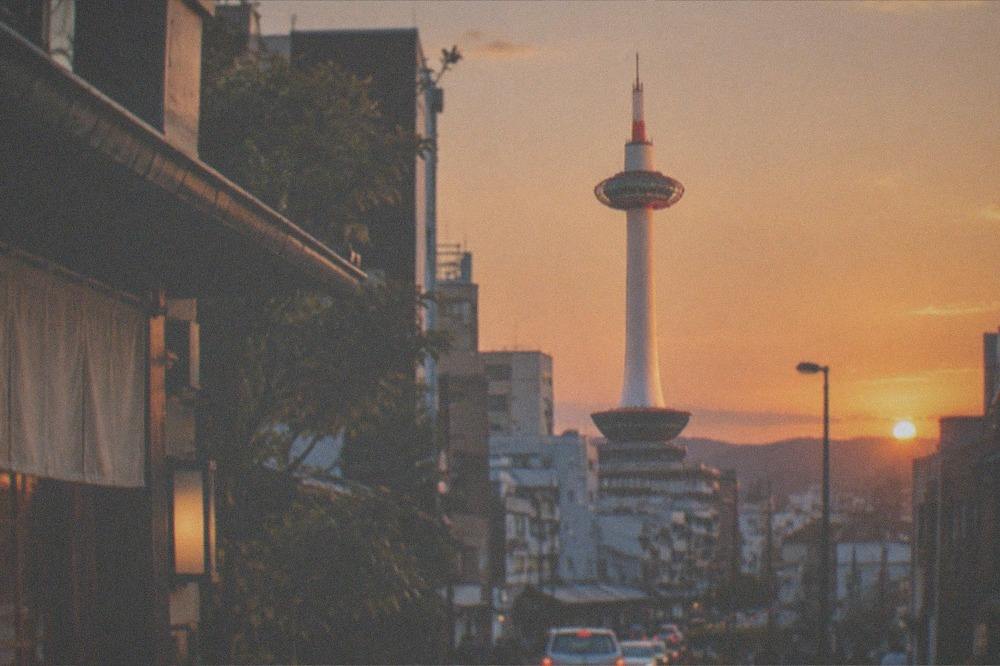
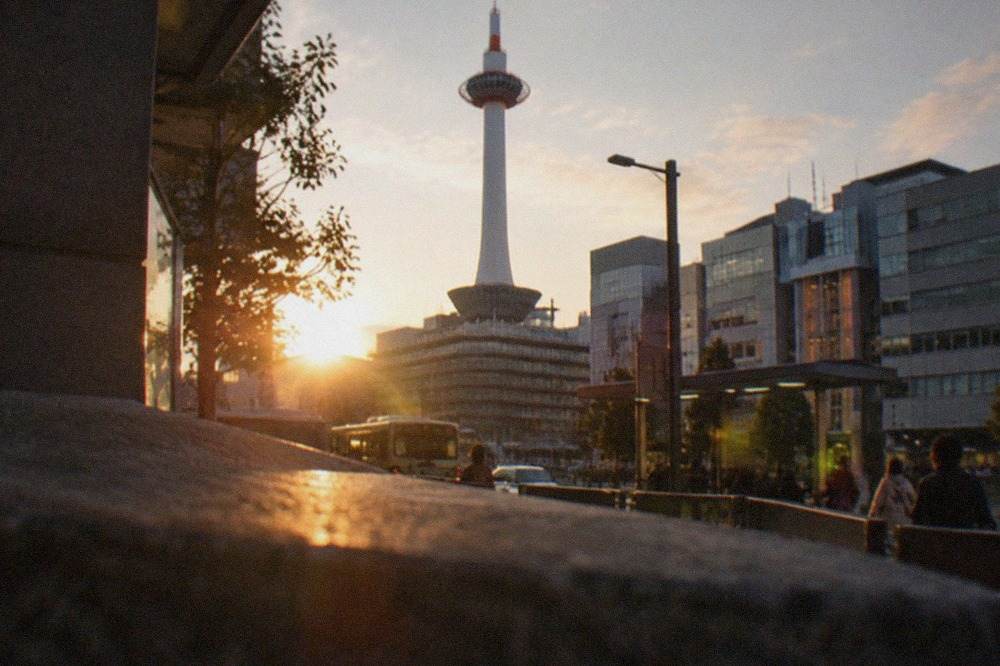
There is also the photographic argument, which favours the tower as a subject rather than a platform. The tower's white, candle-like shaft against sunset is one of the city's most recognisable modern images, and the best photographs of it are taken from the station plaza below, not from inside it. If your goal is pictures rather than panorama, you can get them free from the ground and spend the 900 yen on tea.
What Is There To Eat In Kyoto Tower And Around It?
The tower's basement and lower floors hold a food hall and the attached station retail, with the full range of Kyoto Station's restaurants a two-minute walk away, from budget ramen counters to kaiseki. The tower itself is not a dining destination, and the practical move is to eat in the station complex and visit the deck afterwards, when the evening queue has thinned.
The station district is Kyoto's most under-rated eating area, precisely because visitors assume the good food is in Gion and Pontocho and leave. The station building itself stacks a dozen floors of restaurants, and the Kyoto food guide covers the district in full. For a specific budget question, the cost of dinner in Kyoto has its own answer page, but the short version is that the station's basement and upper floors cover everything from a 1,000 yen ramen bowl to full kaiseki at the famous houses, where one celebrated restaurant by Nanzen-ji prints its lunch kaiseki from 31,625 yen on its own site.
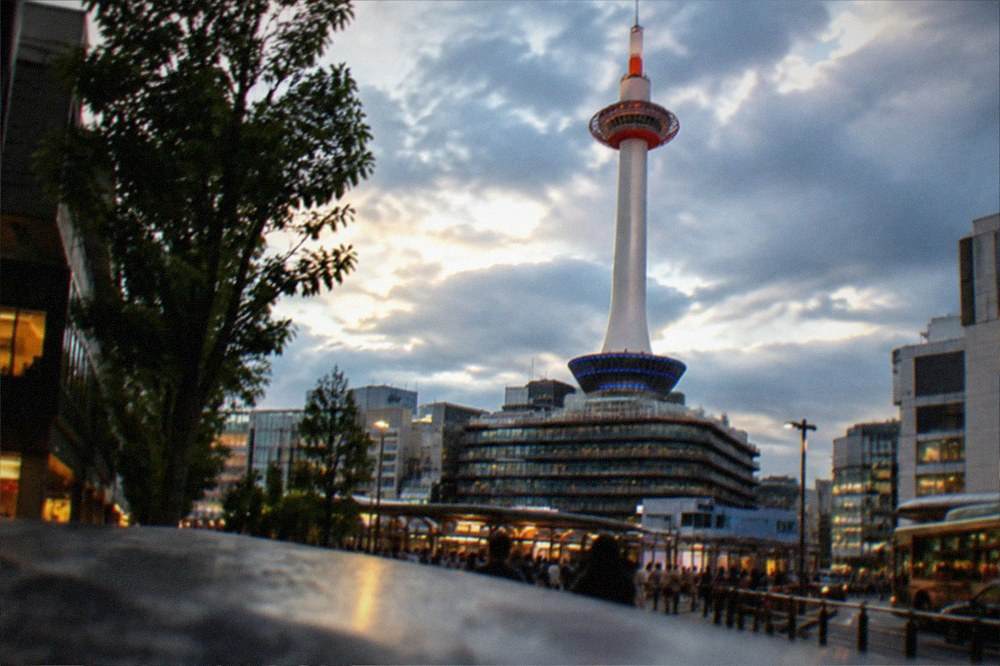
The evening sequence that works: eat in the station between 18:00 and 19:00, walk across to the tower for a 19:30 deck entry, and come down at 20:30 as the last admissions close. The deck's night view of the station's lit glass facade, one of the largest station buildings in the country, is the single best thing in the tower's evening offering, and it costs you nothing extra once you are up there.
Should You Buy Kyoto Tower Tickets In Advance?
Walk-up tickets are the norm, and the deck's capacity and 21:00 close mean it rarely sells out outside peak festival periods, so advance purchase buys convenience rather than access. The stronger advance-planning case is for pairing the tower with a guided day tour, where the operator handles the timing, or with a station-district museum ticket that skips a queue worth skipping.
The tower's own ticketing runs at the door, and the queue, when there is one, moves quickly. The genuine skip-the-line value in this district is at the Samurai Ninja Museum, whose basic entry ticket is sold in advance from 23 dollars per person with a 4.6 rating across 729 reviews, and at the Railway Museum, which can back up on rainy Wednesdays-adjacent days when schools reschedule. For the tower itself, the money is better spent on timing: an evening ticket after the crowds have gone is worth more than any fast-track product sold for a midday slot.
For travellers who want the day handled end to end, the one-day bus tours that circuit the major sights, the strongest of which runs 8 to 9 hours from 102 dollars per person with a 4.9 rating from 17,054 reviews, solve the transport problem that the tower, standing alone, does not. The bus tours start and finish at the station, so the tower slots in naturally as the evening finish to a tour day, climbed after the bus has dropped you back.
Common Questions About The Kyoto Tower
What Does The Kyoto Tower Observation Deck Cost And How High Is It?
Adults pay 900 yen, high school students 700, elementary and junior high students 600, children from age 3 pay 200 and under-3s enter free. The deck is open 10:00 to 21:00 with last admission at 20:30. The tower's height in metres is not printed on the operator's fee page, so this guide does not quote one.
Is Kyoto Tower worth visiting?
It is worth it as an evening or rainy-day addition, or as a first-day orientation tool, at 900 yen for adults. It is not worth it as a substitute for the temples, several of which charge less and hold World Heritage interiors. The deck's quietest and most atmospheric slot is after 19:00.
How do I get to Kyoto Tower?
Walk. The tower stands directly across Karasuma-dori from Kyoto Station's central exit, about two minutes from the ticket gates. No bus or subway ride is needed, which makes it the most accessible paid attraction in the city for rail arrivals.
Can children visit Kyoto Tower?
Yes, and cheaply. School-age children pay 600 yen, ages 3 and up pay 200 yen, and under-3s enter free. The station district around the tower also holds the Kyoto Aquarium and the Railway Museum, making it the city's easiest family day without a bus.
When is Kyoto Tower open?
The observation deck opens at 10:00 and closes at 21:00, with last admission at 20:30, according to the operator's fee page. Those evening hours are the deck's practical advantage over every temple and most museums in the city.
The tower's honest place in a Kyoto trip is modest but real: it is the city's orientation deck, its step-free viewpoint, and its evening option when everything older has closed. Pay the 900 yen after dark, look north until you can name the three mountain walls that hold the city, and then spend the rest of your trip down among the roofs you just saw.