Why Is Fushimi Inari So Famous?
Fushimi Inari is famous for about 10,000 vermilion torii, free entry, and 1,300 years as the head shrine of Inari worship. Here is what the shrine itself says.
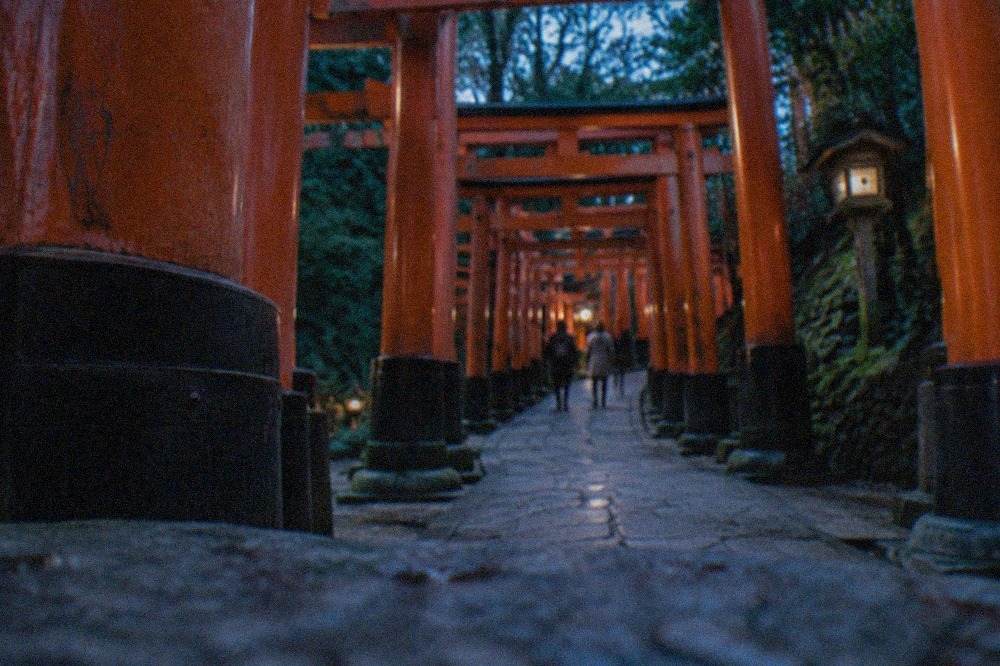
The most photographed place in Kyoto charges nothing to enter. Fushimi Inari Taisha prints no admission fee anywhere on its site, keeps no closing time for its mountain paths, and still drew enough visitors in 2025 to help push Kyoto to a record 62.79 million, the city's own tourism survey reports. The fame rests on three things stacked on one another: a tunnel of vermilion torii that photographs like nowhere else, a shrine tradition the shrine itself dates back 1,300 years, and a mountain hike through them that costs nothing. This page on Kyoto Travel Guide sets out what the shrine's own FAQ and history pages actually say, because almost every guide in print gets at least one of those three wrong.
Why Is Fushimi Inari So Famous?
Fushimi Inari is famous because roughly 10,000 vermilion torii, donated by businesses and individuals over centuries, form tunnels up a 233 m sacred mountain in the middle of Kyoto, entry is free, and the shrine is the head shrine of Inari worship, a tradition the shrine dates to 711. No other site in Japan combines that scale of gate, that age, and that accessibility.
The fame is newer than the shrine. The Senbon Torii, the dense gate tunnels that define every photograph, were built up by donations from businesses thanking Inari for prosperity, and the shrine's FAQ describes about 10,000 torii of all sizes across the whole mountain. That phrase matters. The almost universal error, repeated across travel media, is "10,000 gates in the tunnel". The tunnel holds a fraction of them; the rest are scattered along the full loop of paths, from the main hall to the summit shrines and back. A visitor who walks past the tunnel crowds finds gates thinning out within twenty minutes, then reappearing in singles and pairs all the way up.
The second pillar of the fame is Inari itself. Inari Okami is the deity of rice, harvest and, in modern practice, business prosperity, and Fushimi Inari is the head shrine the others are affiliated with. The shrine's own about page says Inari shrines nationwide are "said to be some thirty thousand", so the honest number is about 30,000, never an exact count. That makes this one shrine the headquarters of one of Japan's largest devotional networks, and it explains the gates: a company that prays for prosperity donates a torii as thanks, and has done for centuries.
The third pillar is simply that the shrine lets everyone in, at any hour, for nothing. The paths have no closing time, a fact the shrine states by publishing only desk and prayer hours and setting none for the mountain. Free, open all night, five minutes from a train station: no other World Heritage-scale site in Kyoto offers that combination. Our full Fushimi Inari shrine attraction page covers the grounds, the halls and the practicalities in depth.
How Old Is Fushimi Inari Taisha?
The shrine dates the enshrinement of Inari Okami on Inariyama to the first Day of the Horse of the second month of 711, carried out by Irogu no Hatanokimi, a Hata clan ancestor, on an imperial order from Empress Genmei. The shrine counted 2011 as the 1300th anniversary, and it hedges its own account with "is said to be".
That hedge is worth keeping. The shrine's history page presents 711 as tradition recorded in ancient texts, not a construction date, so the correct verb is "enshrined in 711", never "built in 711". The story the shrine tells comes from the Yamashirokoku Fudoki: Irogu no Hatanokimi performed a rite with rice cakes, one turned into a swan and flew to Inariyama, rice grew where it landed, and the name Inari follows the rice, ina. The shrine adds that there is reason to believe the faith dates back even further.
The dated chronology on the same page is printable as the shrine prints it:
| Year | Event, in the shrine's own chronology |
|---|---|
| 711 | Inari Okami enshrined on Inariyama by Irogu no Hatanokimi, on imperial order from Empress Genmei |
| 827 | Toji temple timber granted; the shrine granted the junior fifth rank |
| 908 | Repairs by Fujiwara Tokihira |
| 927 | Listed in the Engishiki, the official register of shrines |
| 942 | Granted the highest court rank |
| Around 1000 | Sei Shonagon records climbing the mountain in the Pillow Book |
| 2011 | The 1300th anniversary counted from 711 |
A thousand years of recorded imperial attention, a mention in Japan's most famous court diary, and a founding legend tied to rice: this is a shrine whose fame in Japan long predates any camera. For the wider context of Kyoto's sacred sites, our guide to Kyoto's shrines places Fushimi Inari among the city's other major precincts.
What Do The Torii Gates Actually Mean?
Each torii on the mountain is a donated gift, given by a person or business to Inari in thanks or in hope for prosperity, and the shrine's FAQ counts about 10,000 of them of all sizes across the whole mountain. The vermilion colour is the same bright orange-red used across Inari shrines, associated with the deity and with vitality.
The gates are not architecture the shrine commissioned. They are devotional offerings, which is why so many carry a company name painted in black on the right-hand pillar and a donation date on the left. Walking the tunnel is walking through a ledger of Japanese commerce, from Kyoto sake brewers to national banks, each paying respect to the deity of the harvest that became the deity of the balance sheet. The density of the Senbon Torii section exists because that is where donors' gates cluster closest to the main hall, on the approach to the Yotsutsuji intersection partway up.
The practical reading for a visitor: the famous tunnel is the first ten minutes of a much longer walk. The full circuit of Inariyama, 233 m at its summit, continues through thousands of smaller gates and past thousands of otsuka, worship stones bearing deity names. Those stones are not graves, a point the shrine's own materials make necessary, because the mountain is a Shinto precinct and nobody is buried on it. What the stones mark are dedications to specific Inari manifestations, lined along the paths in ranks that are, in their own way, as striking as the gates.
For visitors pairing the shrine with Kyoto's other headline sights in a single day, a guided bus option covers Fushimi Inari together with Kinkaku-ji and the Arashiyama bamboo grove, which suits a first visit with limited time. Travellers who want the mountain rather than the tunnel should read on, because the two experiences are genuinely different.
Is Fushimi Inari Really Free To Visit?
Yes. Entry to Fushimi Inari Taisha is free, and the shrine prints no fee anywhere on its site. The paths have no closing time; the shrine publishes only desk and prayer hours. That free, always-open access on a train line five minutes from Inari Station is a large part of why the site is famous and why it is crowded at almost every hour.
Free does not mean quiet. The shrine links from its own homepage to the Kyoto Tourism Comfort Forecast, a crowd-prediction tool the city runs on smartphone location data, weather and time of day, and to its own approach cameras, precisely because the gate tunnel is one of the most congested spaces in Japan. The city's 2025 survey counted 62.79 million visitors to Kyoto overall, a record, and dispersal measures for the Fushimi Inari area were among the overtourism steps the city published in 2026.
The honest budget picture for a visit:
| Item | Cost | Note |
|---|---|---|
| Shrine entry and mountain paths | 0 yen | No fee printed anywhere on the shrine's site |
| Senbon Torii tunnel | 0 yen | Part of the free paths |
| Getting there | Train fare only | JR Inari Station is directly opposite the entrance |
| Typical half-day guided walk | From about $73 per person | Paid option, guide-led, covers the quieter upper paths |
For a free-of-charge day built around the shrine and other no-cost sites, our free things to do in Kyoto guide lists what genuinely costs nothing. For photographers, the gate tunnels before 7:00 or after 17:00 are the classic quiet window, and our Kyoto photo spots guide covers where else in the city rewards an early start.
How Long Does The Full Inariyama Mountain Walk Take?
The full circuit of Inariyama, from the main hall up through the Senbon Torii and the summit shrines and back, takes most walkers about two to three hours, on stone steps and dirt paths climbing 233 m. The shrine gives Inariyama's height as 233 m and sets no closing time for the paths, so the walk can be done at night.
Most visitors see only the first section. The tunnel crowds thin sharply after the Yotsutsuji intersection, roughly halfway up, where the view over southern Kyoto opens out and many day-trippers turn back. Above it the paths pass through the ranks of otsuka stones, a string of subsidiary shrines at the summit, and quiet forest slopes where the gates appear one or two at a time. Our full walkthrough of how long it takes to walk up Fushimi Inari covers timings, the stair count by section, and what each stage looks like.
Two honest warnings. The steps are worn and can be slick after rain, and the JMA 1991-2020 normals show July as Kyoto's wettest month at 223.6 mm, not June, so summer walkers should plan for downpours. And the mountain is a living precinct: the otsuka stones bear deity names and are objects of worship, so they are not photo props or seats.
A guided alternative exists for walkers who want the upper mountain with context: the Fushimi Inari Hidden Hiking Tour, from $73 per person and rated 5 from 1,931 reviews, spends its three hours on the quieter paths above the tunnel.
When Is The Best Time To Avoid The Crowds At Fushimi Inari?
Early morning before 8:00, late evening after 18:00, and midweek outside holidays are the quietest windows at Fushimi Inari, because the paths never close and the tunnel is the only congested part. The shrine's own crowd tools, the Kyoto Tourism Comfort Forecast and its approach cameras, show the difference hour by hour.
The structural fact most guides miss: the crowds are not on the mountain, they are in the first 300 metres of it. Because the paths have no closing time, the shrine is one of very few major sights that gets better the later you stay, and a 6:00 start puts a visitor alone in tunnels that by 10:00 hold a queue. Our Kyoto crowds guide covers the same logic for the rest of the city, and the shrine's homepage links the comfort forecast so the check takes a minute.
Weather shapes the visit as much as timing. The JMA normals give Kyoto a July mean daily maximum of 32.0 C and August 33.7 C, and three of the city's six hottest days on record fell in the summers of 2024, 2025 and 2026, so a summer ascent is best done at dawn. Winter is the opposite bargain: January is both the coldest month, mean 4.8 C, and the driest, 53.3 mm, and the gates hold their colour against grey skies with a fraction of the foot traffic. Our Kyoto weather guide carries the full month-by-month normals.
Why Do Foxes Guard Fushimi Inari?
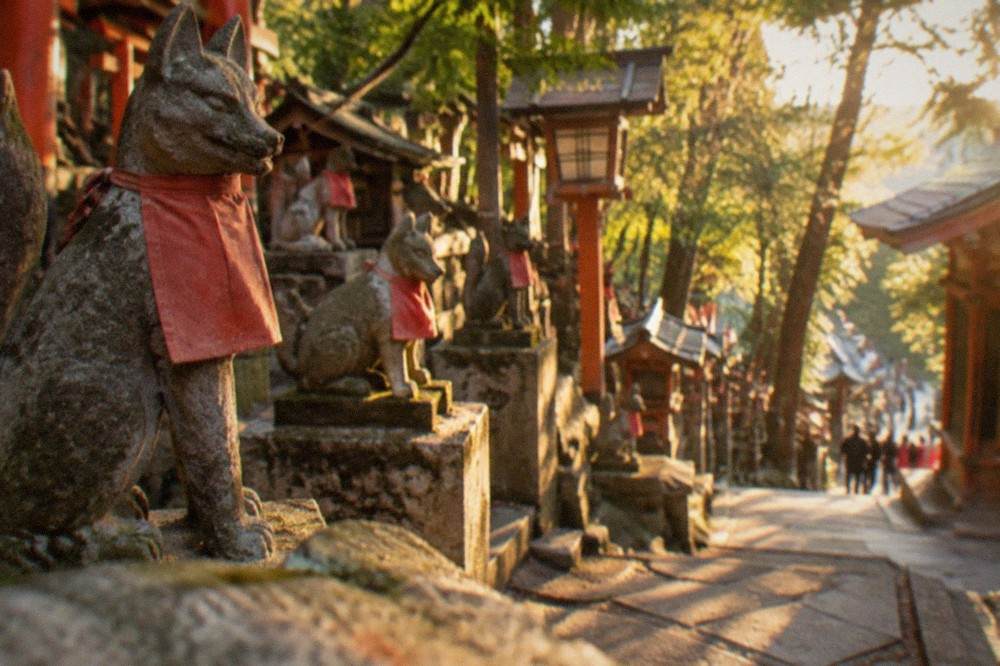
Foxes appear throughout Fushimi Inari as messengers and guardians of Inari Okami, not as the deity itself, and the shrine's grounds hold hundreds of stone and bronze fox statues, many holding keys, rice sheaves or scrolls in their mouths. The white foxes of Inari tradition are the deity's attendants in the shrine's own iconography.
The key, in the mouth of many of the statues, is conventionally read as the key to the rice storehouse, tying the messenger back to the harvest deity the shrine enshrined in 711. Visitors notice the foxes before they notice anything else after the gates: pairs flank the main hall approaches, smaller ones sit in the otsuka ranks up the mountain, and votive tablets painted as foxes hang in rows near the main hall for worshippers to inscribe.
The fox connection is one reason the shrine photographs so well and travels so far through film, advertising and social media. Vermilion gates, stone foxes and a mountain forest at the edge of a modern city is a composition that needs no caption, and the shrine's free, round-the-clock access means content creators can get it at dawn without a permit or a fee. Fame on this scale is a loop: the images draw the crowds, and the crowds confirm the images.
Common Questions About Fushimi Inari
Why Is Fushimi Inari So Famous?
For the combination of about 10,000 vermilion torii climbing a 233 m sacred mountain, free entry with no closing time, and 1,300 years as the head shrine of about 30,000 Inari shrines across Japan. The gate tunnels photograph unlike anywhere else, and the shrine's own chronology, from the 711 enshrinement to Sei Shonagon's climb around the year 1000, gives the place a recorded history most sights cannot match.
Is Fushimi Inari free?
Yes. The shrine prints no admission fee anywhere on its site, and the mountain paths have no closing time. Only the shrine's office desks and prayer reception keep set hours.
How many torii gates are at Fushimi Inari?
The shrine's FAQ says about 10,000 torii of all sizes across the whole mountain. The Senbon Torii tunnel holds only a fraction of them; the rest line the full loop of paths to the summit and back.
Is anyone buried at Fushimi Inari?
No. It is a Shinto shrine, and the stone markers on the slopes are otsuka, worship stones bearing deity names, not graves. Our page on who is buried at Fushimi Inari untangles the confusion in full.
Can you visit Fushimi Inari at night?
Yes, the paths have no closing time, and the shrine is one of the few major Kyoto sights that can be walked after dark. The gates are lit along the lower sections, and crowds after 18:00 are a fraction of the daytime peak.
How long does the walk take?
The full mountain circuit takes most walkers two to three hours. The famous tunnel section alone takes about twenty minutes, and most visitors see only that part.
The deeper answer to the fame is that Fushimi Inari keeps being three things at once: a working head shrine with a 1,300-year devotional network behind it, a free public mountain open at every hour, and the single most recognisable photograph in Japan. The gates made it famous, the price of admission made it universal, and the mountain keeps it honest, because anyone who climbs past the tunnel finds the shrine as it has always been, quiet, wooded and lined with the gifts of the grateful.