How Much Is The Kyoto Accommodation Tax Per Person Per Night By Room Rate?
Kyoto charges every overnight visitor an accommodation tax on top of the room rate, and the tiers were rewritten on 1 March 2026. A 20,000 yen room now carries 1,000 yen per person per night, not 500, and a luxury room can carry 10,000 yen. Most guides still print the old tiers.
Short answer
The Kyoto accommodation tax is charged per person per night on the room-only rate. From 1 March 2026 the five tiers are 200 yen under 6,000, 400 yen from 6,000 to under 20,000, 1,000 yen from 20,000 to under 50,000, 4,000 yen from 50,000 to under 100,000, and 10,000 yen at 100,000 yen and above.
Kyoto charges an accommodation tax to everyone who stays the night in the city, and on 1 March 2026 the city rewrote the top three tiers. A room billed at 20,000 yen now carries 1,000 yen per person per night instead of 500, a room at 50,000 yen carries 4,000 yen instead of 1,000, and a room at 100,000 yen or more carries 10,000 yen, ten times the old top rate. The city's own announcement, published on the Kyoto City site and echoed by the tourism association, projects about 12.6 billion yen a year from the revised levy. The two bottom tiers did not move.
The practical point for a visitor is simple: the tax is charged per person, per night, on the room-only charge, and it is collected by the property at check-in or check-out, not by the city directly. Two people sharing a 25,000 yen room pay 2,000 yen a night in tax between them, not 1,000. A family of four in a mid-range hotel can add several thousand yen to a week-long stay without ever seeing it itemised until the bill arrives. This page sets out the current tiers, how the base is calculated, who pays, and how the change interacts with what Kyoto costs generally, using the city's own ordinance figures throughout. The team behind Kyoto Travel Guide keeps this page on the post-March 2026 schedule because most competing guides still print the old table.
How Much Is The Kyoto Accommodation Tax Per Person Per Night By Room Rate?
The Kyoto accommodation tax is charged per person per night on the room-only rate, in five tiers: 200 yen for a room under 6,000 yen, 400 yen from 6,000 to under 20,000 yen, 1,000 yen from 20,000 to under 50,000 yen, 4,000 yen from 50,000 to under 100,000 yen, and 10,000 yen for a room of 100,000 yen or more. The middle and top tiers rose on 1 March 2026, from 500 and 1,000 yen respectively.
The tiers above are the city's current ordinance figures, confirmed on the Kyoto City site and on the tourism association's own notice. The tax applies to every overnight stay in the city, hotel, ryokan, guesthouse or machiya rental alike, and it is levied on the accommodation charge only, excluding meals and excluding consumption tax. That exclusion matters more than it sounds: a 22,000 yen package that includes dinner and breakfast is not necessarily in the 1,000 yen tier, because the taxable base may be only the room component of that package.
Two worked examples show the arithmetic. A couple sharing a 15,000 yen room at a business hotel pays 400 yen each, 800 yen a night, 5,600 yen across a week. The same couple in a 60,000 yen ryokan room with kaiseki dinner pays 4,000 yen each, 8,000 yen a night, which is more than many travellers budget for a full day of temple admissions. The tax is regressive in one direction only: it is flat per person within each tier, so a 19,999 yen room and a 6,000 yen room both carry 400 yen, while one yen more jumps the bill to 1,000 yen per person.
| Room rate per night (room only) | Tax per person per night | Tier before 1 March 2026 |
|---|---|---|
| Under 6,000 yen | 200 yen | 200 yen, unchanged |
| 6,000 to under 20,000 yen | 400 yen | 400 yen, unchanged |
| 20,000 to under 50,000 yen | 1,000 yen | 500 yen |
| 50,000 to under 100,000 yen | 4,000 yen | 1,000 yen |
| 100,000 yen and above | 10,000 yen | 1,000 yen |
What Changed On 1 March 2026?
The 1 March 2026 revision tripled the middle tier from 500 to 1,000 yen and raised the top tier from 1,000 yen to a four-tier ladder ending at 10,000 yen, while leaving the two bottom tiers untouched. The city expects roughly 12.6 billion yen a year from the revised tax, and the change was made with the consent of the Minister of Internal Affairs.
The revision was announced by Kyoto City in late 2025 and took effect for stays from 1 March 2026. The city's stated purpose is overtourism management: the revenue funds crowd dispersal, transport measures and preservation, and the city frames the steep top tiers as a way to collect from high-spending visitors rather than spread the cost across budget travellers. The bottom two tiers, which cover most guesthouse and business hotel rooms in the city, were deliberately left alone.
The context is the visitor volume the city is managing. The city's own 2025 tourism survey, released in June 2026, recorded a record 62.79 million visitors in the calendar year, of whom 12.68 million were foreign, and overnight guests numbered 16.59 million. Every one of those overnight stays generated accommodation tax under the tiers in force that night. The 2025 spending figure, 2.0474 trillion yen, is the pool the city is taxing into, and the survey reports satisfaction above 90 percent for both Japanese and foreign visitors, which the city reads as room to levy more at the top end.
The change is also why so much online advice is now wrong. A guide written in 2024 or 2025 that quotes 500 yen for a 20,000 yen room, or 1,000 yen as the maximum, is describing a schedule that expired. The same staleness affects other Kyoto prices: Ginkaku-ji doubled its admission to 1,000 yen in April 2026, and Tofuku-ji revises its fees on 1 November 2026. Checking the date on any Kyoto price list has become a survival skill, and the same discipline applies to accommodation advice, which is why our where to stay in Kyoto guide works from current figures rather than inherited ones.
| Stay profile | Room rate per night | Tax per person per night | Tax for two people, 3 nights |
|---|---|---|---|
| Guesthouse dorm-adjacent private room | 5,500 yen | 200 yen | 1,200 yen |
| Business hotel double | 14,000 yen | 400 yen | 2,400 yen |
| Mid-range hotel, central | 28,000 yen | 1,000 yen | 6,000 yen |
| Upscale ryokan with dinner | 65,000 yen | 4,000 yen | 24,000 yen |
| Luxury suite | 120,000 yen | 10,000 yen | 60,000 yen |
A first night in Gion is one of the cheapest ways to spend an evening in Kyoto, and it pairs well with any room rate. The Gion magical night walking tour runs about an hour and forty minutes and covers the geisha district's lanes and shrines with a guide who can separate the real training houses from the film-set mythology.
How Is The Kyoto Accommodation Tax Calculated?
The taxable base is the room-only charge for one night, excluding meal charges and excluding consumption tax, and the tax is then applied per person staying in that room. A 27,500 yen room with breakfast and a 10 percent service charge is taxed on its accommodation component only, which the property itemises on the final bill.
The exclusion of meals is the part that catches ryokan guests out. A night in a traditional inn is usually sold as a package with dinner and breakfast, sometimes at 40,000 yen or more per person, and the tax is not charged on that headline figure. The property separates the accommodation charge from the meal charges, applies the tier to the accommodation line, and collects the result. A package priced per person rather than per room still splits the same way.
The per-person rule is the other half of the arithmetic. Four family members in one 18,000 yen hotel room pay 400 yen each, 1,600 yen a night, because the ordinance taxes the guest, not the room. Solo travellers in the same room pay a quarter of that. This is why the tax hits families and groups proportionally harder than the room rate alone suggests, and why a "tax included" rate quoted by an online booking site may still settle differently at the desk when the front desk counts heads.
For stays that cross the tier boundary, each night is assessed on that night's own rate. A three-night booking at 19,000, 19,000 and 21,000 yen pays 400, 400 and 1,000 yen per person, not a blended figure. Properties handle this automatically on the folio, but it is worth reading the itemised bill rather than the prepaid amount, especially where a rate change mid-stay, a weekend uplift or a seasonal surcharge, moves a night across a threshold.
| Bill component | Included in taxable base? |
|---|---|
| Room charge for the night | Yes |
| Kaiseki dinner and breakfast at a ryokan | No |
| Consumption tax | No |
| Service charge applied to the room | Yes, as part of the accommodation charge |
| Extra bed for a child | Yes, and the child is a taxable person |
| Cleaning or facility fees itemised as accommodation | Yes |
Who Pays The Kyoto Accommodation Tax?
Every person staying overnight in accommodation inside Kyoto City pays it, Japanese and foreign visitors alike, with no exemption for nationality, length of stay or booking channel. Children are charged as persons, and the tax is collected by the property on the city's behalf, usually at check-out or on the final folio.
There is no visitor exemption and no resident exemption for people staying in paid accommodation. The tax is not a foreigner surcharge, and it should not be confused with residency-based pricing proposals that have been discussed for Kyoto buses but remain unconfirmed as active policy. The accommodation tax is settled law with a published tier table, and it applies uniformly.
The collection mechanism is the property. Hotels, ryokan, guesthouses, machiya rentals and any licensed overnight lodging add the tax to the guest's bill and remit it to the city. Practically, that means the charge appears on the folio at check-out, sometimes as a separate line, sometimes folded into a "taxes and fees" total. Guests who prepaid the room through a booking site should expect the accommodation tax to be collected separately at the desk, since it is a city levy on the stay rather than part of the room rate the site sold.
One boundary worth knowing: the tax follows the city limits, not the tourist area. A stay in Otsu on Lake Biwa, or in Kameoka west of the mountains, is outside Kyoto City and outside this tax, though those towns sit within Kyoto Prefecture and may levy their own. The city's 62.79 million visitor figure covers Kyoto City specifically, and so does the ordinance. Anyone splitting a trip between the city and its surroundings will see the tax appear and disappear on the bills accordingly, which is one reason our Kyoto itinerary suggestions sometimes push an overflow night toward Lake Biwa.
How Does The Kyoto Accommodation Tax Compare With Other Kyoto Costs?
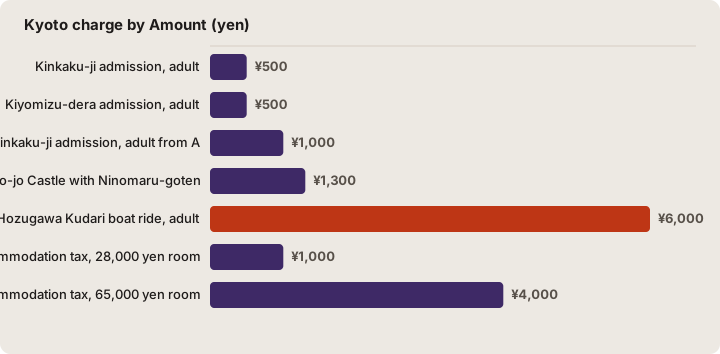
At the bottom tiers the tax is smaller than a single temple admission, but from the third tier up it exceeds almost every entrance fee in the city: 1,000 yen per person per night matches Ginkaku-ji's new doubled admission, and 4,000 yen exceeds any single Kyoto entrance fee on the verified list.
Putting the tax beside the city's other charges shows how steep the top of the ladder has become. Kinkaku-ji charges 500 yen for adults, unchanged since April 2023 per the temple's own notice. Ginkaku-ji doubled to 1,000 yen in April 2026, its first rise in 32 years. Nijo-jo Castle charges 800 yen, or 1,300 yen with the Ninomaru-goten Palace. Even the most expensive verified single admission, none of them, reaches the 4,000 yen tier of the accommodation tax, and only a 100,000 yen room's 10,000 yen charge exceeds what a visitor would spend on a full day of paid entries.
| Kyoto charge | Amount | Source |
|---|---|---|
| Kinkaku-ji admission, adult | 500 yen | the temple's own access page |
| Kiyomizu-dera admission, adult | 500 yen, single source | not printed by the temple |
| Ginkaku-ji admission, adult from April 2026 | 1,000 yen | the temple's revision notice |
| Nijo-jo Castle with Ninomaru-goten | 1,300 yen | the castle's fee page |
| Hozugawa Kudari boat ride, adult | 6,000 yen | the operator's ticket page |
| Accommodation tax, 28,000 yen room | 1,000 yen per person per night | the city ordinance |
| Accommodation tax, 65,000 yen room | 4,000 yen per person per night | the city ordinance |
The comparison cuts both ways. A budget traveller in a 5,500 yen guesthouse room pays 200 yen a night, less than one temple entry across a whole week. A traveller in the upper tiers is paying, nightly, what the city hopes will fund the crowd measures that make those very districts walkable: the tourist express buses, the dispersal campaigns and the etiquette patrols that the 2025 and 2026 city measures describe. Whether that framing satisfies the guest is another matter, but the revenue purpose is documented.
The tax also lands on top of room rates that have their own dynamics. Kyoto's hotel supply has been growing, and the city's 2025 survey shows foreign overnight guests at 8.09 million against 8.49 million Japanese, a near-even split that keeps pressure on central properties in peak weeks. Our best hotels in Kyoto guide tracks what a night actually costs by area and season, which is the number the tax tier hangs off.
How Does The Tax Affect A Budget Trip To Kyoto?
A budget traveller in a room under 6,000 yen pays 200 yen a night, 1,400 yen across a week, which is less than three temple admissions and roughly the cost of one bus-and-subway day pass. The revision deliberately left the two bottom tiers alone, so the cheapest stays are barely affected.
The design of the March 2026 change protects the bottom of the market. A dorm-adjacent guesthouse room, a business hotel on a weekday, or a shared machiya rental all sit in the 200 or 400 yen tiers, and the arithmetic of a budget week barely moves. The city's own framing, that high-spending visitors should carry the overtourism cost, is visible in the tier structure: the increases begin at the 20,000 yen boundary, exactly where leisure travel shifts from necessity to choice.
For a mid-range traveller the change is real but absorbable. A 28,000 yen room went from 500 to 1,000 yen per person per night, an extra 500 yen, which over four nights for two people is 4,000 yen, roughly one good dinner or a day of admissions. The pain concentrates at the top. A 65,000 yen ryokan night went from 1,000 to 4,000 yen per person, so a two-person, two-night stay now carries 16,000 yen in accommodation tax alone, more than the cost of most full-day guided tours in the city.
Budget visitors can also lean on what the city genuinely does not charge for. Fushimi Inari Taisha publishes no admission fee anywhere on its site, the Kyoto Imperial Palace states it is open to all with no advance application, and the Arashiyama bamboo path, Nishiki Market and the walkable districts of Gion, Pontocho and the Philosopher's Path cost nothing to enter. Our free things to do in Kyoto guide is built on that list, and the tax arithmetic makes it more relevant, not less. A traveller who sleeps cheap and walks the free spine of the city can keep a Kyoto week's fixed costs remarkably low even after the revision.
Can You Avoid Or Reduce The Kyoto Accommodation Tax?
You cannot legally avoid it inside Kyoto City, but you can control the tier: sleeping outside the city limits in Otsu or Kameoka removes the tax entirely, and choosing a room just under a tier boundary, or a room-only rate without meals, keeps the taxable base in a lower band. Splitting a long stay between the city and its surroundings is the one structural saving.
The honest version of this question is tier management, not evasion. The tax is a legal obligation of the stay, collected by the property, and there is no booking channel, passport or loyalty status that waives it. What a planner can do is shape where the taxable nights fall. A trip that spends three nights in Kyoto City and two in Otsu, on Lake Biwa, pays the city tax on three nights only, and the Lake Biwa guide covers what that trade costs in commuting time.
Inside the city, the boundary effect is worth knowing. A 19,800 yen room and a 20,000 yen room differ by 200 yen in rate but 600 yen per person per night in tax, so a party of three saves 1,800 yen a night by staying under the line. The same logic applies at 50,000 and 100,000 yen. This is not a reason to book a worse room, but it is a reason to read the folio when a property quotes a rate that sits near a boundary, and to remember that the taxable figure excludes meals, which can pull a package stay down a tier.
Timing is the other lever, and it works through the room rate rather than the ordinance. Kyoto's room rates swing hard by season, and the tax follows the nightly rate, so the same hotel can sit in the 400 yen tier on a February weekday and the 1,000 yen tier during the cherry blossom or foliage peaks. The JMA phenology record gives the planning anchors: the 1991-2020 normal for cherry full bloom in Kyoto is 4 April, and the normal for maple red leaves is 5 December, later than most guides claim. Our best time to visit Kyoto and Kyoto crowds guides work through the shoulder seasons where both rates and crowd comfort improve.
| Strategy | Effect on the tax | Trade-off |
|---|---|---|
| Sleep outside the city (Otsu, Kameoka) | Removes it entirely | Commute time and transport cost |
| Book just under a tier boundary | Drops one tier | Slightly smaller or plainer room |
| Room-only rate, no meals | Lower taxable base | Meals paid separately |
| Travel in shoulder season | Lower nightly rate, often lower tier | Weather and bloom timing |
| Fewer nights, day trips from one base | Fewer taxable nights | Longer daily travel |
How Should You Budget For The Tax On A Kyoto Trip?
Budget the tax as a per-person, per-night line item using the tier that matches your room rate: 200 or 400 yen for guesthouse and business hotel stays, 1,000 yen for mid-range, 4,000 yen for upscale, 10,000 yen for luxury, and add it to your nightly room figure before comparing neighbourhoods or booking channels.
The clean way to do it is to fold the tax into the effective room rate at the planning stage. A 26,000 yen quoted rate is really 27,000 yen per person per night for a solo guest once the tax lands, and for a couple sharing it is 28,000 yen all-in. Comparing a 26,000 yen room in Higashiyama against a 22,000 yen room near the station is not a 4,000 yen decision, it is a 6,000 yen decision, because both rooms cross into the same tier and both guests pay it.
For trip-cost purposes, the tax is rarely the deciding figure, but it is the figure most often forgotten. Our Kyoto trip cost guide builds the full per-day budget, and the accommodation tax belongs in the accommodation row, not in a surprise at check-out. Two people, five nights, a 24,000 yen room: 10,000 yen in city tax across the stay, enough for a full extra activity day if it had been planned rather than discovered on the folio.
The final practical note is documentation. Ask for the itemised bill. Properties must show the accommodation charge separate from meals and from the tax itself, and that breakdown is the only way to confirm the correct tier was applied, particularly for ryokan packages where the room-only component is not obvious from the headline price. If the folio shows the tax charged on the full package including dinner, that is worth querying at the desk, politely, with the city's own tier table as the reference.
Between the front desk and the folio, the days themselves are what the tax ultimately funds and what the stay is for. The Nishiki Market brunch walking tour covers the market's seven tastings in about three hours, and the perfect one-day bus tour strings the headline temples together in eight to nine hours for travellers who want the survey version of the city before settling into a neighbourhood.
Common Questions About The Kyoto Accommodation Tax
How Much Is The Kyoto Accommodation Tax Per Person Per Night By Room Rate?
Per person per night: 200 yen for a room under 6,000 yen, 400 yen from 6,000 to under 20,000 yen, 1,000 yen from 20,000 to under 50,000 yen, 4,000 yen from 50,000 to under 100,000 yen, and 10,000 yen at 100,000 yen and above. These are the tiers in force from 1 March 2026.
Do Children Pay The Kyoto Accommodation Tax?
Yes. The tax is charged per person staying the night, and the city's ordinance does not exempt children. A family of four in a 15,000 yen room pays 400 yen each, 1,600 yen a night in total.
Is The Kyoto Accommodation Tax Charged On Meals At A Ryokan?
No. The taxable base is the room-only charge, excluding meal charges and consumption tax. A ryokan package with kaiseki dinner and breakfast is taxed on its accommodation component, which the property itemises on the bill.
When Did The Kyoto Accommodation Tax Change?
1 March 2026. The third tier rose from 500 to 1,000 yen, the fourth from 1,000 to 4,000 yen, and the top tier from 1,000 to 10,000 yen. The two bottom tiers were unchanged.
Can You Avoid The Kyoto Accommodation Tax By Staying Outside The City?
Yes, structurally. The tax applies to stays inside Kyoto City, so nights in Otsu on Lake Biwa or in Kameoka are outside its scope, though other municipalities may levy their own. Inside the city the tax is a legal part of the stay.
Does The Kyoto Accommodation Tax Apply To Foreign Visitors Only?
No. Every overnight guest in paid accommodation inside Kyoto City pays it, Japanese and foreign alike. It is a city levy on the stay, collected by the property, not a nationality-based charge.
The tier table is the whole system in one glance, and it is the thing to carry to the booking screen: find the room-only rate, find the band it falls in, multiply by people and nights. Everything else, the meal exclusions, the boundary effects, the city-limit geography, is detail on top of that arithmetic, and the post-March 2026 schedule is the only one worth planning against.