Hozugawa River Boat Ride: Times, Fares And How To Do It
The Hozugawa Kudari runs a flat-bottomed wooden boat down the Hozu gorge from Kameoka to Arashiyama, a journey of about two hours that ends a short walk from the bamboo grove. The operator's own ticket page sets the adult fare at 6,000 yen, a figure most older guides still quote wrong.
Short answer
The Hozugawa Kudari boat ride from Kameoka to Arashiyama takes about two hours and costs 6,000 yen for adults and 4,500 yen for children, on 24-seat shared boats. The regular timetable runs from 10 March to 13 December 2026.
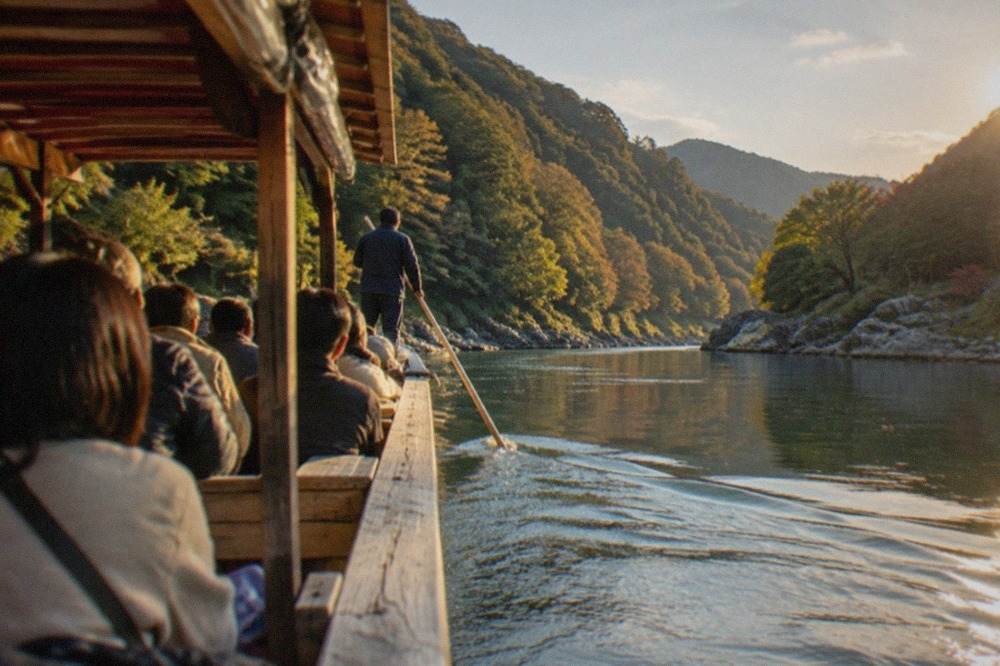
The Hozugawa Kudari is one of the few Kyoto experiences where the journey genuinely is the destination. A flat-bottomed wooden boat, poled and rowed by a crew of three or four, works its way down the Hozu gorge from Kameoka to Arashiyama, past rock walls, rapids and a landscape that has not changed much since the route was engineered in the early seventeenth century to float lumber and rice down to the city. The ride ends at a dock a few minutes' walk from Togetsukyo bridge, which makes it one of the most practical ways to arrive in Arashiyama rather than fight the crowds arriving by train.
The operator's own ticket page is the only reliable source for what this costs and when it runs, and it contradicts a lot of what is still published. The widely repeated fare of about 4,100 yen is stale. The current price is 6,000 yen for an adult and 4,500 yen for a child, and the ride takes about two hours. This guide from Kyoto Travel Guide lays out the current numbers, the season, the practical route and how the boat stacks up against the Sagano Romantic Train, which runs down the same valley on rails.
How Long Is The Hozugawa Boat Ride From Kameoka To Arashiyama?
The Hozugawa Kudari boat ride from Kameoka to Arashiyama takes about two hours on the water, covering roughly 16 kilometres of the Hozu gorge. Scheduled shared boats carry 24 passengers each, and the operator's timetable runs the regular season from 10 March to 13 December 2026, with a reduced winter timetable outside those dates.
Two hours is the number the operator itself prints, and it is honest about why it is an approximation: the time depends on the river level. After heavy rain the current runs faster and the boats move quickly; in the dry stretches of late summer the crew poles through shallows and the trip stretches out. The ride is downstream the whole way, from the departure dock at Torokko Kameoka down to the landing at Arashiyama just upstream of Togetsukyo bridge.
The distance is short on a map but slow by water because the Hozu bends constantly through the gorge. There are a handful of rapids, each brief, with flat water between them where the boatmen point out rock formations with names most visitors will not retain. Boats pass each other regularly, and the crews of competing boats trade banter across the water, which is part of the show.
Because the ride ends in Arashiyama and starts in Kameoka, the practical time budget is closer to half a day. You need to get to Kameoka first, which means a 25-minute ride on the Sagano Romantic Train or a local JR line from Kyoto Station, and once you land in Arashiyama you will want hours more for the bamboo grove and Tenryu-ji. Most people fold the boat into a full Arashiyama day, and that is the right instinct. For a sense of how the whole district fits together, see what is so special about Arashiyama.
How Much Does The Hozugawa Kudari Cost?
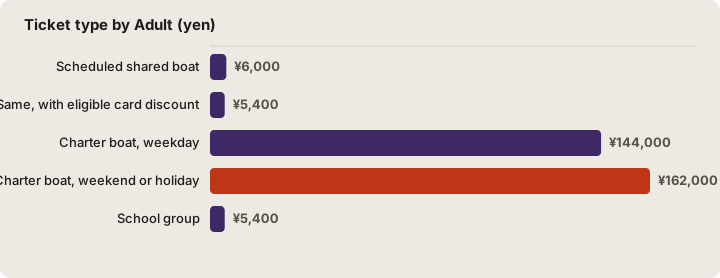
An adult ticket costs 6,000 yen and a child ticket, valid from infant age through elementary school, costs 4,500 yen on the operator's current published fare table. Scheduled shared boats seat 24 passengers, and a private charter runs 144,000 yen on weekdays or 162,000 yen on weekends and holidays. School groups pay reduced rates of 5,400 or 5,000 yen.
Those are the operator's own numbers, read directly from its ticket page, and they matter because almost every guide still circulating quotes the old fare. The figure of about 4,100 yen that appears across older travel content predates a revision; the operator's page now prints 6,000 yen, and some card holders get a 10 percent discount that brings it to 5,400 yen for adults and 4,050 yen for children. Check the operator's site for which cards qualify before assuming you will get it.
For a family with two elementary-age children, the boat alone costs more than most temple admissions in the city combined, because every member pays the full fare. That is not an argument against it, but it is an argument for knowing the number in advance rather than discovering it at the dock. Here is how the fare structure sits:
| Ticket type | Adult | Child | Notes |
|---|---|---|---|
| Scheduled shared boat | 6,000 yen | 4,500 yen | 24 seats per boat |
| Same, with eligible card discount | 5,400 yen | 4,050 yen | About 10 percent off, select cards |
| Charter boat, weekday | 144,000 yen | Whole boat, up to 24 seats | |
| Charter boat, weekend or holiday | 162,000 yen | Whole boat, up to 24 seats | |
| School group | 5,400 yen | 5,000 yen | Under 35 and 35-plus per person |
The charter price looks startling until you do the arithmetic: a full 24-seat weekend charter costs only a little more per person than the walk-on fare, and groups that can guarantee a full boat sometimes come out close to even, with the boat and crew to themselves. Couples and solo travellers should stick to the scheduled departures.
If you are building a full Arashiyama day, the boat is usually the single largest line item. The bamboo path itself is free, Iwatayama Monkey Park charges 800 yen for visitors 16 and over and 400 for ages 4 to 15, and Tenryu-ji tickets its garden, buildings and Hatto ceiling separately at 500 yen for the garden plus 300 for the buildings plus 500 for the ceiling. A realistic per-person budget for the district depends almost entirely on whether the boat is in it. Our broader things to do in Kyoto rundown covers how that compares with the rest of the city.
What Is The Ride Actually Like?
The Hozugawa Kudari is a two-hour downstream run through a forested gorge in an open wooden boat, with brief rapids, flat stretches and commentary in Japanese from a crew of three or four boatmen. You will get splashed at the rapids, the operator hands out rain gear, and there is no roof or heating, so the boat runs in whatever weather the day brings.
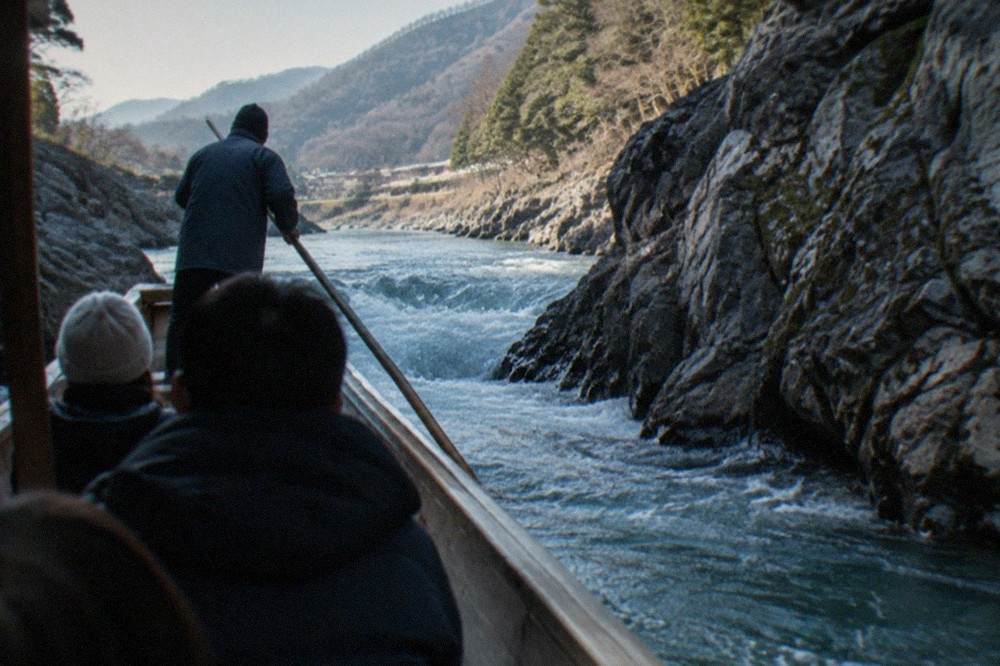
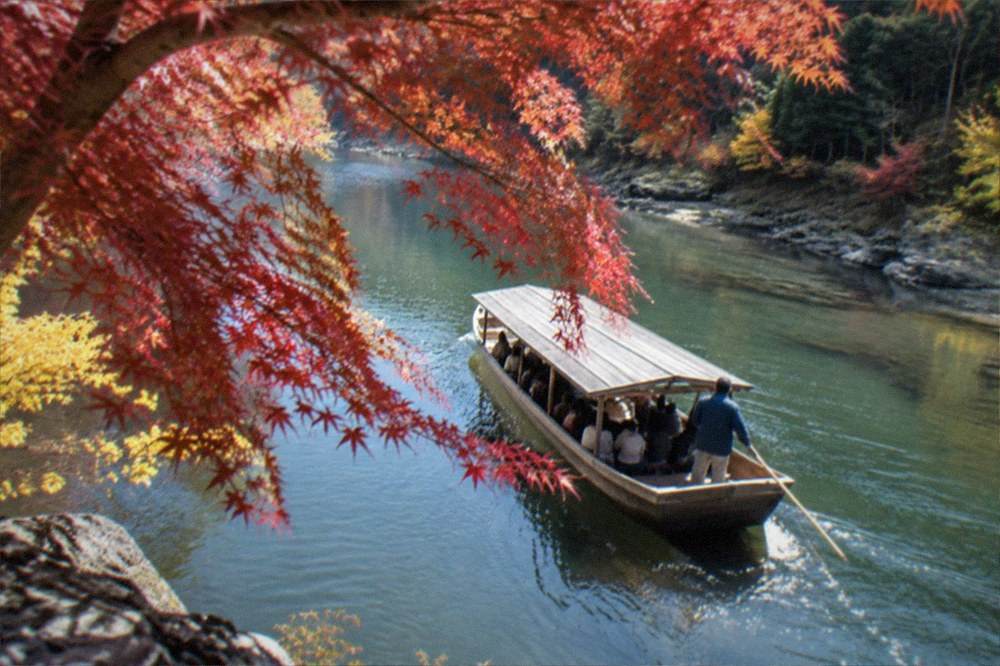
The boats are long, shallow-draught wooden craft with bench seating, and the crew stands at bow, stern and midships with poles and oars. The rapids are the punctuation, not the substance: each lasts a few seconds, the hull shudders, water comes over the gunwale at the front rows, and then the river flattens out again. Between them the gorge does the work, with rock faces, tunnels of overhanging maple and cedar, and herons standing in the shallows.
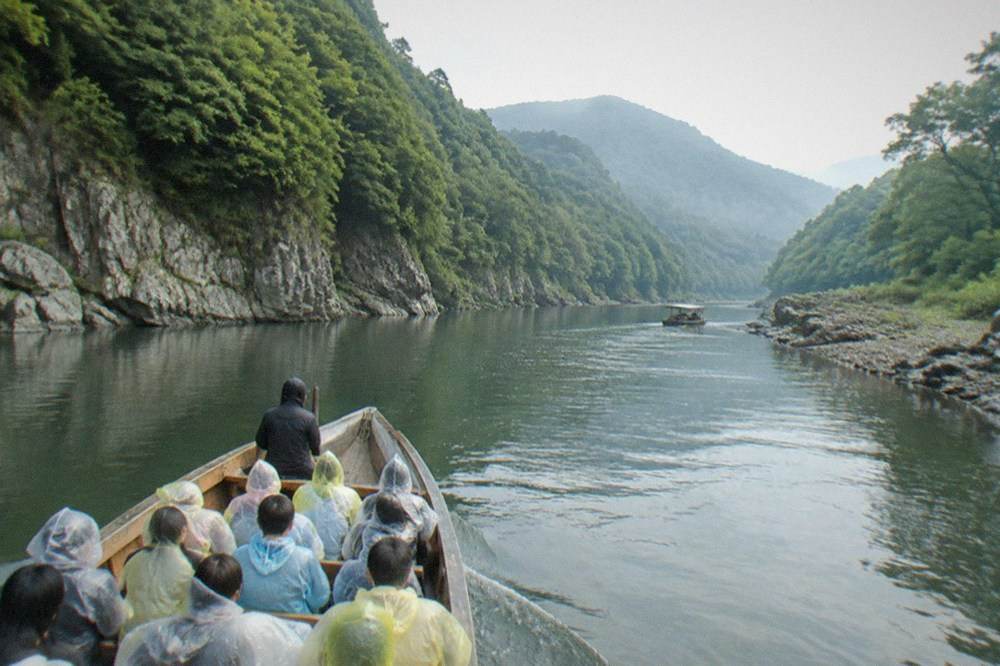
Two practical notes that first-time visitors underprepare for. First, the front rows take the splash; if you are carrying a camera, keep it in a sealed bag until the flat water. Second, the ride is unshaded in summer and cold in winter, because the gorge funnels wind along the water. The JMA 1991-2020 normals for Kyoto station put August's mean daily maximum at 33.7 C and January's mean daily minimum at 1.5 C, and both ends of that range feel stronger on an open boat. Dress for the water, not the street.
The ride is also, quietly, a piece of engineering history. The channel was opened in the early seventeenth century under the direction of the merchant Suminokura Ryoi, who cut through rapids and rebuilt the riverbed to float timber and rice from the Tanba region down to Kyoto. The boats carried freight for centuries before they carried tourists, and the modern passenger operation keeps the hull shape and the poling technique of the freight era. The gorge you float through is the reason Arashiyama became a retreat for court nobles in the first place, which is the thread running through our Arashiyama area guide.
How Do You Get To Kameoka And Back From Arashiyama?
The standard route is a 25-minute ride on the Sagano Romantic Train from Arashiyama's Torokko Arashiyama station to Torokko Kameoka, then the boat back down the river to Arashiyama, so the whole loop needs no backtracking. Coming from Kyoto Station, the JR Sagano Line reaches Kameoka in about 30 minutes, and the boat dock is a short walk or shuttle from there.
The classic combination, and the one most visitors should build, is train up and boat down. The Sagano Romantic Train is a sightseeing railway that runs on the opposite side of the valley from the river, through the same gorge by a different angle, and its one-way fare is 880 yen for adults, defined as 12 and over, and 440 yen for children aged 6 to 12, with toddlers free when accompanied. You board at Torokko Arashiyama or Saga-Arashiyama, ride the valley to Torokko Kameoka, and the boat dock is close to the station at the Kameoka end.
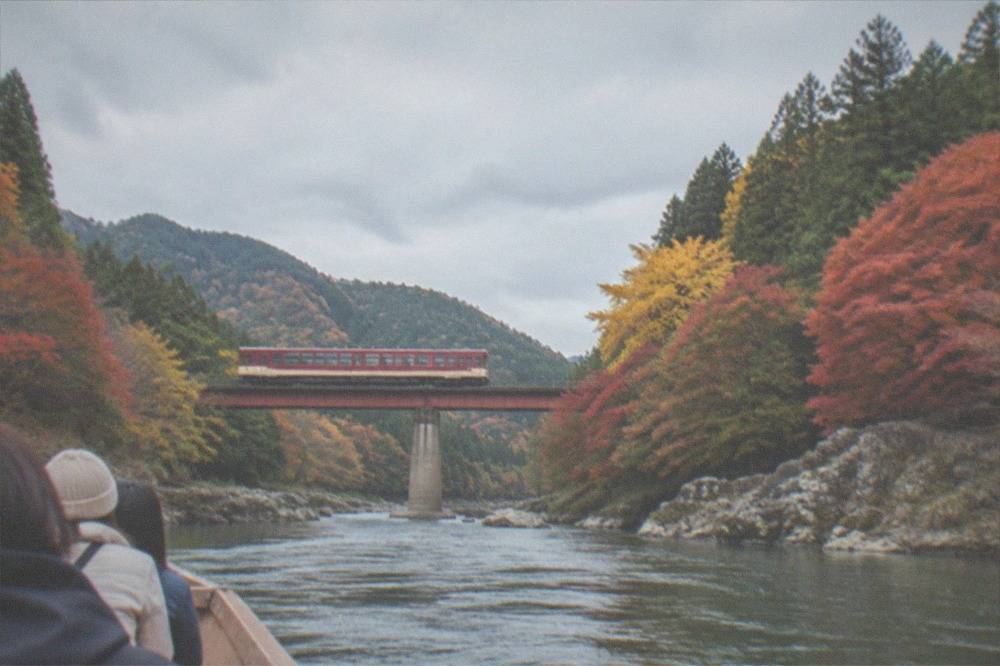
Doing it in the other order, boat first, means starting your day in Kameoka, which is reachable by JR local from Kyoto Station in about half an hour. That version suits early starters, because the first boats leave mid-morning and the last departures are early afternoon, and arriving in Arashiyama by water at midday puts you into the district at its most crowded. The train-up, boat-down order reverses that: you see the gorge in the relative calm of the morning and land in Arashiyama with the afternoon ahead.
One thing the train and the boat do not share is a ticket. They are separate operators with separate fare tables, and the Sagano train's season and closed days do not track the boat's exactly. The train's operating pattern, including which Wednesdays it closes outside peak periods, is published on the operator's timetable, so check it rather than assuming a running day. Our Sagano Romantic Train guide and the bamboo grove walkthrough cover the train side in detail.
| Route option | Rough time | Fare | Direction |
|---|---|---|---|
| JR Sagano Line, Kyoto Station to Kameoka | About 30 min | Local JR fare | To the boat's start |
| Sagano Romantic Train, Torokko Arashiyama to Torokko Kameoka | About 25 min | 880 yen adult, 440 child | Up the valley |
| Hozugawa Kudari boat, Kameoka to Arashiyama | About 2 hours | 6,000 yen adult, 4,500 child | Down the river |
| Walk from boat dock to Togetsukyo bridge | 5 to 10 min | Free | Into Arashiyama |
When Does The Hozugawa Kudari Run?
The regular timetable runs from 10 March to 13 December 2026, with a reduced winter timetable from 8 December to 9 March and no service from 29 December to 4 January. Boats run several departures a day, the first around mid-morning and the last in the early afternoon, and the operator was running normally as of mid-September 2026.
The season is set by the river, not by tourist demand. Winter brings the reduced timetable because the water is cold, the days are short, and the gorge loses sun early; the late-December to early-January closure is the only hard gap. Outside those weeks, the boat runs in rain, and rain is arguably when it is at its best, because the river rises and the rapids sharpen. The operator posts same-day status and waiting times on its site, which is worth checking in typhoon season, when high water can suspend service.
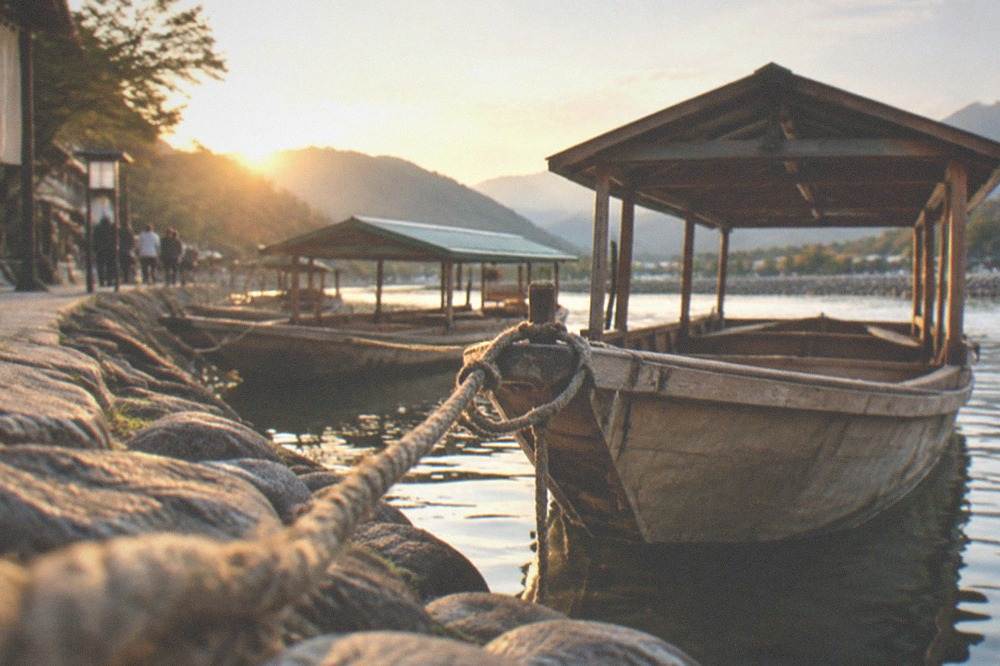
Peak demand is not subtle. Cherry season, Golden Week in early May, the summer holidays and above all the maple season in late November fill the boats weeks ahead, and the JMA phenology record explains why November is the crunch: the official red-leaf marker at the Kyoto observatory has a 1991-2020 normal of 5 December, and the Arashiyama foliage typically peaks in the second half of November, so the whole valley is at maximum crowd exactly when the boat is at maximum beauty. Book ahead for that window, and read our Kyoto autumn leaves guide for the timing logic.
One piece of history that honest coverage should not skip: a fatal capsizing occurred on this river in March 2023, and service was suspended and later resumed. The operator's own site does not publish the resume date, so this guide does not state one. What can be said is current status: the operator was running a normal timetable with same-day ticketing and live waiting-time notices as of mid-September 2026.
Hozugawa Boat Or Sagano Romantic Train: Which One?
For most first-time visitors the answer is both, in the order train up and boat down, because they see different sides of the same valley for a combined fare of 6,880 yen for an adult. If you must choose one, the boat is the longer, more physical experience at two hours and 6,000 yen, while the train is a 25-minute, 880-yen ride that is easier with small children or limited mobility.
The two are not really competitors. The train runs the valley's eastern shoulder, mostly above and beside the river, with the best views on the river side of the carriage; the boat runs the river itself, through the middle of what the train looks down on. The train is comfortable, covered and quick. The boat is open, slow, wet at the rapids and several times the price. Families with children under about five generally manage the train better than two hours on an open hull, though infants do ride the boats, and the child fare applies from infancy.
| Hozugawa Kudari boat | Sagano Romantic Train | |
|---|---|---|
| Duration | About 2 hours | About 25 minutes |
| Adult fare | 6,000 yen | 880 yen (12 and over) |
| Child fare | 4,500 yen (infant to elementary) | 440 yen (ages 6 to 12), toddlers free |
| Cover | Open boat, rain gear provided | Covered carriages |
| Best for | The gorge itself, rapids, a half-day experience | Speed, comfort, small children |
| Season | 10 March to 13 December regular | Roughly March to December, most Wednesdays closed outside peaks |
The train's closed-day pattern is a real constraint on the combined loop: because the train closes most Wednesdays outside peak periods, a Wednesday visit can leave you doing the boat with a JR local connection instead. That still works, since the JR Sagano Line serves Kameoka directly, but the sightseeing train is the nicer ride up. Check the operator's timetable for the date you plan, and if the pairing appeals, the three days in Kyoto itinerary slots the whole Arashiyama loop into a workable first day.
How Should You Plan The Day Around The Boat?
The strongest structure is an early start in Arashiyama, the bamboo grove and Tenryu-ji before the crowds thicken, the Sagano train up the valley late morning, the boat back down after lunch, and Iwatayama Monkey Park or the temples in the late afternoon. The boat's midday position in that sequence is fixed by its timetable, so build the rest of the day around it rather than the reverse.
Arashiyama rewards early arrival more than almost anywhere in Kyoto, because the bamboo path is a public walkway with no gate and no fee, open around the clock, and it goes from empty at 7:00 to shoulder-to-shoulder by 10:00 in high season. The city's 2025 tourism survey recorded 62.79 million visitors across the year, and a large share of them pass through this district, so the morning margin is the difference between a walk and a shuffle. Our page on how long to walk the Arashiyama bamboo grove has the timings.
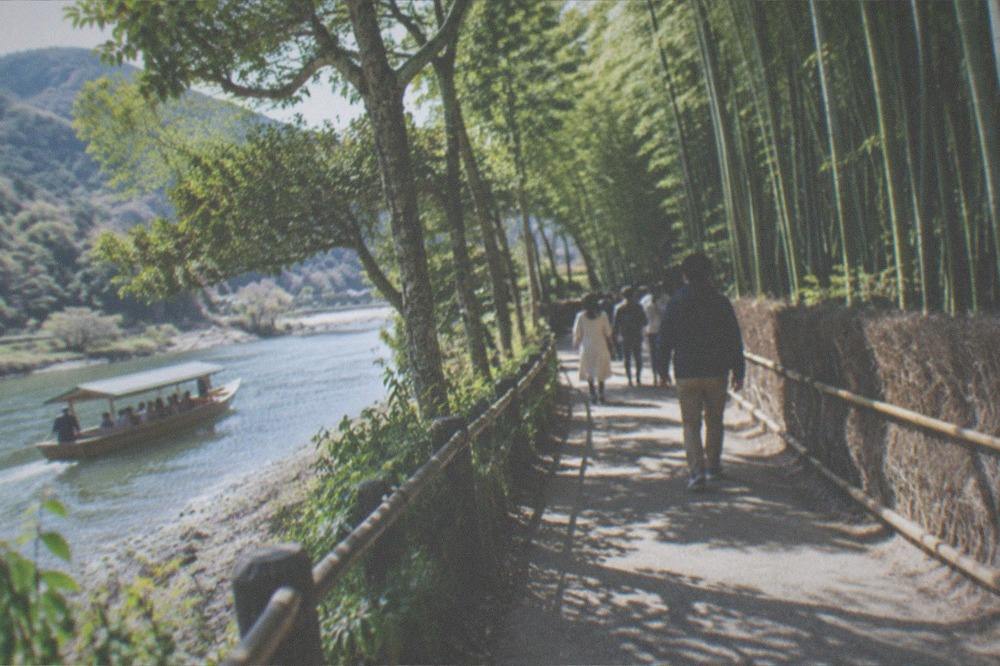
Lunch belongs in Arashiyama before the boat, not Kameoka after it, because the Kameoka end of the line has far fewer options. The district around Togetsukyo has everything from yudofu shops to conbini runs, and a proper sit-down meal before a two-hour open-boat ride is wiser than eating after, when you land mid-afternoon with the day half gone. For the food angle, our Kyoto street food guide covers what to grab.
After the boat lands you are back at the Arashiyama core with the afternoon ahead. Iwatayama Monkey Park is a 20-minute uphill walk from the dock and stays open until 16:00, with last entry about 30 minutes before closing, and it shuts early in bad weather or when the monkeys head back up the hill, so treat it as weather-dependent. The calmer alternative is to finish along the river, cross Togetsukyo and drift toward the quieter temple streets; our Kyoto neighborhoods guide places Arashiyama in context against the eastern districts.
What Should You Know Before You Go?
Bring layered clothing and a waterproof bag for electronics, accept that the front rows get soaked at the rapids, buy tickets ahead for cherry season and late November, and do not plan the boat as a rainy-day fallback without checking the operator's live status, because high water suspends it. The last departures are early afternoon, so a late start can miss the boat entirely.
The practical failure modes are consistent. People arrive at Kameoka expecting to buy a ticket for the next boat in peak foliage and find the day sold out. People dress for the street temperature and spend two hours chilled by gorge wind. People assume the boat runs on a fixed clock and discover the last sailing left before they finished lunch. All three are avoidable with the operator's own site, which posts the timetable, the fares, same-day status and waiting times.
Accessibility is the honest limitation. Boarding means stepping down into a wooden hull from a dock, there is no wheelchair access on the boats, and the ride involves sitting on low benches without restraints for two hours. The Sagano Romantic Train is the accessible option in this valley. Travellers with mobility constraints should read our Kyoto accessibility guide before committing to the boat, and travellers building a slower Kyoto trip generally get more from the two days in Kyoto itinerary, which leaves room for the valley without rushing it.
Weather cuts both ways here, and the JMA normals explain the pattern. July is Kyoto's wettest month at 223.6 mm against June's 199.7 mm, so summer riders should expect the possibility of a wet ride regardless of the river, while October and November, at 143.2 and 73.9 mm respectively, are the drier window and the reason autumn is the premium season. The operator's rain gear covers the rapids; it does not turn a downpour into a dry afternoon.
Common Questions About The Hozugawa River Boat Ride
How long is the Hozugawa boat ride from Kameoka to Arashiyama?
About two hours on the water, depending on the river level. The operator prints two hours as the standard figure, with faster runs after rain and slower passages in low water. Budget half a day including transport to Kameoka.
How much does the Hozugawa Kudari cost?
6,000 yen for an adult and 4,500 yen for a child from infant age through elementary school, on the operator's current published fare table. A private charter runs 144,000 yen on weekdays and 162,000 yen on weekends and holidays for the whole 24-seat boat. The figure of about 4,100 yen still quoted in older guides is out of date.
Do you get wet on the Hozugawa boat ride?
Yes, at the rapids, particularly in the front rows. The operator provides rain gear, but anything you want to keep dry, especially cameras and phones, should be in a sealed bag. Between rapids the ride is calm.
Is the Hozugawa Kudari running after the 2023 accident?
Yes. A fatal capsizing occurred in March 2023 and service was suspended, then later resumed; the operator's site does not publish the resume date. As of mid-September 2026 the operator was running a normal timetable with same-day ticketing and live waiting-time notices.
Can you combine the boat with the Sagano Romantic Train?
Yes, and it is the standard loop: the train up the valley from Torokko Arashiyama to Torokko Kameoka, then the boat back down the river to Arashiyama. The two are separate operators with separate tickets, and the train closes most Wednesdays outside peak periods, so check its timetable for your date.
When does the Hozugawa Kudari stop running for the year?
The regular 2026 timetable runs to 13 December, with a reduced winter timetable from 8 December to 9 March and a full closure from 29 December to 4 January. The last departures each day are in the early afternoon, so late starts can miss the final boat.
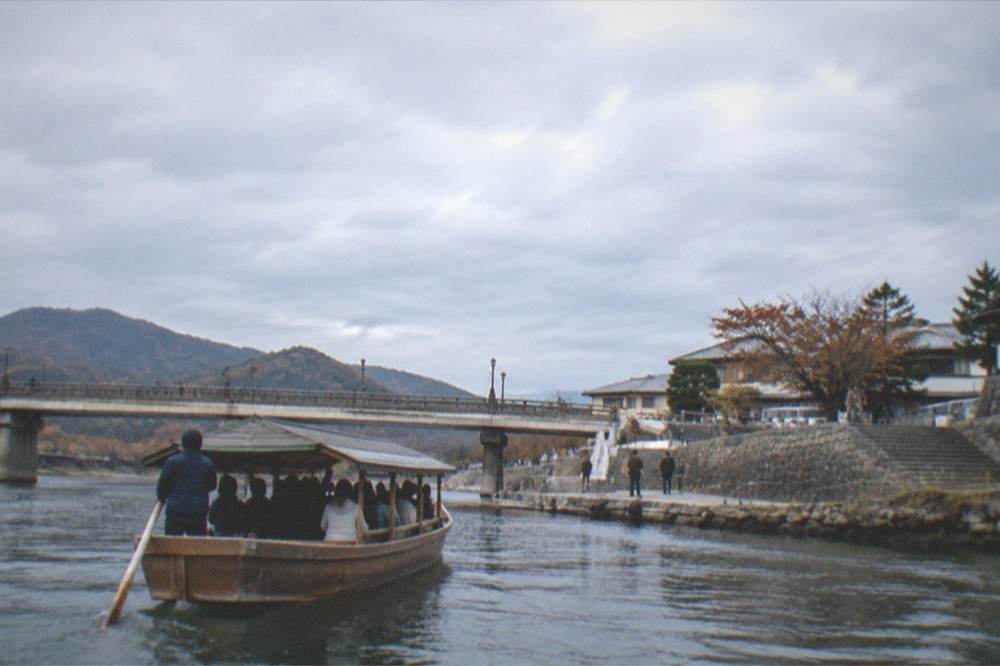
The Hozugawa Kudari is priced like a premium experience and delivers one: two hours of a working river, a gorge the city has been using as a highway for four centuries, and a landing that puts you in Arashiyama with the afternoon still yours. Get the fare right, book ahead if your dates touch the foliage window, and ride the train up so the river carries you home.