Pontocho Alley: Where Does Pontocho Alley Run, From Shijo To Sanjo Along The Kamo River?
Pontocho Alley is the narrow stone-paved lane pressed between the Kamo River's west bank and the backs of the Kiyamachi buildings, running from Shijo-dori in the south to Sanjo-dori in the north. It is one of Kyoto's five hanamachi geisha districts and one of its most concentrated dining streets.
Short answer
Pontocho Alley runs north-south between Shijo-dori and Sanjo-dori on the west bank of the Kamo River in central Kyoto, a narrow lane of restaurants, teahouses and riverside dining platforms.
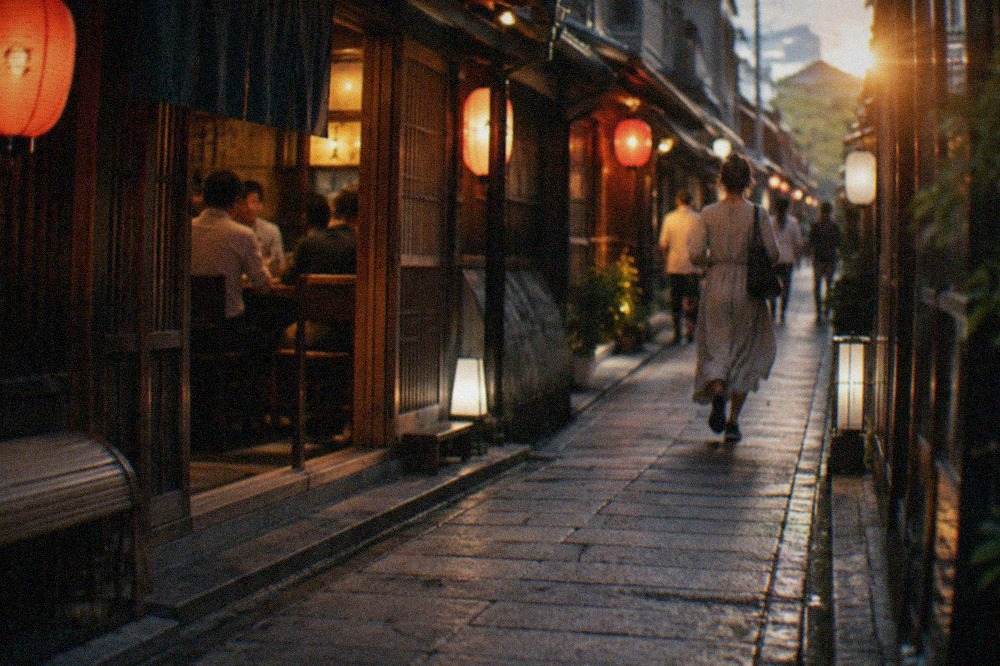
Pontocho Alley is the narrow lane that runs from Shijo-dori in the south to Sanjo-dori in the north, sandwiched between the west bank of the Kamo River and the buildings of Kiyamachi. At its narrowest points two people passing have to turn sideways. The lane is one of Kyoto's five hanamachi, the geisha districts, and it is also one of the densest concentrations of restaurants in the city, with establishments stacked along both sides for its full length. In summer the restaurants on the river side open their wooden platforms over the water, a Kyoto dining tradition called kawadoko, and the lane takes on a second evening life that has nothing to do with lunch.
This page from Kyoto Travel Guide covers where the alley runs, what it costs to eat there, how the kawadoko season works, and what the geisha district rules actually are, because the last of those is where most visitors get it wrong.
Where Does Pontocho Alley Run, From Shijo To Sanjo Along The Kamo River?
Pontocho Alley runs north to south between Sanjo-dori at its northern end and Shijo-dori at its southern end, along the west bank of the Kamo River in central Kyoto. The lane sits between the river and Kiyamachi-dori, one block west, and its full length is a few minutes' walk from either bridge.
The geography is simple once you see it once. The Kamo River flows north to south through central Kyoto. Pontocho is the strip of land immediately west of the river between the Shijo bridge and the Sanjo bridge. Kiyamachi-dori runs parallel to it one block further west, and the buildings between the two streets have fronts on Kiyamachi and backs, or in many cases fronts, on Pontocho. The alley is not a through road. It is a pedestrian lane, stone-paved in parts, and the only vehicle traffic you will see is delivery bicycles and the occasional service cart.
The two anchor points matter for planning. Shijo-dori at the south end is the main east-west axis of central Kyoto, with the Shijo bridge crossing to Gion on the east bank. Sanjo-dori at the north end is where you find the Keihan Sanjo station and the beginning of the walk toward the Kyoto Imperial Palace if you keep going west. Most people enter from Shijo because that is where the crowds from Gion and the Shijo shopping district spill over, and the lane's southern half is correspondingly the busier half.
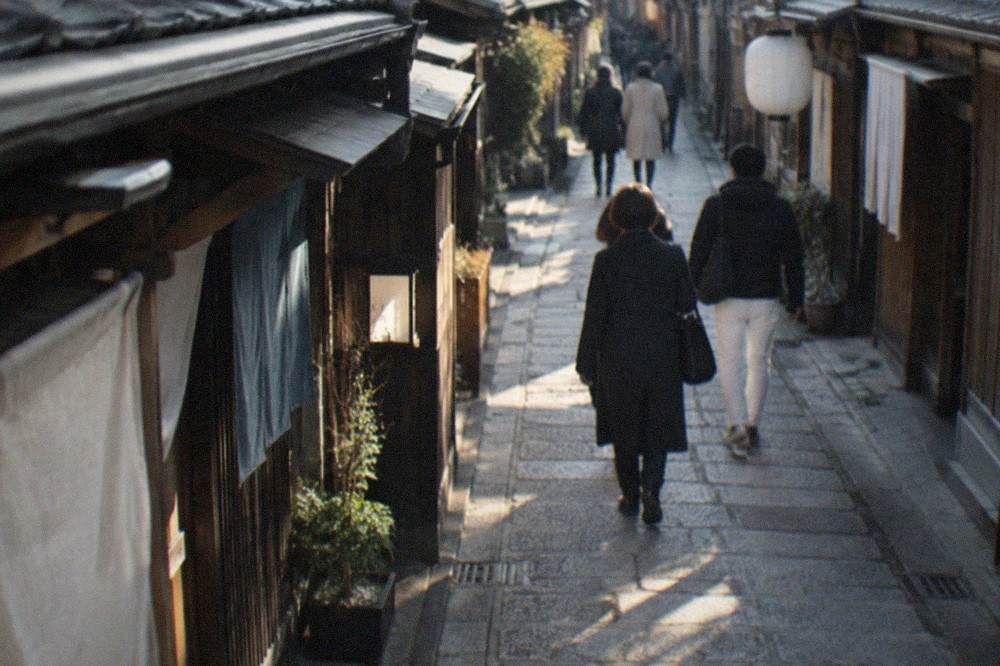
The north end, toward Sanjo, thins out and gets quieter, and the character shifts from big-name restaurants to smaller counters and bars. If you are coming from Nishiki Market, which is about ten minutes west on foot, the natural route is east along Shijo-dori and then north into the alley from the Shijo end.
What Is Pontocho Alley Actually Known For?
Pontocho is known for three things stacked on top of each other: it is one of Kyoto's five geisha districts, it is one of the city's densest restaurant streets, and it is the home of kawadoko, the summer dining platforms built out over the Kamo River. The same narrow lane carries all three.
The geisha district history comes first chronologically. Pontocho developed in the early Edo period as a strip of reclaimed riverbank land, and by the seventeenth century it had become an entertainment quarter serving the traffic along the Takase canal and the Kamo River. It was formally recognised as one of Kyoto's hanamachi, and today it remains a working kagai, meaning geiko and maiko still live and work there, affiliated with the district's ochaya teahouses. The Gion district across the river is larger and more famous, but Pontocho is the more compact and, in the evening, arguably the more atmospheric of the two.
The restaurant density is the second identity. The lane is roughly 500 metres long and holds well over a hundred establishments, from standing bars that seat six people to multi-storey kaiseki houses. The width of the lane means everything is close: you can read a dozen menus in a two-minute walk. This is also why the lane photographs so well, and why it is the answer most often given to the question of Kyoto's most famous alley.
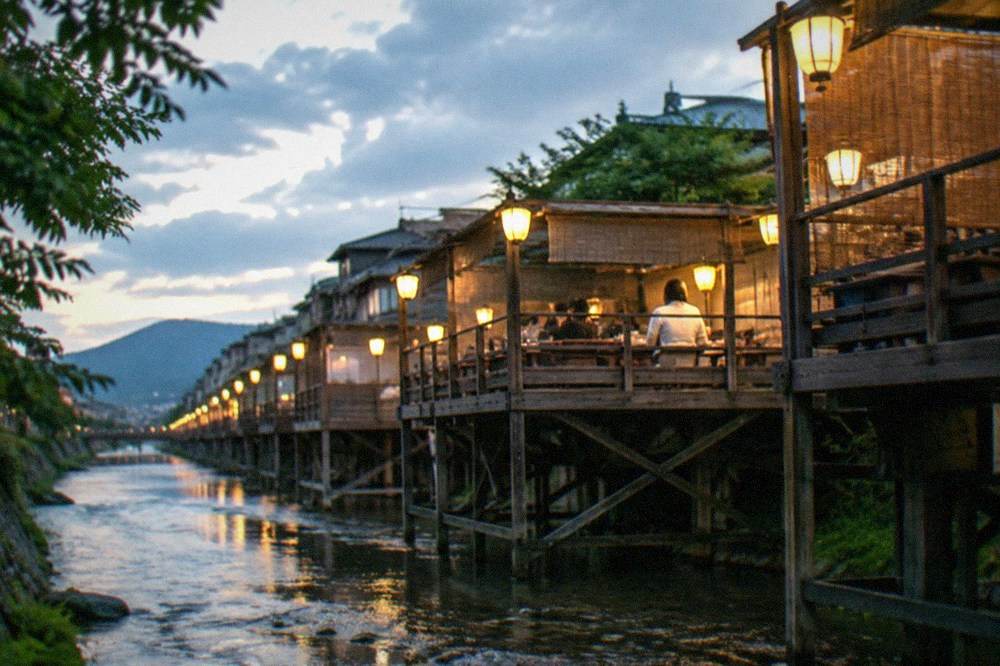
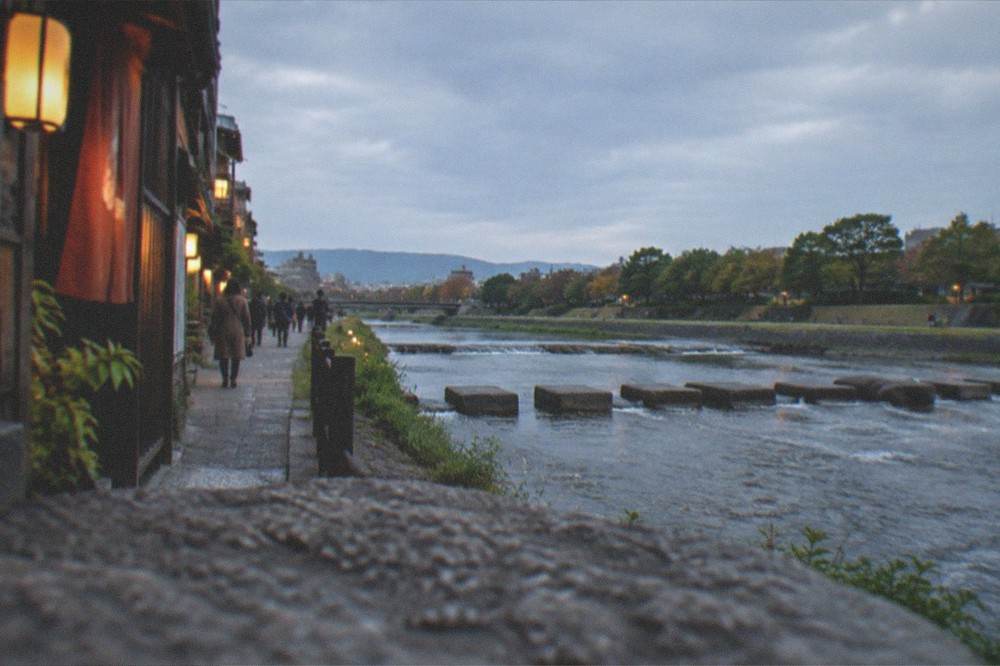
The kawadoko season is the third identity and the most seasonal. From roughly May through September, the restaurants on the river side extend wooden platforms out over the water, and diners eat a few metres above the riverbed with the sound of the shallows underneath. The platforms are taken down in autumn. This is a centuries-old tradition tied to the river's summer role as a cooling space, and it is the single most memorable dining format in central Kyoto.
When Is The Kawadoko Season On Pontocho Alley?
The kawadoko river platforms on Pontocho generally run from May through September, with the peak season in July and August when the platforms are the city's most sought-after outdoor tables. Each restaurant sets its own dates, so there is no single official opening day for the lane.
The season follows the heat rather than a fixed calendar. The Japan Meteorological Agency's 1991 to 2020 normals for Kyoto station show July as the wettest month at 223.6 mm and August as the hottest, with a mean daily maximum of 33.7 C, and the platforms exist precisely because of those months: dining over running water was the pre-air-conditioning answer to a Kyoto summer. Three of Kyoto's six hottest days on record fell in the summers of 2024, 2025 and 2026, and July and August 2025 both ranked among the five hottest months ever measured at the station, so the tradition has if anything become more relevant.
Booking is the practical issue. The best-positioned platforms, especially the corner seats at the Shijo end, go early, and many restaurants take reservations weeks ahead for weekend evenings in July and August. Prices on the platforms are typically set-menu rather than a la carte, and they run higher than the same restaurant's indoor seating because the format is a seasonal event. Walk-ins are possible on weekday evenings in May, June and September, but treat a July or August Friday night as a reservation-only proposition.
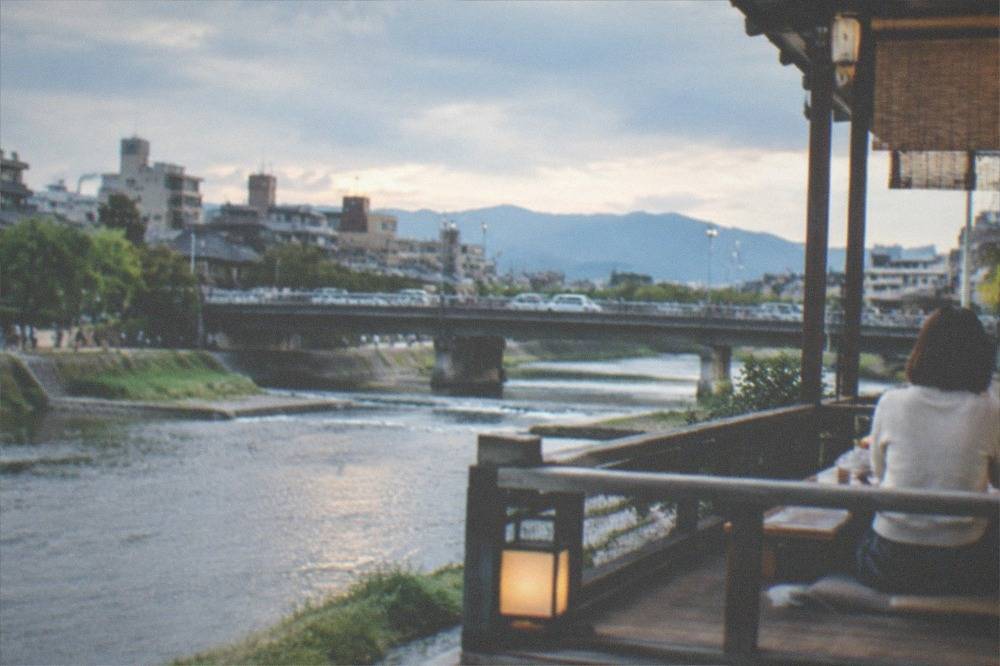
A note on the river itself: the Kamo River's channel is shallow and controlled, but water levels do rise after heavy summer rain. Restaurants close platforms when the river is high, and this happens without much notice, so a July typhoon week can wipe out a booking. Check with the restaurant on the day if the weather has been bad.
How Much Does It Cost To Eat On Pontocho Alley?
Eating on Pontocho spans an enormous range for one narrow lane: standing bars and small counters at a few thousand yen, mid-range izakaya and riverside set menus in the middle, and kaiseki houses whose full courses open well above 30,000 yen. The lane's own restaurants set their own prices, so check each menu.
The honest anchor for the top end comes from a restaurant that publishes its own prices: Hyotei, by Nanzen-ji, prints kaiseki from 31,625 yen at lunch and from 37,950 yen at dinner in its main building, tax and service included, while the same house's annex serves asa-gayu rice porridge at 5,445 yen and a Shokado bento at 7,260 yen. Those are Hyotei's own prices, not a Kyoto average, and they are not on Pontocho, but they show the shape of the market the lane's top restaurants sit in: a famous kaiseki house's course opens above 30,000 yen while its own casual annex is under 8,000.
On Pontocho itself, the practical bands look like this:
| Type of place | Typical spend per person | Notes |
|---|---|---|
| Standing bar | 1,000 to 3,000 yen | Cash-friendly, no reservation, often a cover charge |
| Small counter or izakaya | 3,000 to 8,000 yen | Walk-in possible on weekdays |
| Riverside kawadoko set menu | Set menu, from around 6,000 yen | Seasonal format, May to September |
| Full kaiseki course | Opens above 30,000 yen at famous houses | Reservation from two people is standard |
These bands are planning ranges, not promises: every restaurant on the lane sets its own menu, and the only prices this site states as verified figures are the ones a restaurant prints on its own page. The ranges above describe what you will find when you read the menus, and the menus are posted at the door, which is the point of a walking lane.
Can You See Geisha On Pontocho Alley?
Yes, Pontocho is a working geisha district and geiko and maiko do move through the lane in the early evening on their way to appointments, but there is no viewing spot, no schedule and no guarantee, and the rules about photographing them are strict and enforced by the district itself.
The honest framing comes from the Kyoto City Tourism Association's own guidance: do not touch, chase or photograph geiko and maiko without permission, and do not enter private property or photograph it where that is prohibited. That is the city-level rule, and it is about conduct rather than money. The situation in the private alleys is a separate matter: in Gion, signs put up by the Gion South Side district council on the private alleys off Hanamikoji threaten a 10,000 yen penalty for unauthorized photography. That is council signage on private property, not a city fine, and the distinction matters because it explains why the rules are enforced by the community rather than by police. Pontocho's own alleys carry similar private-property logic: the lane's public way is the lane itself, and the side passages and building interiors are not.
What this means in practice: the early evening, roughly the hour before dinner service, is when working geiko and maiko are most likely to be moving between teahouses, and the correct behaviour is to let them pass. Never block a doorway, never follow, and never raise a camera. The city's tourism association publishes this guidance directly, and the district councils reinforce it with signage. A reader who wants to understand the culture rather than glimpse it gets far more from a guided walk, and the geisha district walks in Gion are built around the history and the architecture rather than a sighting.
When Is The Best Time To Walk Pontocho Alley?
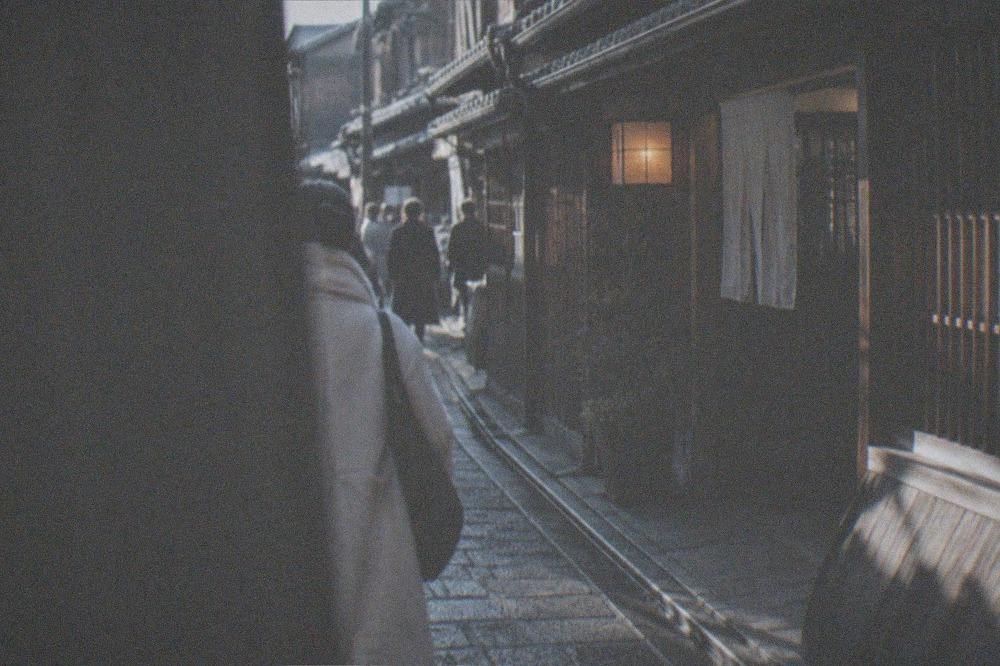
Pontocho is at its best in the early evening from May through September, when the kawadoko platforms are up, the lanterns are lit and dinner service is starting, and the lane is quietest in the late morning before the restaurants open for the day.
The evening case is straightforward: the lane was built for evening. The lanterns, the noren curtains, the sound from open kitchens and the river platforms are all evening phenomena, and in summer the hour just after sunset, when the heat breaks, is when the lane is itself. The JMA normals put sunset-season Kyoto at a mean August maximum of 33.7 C, and the river corridor is measurably cooler than the streets a block west, which is why the tradition exists.
The seasonal case is more nuanced. Cherry blossom season draws crowds to the riverbanks, and the JMA's 2026 data recorded full bloom in Kyoto on 30 March against a 1991 to 2020 normal of 4 April, so the blossom window has been running early. Autumn brings the maple crowds, and the JMA normal for the observatory's maple specimen turning red is 5 December, far later than most guides claim for the Arashiyama and Higashiyama peaks, so an early-November visit to Kiyomizu-dera or Eikan-do pairs well with a Pontocho evening without competing with the foliage peak.
| Period | What the lane is like | Pair it with |
|---|---|---|
| Late morning | Quiet, shops opening, no dining | Nishiki Market brunch walk |
| Early evening, May-Sep | Kawadoko platforms up, lanterns lit | Dinner on or near the river |
| Early evening, Oct-Apr | Lanterns and indoor dining, no platforms | Kawaramachi bar crawl |
| July | Peak platform season, busiest, wettest month | Book well ahead |
One planning note: July is Kyoto's wettest month at 223.6 mm against June's 199.7 mm in the JMA 1991 to 2020 normals, a reversal of the common assumption that the rainy season peaks in June. July evenings on the platforms are glorious between the showers, but the showers are real.
What Is Close To Pontocho Alley?
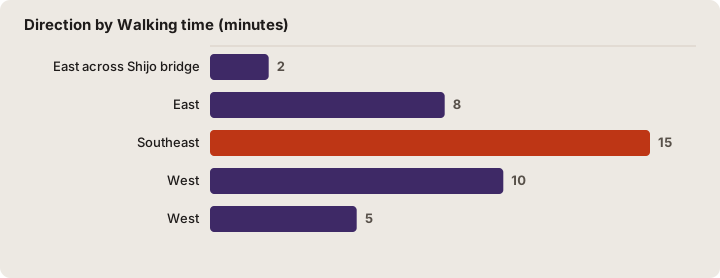
Pontocho sits in the middle of central Kyoto's most walkable cluster: Gion and Yasaka Shrine are across the Shijo bridge to the east, Nishiki Market and the Kawaramachi shopping streets are five to ten minutes west, and Kiyomizu-dera is a fifteen to twenty minute walk southeast.
The lane's location is its strongest practical asset. Everything worth pairing with a Pontocho evening is on foot:
| Direction | Attraction | Walking time | Notes |
|---|---|---|---|
| East across Shijo bridge | Gion | 2 minutes | Geisha district, Hanamikoji street |
| East | Yasaka Shrine | 8 minutes | Free, open grounds |
| Southeast | Kiyomizu-dera | 15-20 minutes | 500 yen admission, opens 6:00 |
| West | Nishiki Market | 10 minutes | Shops keep their own hours |
| West | Kawaramachi | 5 minutes | Bars and shopping |
| North along the river | Kamo River walk | Continuous | Riverbank promenade |
A full evening shapes up naturally: the river walk south to north, the lane itself from Shijo to Sanjo, then either dinner on a platform or a turn west into Kawaramachi for bars. For a fuller day built around this part of the city, the things to do in Kyoto page covers the wider map, and the Kyoto nightlife guide extends the evening beyond the lane.
What Are The Rules And Etiquette On Pontocho Alley?
The rules that matter on Pontocho are about the geisha district and private property: do not photograph geiko and maiko without permission, do not enter or photograph private property where prohibited, and treat the side alleys and building entrances as private even though the lane itself is a public way.
The city-level guidance from the Kyoto City Tourism Association is conduct-based: no touching, chasing or photographing geiko and maiko without permission, and no entering private property or photographing it where prohibited. In the neighbouring Gion district, the Gion South Side district council's signs on the private alleys off Hanamikoji threaten a 10,000 yen penalty for unauthorized photography, which is council signage on private land rather than a municipal fine. Pontocho's parallel spaces, its side passages, its teahouse entrances, its residential steps, carry the same private logic, and the working district's patience with camera phones is thin for good reason.
Beyond the geisha district rules, the lane's etiquette is ordinary narrow-street etiquette. The lane is a working restaurant street, not a theme park: kitchens take deliveries, staff move through with purpose, and the residents above the restaurants are actual residents. Eating while walking is discouraged at Nishiki Market a few blocks west, where stalls ask you to eat at the stall, and the same logic applies here. Photography of the lane itself, its lanterns and facades, is normal and expected; photography of people, doorways and interiors is not.
For visitors who want the district's culture explained rather than policed, a guided evening walk does the job properly, and the food and drink walks around this part of the city, from the sake and food tours to the Gion geisha walks, are built for exactly that.
The strongest of those pairings for this lane is the sake side of the evening. Fushimi, Kyoto's brewing district, sits a short rail hop south of the city, and the flavours that fill Pontocho's counters start there.
Common Questions About Pontocho Alley
Where Does Pontocho Alley Run, From Shijo To Sanjo Along The Kamo River?
Pontocho Alley runs north-south between Sanjo-dori at the north end and Shijo-dori at the south end, on the west bank of the Kamo River in central Kyoto, one block east of Kiyamachi-dori.
How Long Does It Take To Walk Pontocho Alley?
The lane is roughly 500 metres long, so an unhurried end-to-end walk takes ten minutes or so, and most people spend longer reading menus than walking.
Can You See Geisha On Pontocho Alley?
Pontocho is a working hanamachi and geiko and maiko do move through the lane in the early evening, but there is no viewing spot or schedule, and the city's guidance is strict: no touching, chasing or photographing them without permission.
When Are The River Platforms Up On Pontocho?
The kawadoko platforms generally run from May through September, with each restaurant setting its own dates, and the peak demand is on July and August evenings.
Is Pontocho Alley Expensive?
The lane spans standing bars at a few thousand yen up to kaiseki houses whose courses open well above 30,000 yen, so it is as expensive or as cheap as the door you choose, and the menus are posted outside.
What Is The Closest Station To Pontocho Alley?
Keihan Gion-Shijo station sits at the south end by the Shijo bridge, and Hankyu Kyoto-Kawaramachi station is a few minutes west, so both ends of the lane are rail-served.
Pontocho rewards the slow pass. Walk it once at midday to read the menus, then come back after dark for the lane as it actually lives, and if the season is right, book a platform and let the river do the cooling.