How Long Is The Philosopher's Path in Kyoto From Ginkaku-ji To Nanzen-ji?
A canal-side walk through northern Higashiyama, free to enter, bookended by two of Kyoto's most visited temples.
Short answer
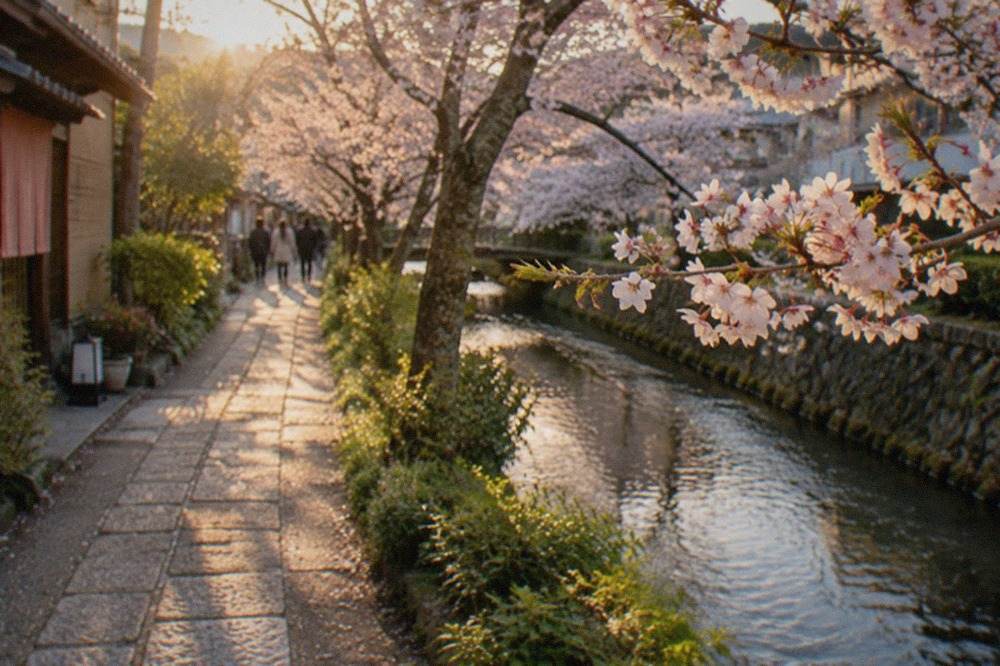
The Philosopher's Path is a free public canal-side walk of roughly two kilometres between Ginkaku-ji in the north and Nanzen-ji in the south, taking 30 to 45 minutes of pure walking and half a day with temple stops.
The Philosopher's Path is a stone walkway beside the Lake Biwa Canal in northern Higashiyama, running between Ginkaku-ji at the top of the hill and Nanzen-ji near the Okazaki museum district. Walking it costs nothing. The name comes from the Kyoto University philosopher Kitaro Nishida, who is said to have used the route for his daily meditative walk in the early twentieth century, and the path keeps that unhurried character even now, in a city that drew a record 62.79 million visitors in 2025 according to the city's own tourism survey. The cherry trees along the canal are the reason most people come, and the JMA phenology record for Kyoto gives the 1991 to 2020 normal full-bloom date as 4 April, which makes early April the single busiest stretch of the year here.
What Is The Philosopher's Path in Kyoto?
The Philosopher's Path is a roughly two-kilometre public walkway beside the Lake Biwa Canal in northern Higashiyama, running downhill from Ginkaku-ji past Honen-in and Otoyo-jinja to Nanzen-ji. It is free to walk at any hour, it is a normal residential street with no gate or ticket, and it takes its name from the philosopher Kitaro Nishida, who is said to have walked it daily.
The canal it follows is an engineering landmark in its own right. The Lake Biwa Canal was built in the late nineteenth century to carry water, freight and, later, hydroelectric power from Lake Biwa into Kyoto, and the section between Keage and the northern hills is the stretch the path shadows. The water still runs, the weeping willows still lean over it, and the cherry trees planted along the banks are the reason the route is one of the city's hundred designated cherry viewing spots.
What surprises many first-time visitors is how small-scale it all is. This is not a park with an entrance. It is a canal-side lane passing private houses, small cafes, pottery shops and a handful of temples, and the walk works precisely because nothing about it is fenced off. You can join it anywhere along its length, leave it at any cross street, and return the next morning. For a first orientation to what the wider city holds, our things to do in Kyoto round-up places the path in context alongside the bigger ticketed sights.
How Long Is The Philosopher's Path From Ginkaku-ji To Nanzen-ji?
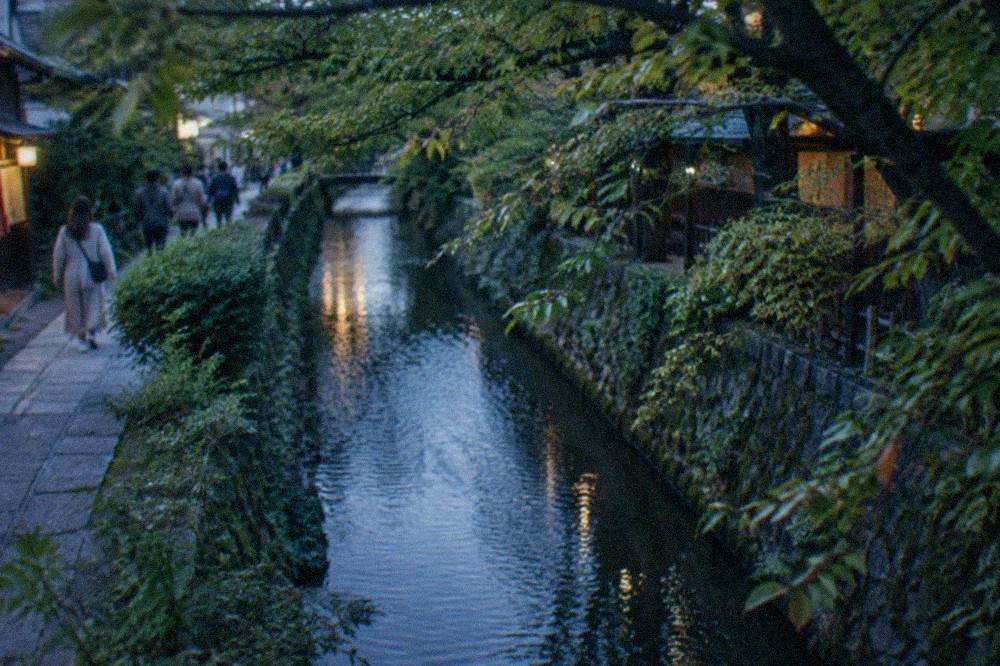
The Philosopher's Path from Ginkaku-ji to Nanzen-ji is commonly described as a walk of about two kilometres, taking 30 to 45 minutes of continuous walking. With temple visits along the way, most people spend two to three hours on it, and half a day if they go inside every temple. Walking it from Ginkaku-ji means going downhill, which is the easier direction.
The honest answer has two parts, because the distance and the experience are different things. The canal itself runs in a fairly straight line south from the Ginkaku-ji end, and a walker who never stops covers it quickly. Nobody should plan to never stop. Honen-in's moss gate, the Otoyo-jinja shrines with their animal guardians, the Eikan-do approach and the Nanzen-ji aqueduct all sit within a few minutes of the path, and each one is worth at least a short pause.
Direction matters more than most guides admit. Starting at Ginkaku-ji means a gentle downhill or level walk the whole way, finishing at Nanzen-ji where the subway and the Okazaki museum district are close at hand. Starting at Nanzen-ji means climbing, which is manageable but noticeable in July, when the JMA 1991-2020 normals put the mean daily maximum at 32.0 C. Kyoto's wettest month is July at 223.6 mm of rain, ahead of June at 199.7 mm, so an umbrella earns its place in the bag either way.
| Segment | Approximate walking time | What you pass |
|---|---|---|
| Ginkaku-ji gate to Honen-in | 10 to 15 minutes | Canal head, cafes, pottery shops |
| Honen-in to Otoyo-jinja | 10 minutes | Mossy temple gate, quiet residential lanes |
| Otoyo-jinja to Eikan-do approach | 10 to 15 minutes | Shrines, small shops, temple approaches |
| Eikan-do approach to Nanzen-ji | 10 minutes | Brick aqueduct, Sanmon gate, Okazaki edge |
If you would rather have a guide handle the terrain, the temples and the storytelling in one go, a small-group hiking tour is the strongest fit for this part of the city, and the Kurama and Kibune hike below covers the deeper mountains to the north.
What Does It Cost To Walk The Philosopher's Path in Kyoto?
Walking the Philosopher's Path itself is free: it is a public street with no gate, ticket or opening hours. The costs sit at either end and at the temples beside it. Ginkaku-ji charges 1,000 yen for adults from 1 April 2026, double its old 500 yen fee, while Nanzen-ji's Hojo garden and Sanmon gate each charge 600 yen, ticketed separately.
The Ginkaku-ji change is the one to plan around. The temple's own notice, dated January 2026, raised the adult fee from 500 to 1,000 yen and the child fee from 300 to 500 yen with effect from 1 April 2026, the first revision in 32 years. Any guide still quoting 500 yen is out of date. Ginkaku-ji at 1,000 yen is now twice Kinkaku-ji's 500 yen, and for a first visit the Silver Pavilion's garden and the two dry landscapes along its route justify the fee, but budget for it.
| Site on or beside the path | Adult admission | Notes |
|---|---|---|
| The Philosopher's Path itself | Free | Public street, no closing time |
| Ginkaku-ji | 1,000 yen | Doubled from 500 on 1 April 2026 |
| Honen-in | Free grounds | Small temple beside the path |
| Nanzen-ji grounds | Free | Grounds open to all |
| Nanzen-ji Hojo garden | 600 yen | Separate ticket |
| Nanzen-ji Sanmon gate | 600 yen | Separate ticket, steep stairs |
Nanzen-ji's own hours are 8:40 to 17:00 from March to November and 8:40 to 16:30 in winter, with no general visits from 28 to 31 December. Ginkaku-ji opens at 8:30 and closes at 17:00 from 1 March to 30 November, moving to 9:00 to 16:30 for the winter months. The path between them never closes, so an evening walk after the temples shut is entirely possible, and the canal after dark is quiet in a way the daytime crowd never is.
For visitors spreading a budget across several days, the free-to-walk route is one of the best value stretches in the city, and our Kyoto on a budget guide lists the other genuinely free sights, including Fushimi Inari Taisha, whose own site publishes no fee anywhere, and the Kyoto Imperial Palace.
When Is The Best Time To Walk The Philosopher's Path in Kyoto?
Early April is the peak, because the JMA 1991-2020 normals put Kyoto's cherry full bloom at 4 April, and the canal's trees are among the city's designated viewing spots. Late November is the quieter rival, when the maples turn. In 2026 the JMA recorded cherry full bloom on 30 March, four days ahead of normal, so the first week of April is the safe window.
The JMA phenology record for the Kyoto observatory gives the detail most guides skip. Cherry flowering has a normal date of 26 March and full bloom of 4 April; in 2026 flowering came on 23 March and full bloom on 30 March, both ahead of the normals. The maple marker is later than people expect: the official red-leaf normal is 5 December, though that is the observatory's specimen tree, not the Higashiyama peak, which arrives in late November.
| Marker | 1991-2020 normal | 2025 | 2026 |
|---|---|---|---|
| Cherry flowering | 26 March | 27 March | 23 March |
| Cherry full bloom | 4 April | 5 April | 30 March |
| Maple red leaves | 5 December | 10 December | Not yet recorded |
| Ginkgo yellow leaves | 24 November | 25 November | Not yet recorded |
Crowds follow the blossoms. The city's 2025 survey counted 62.79 million visitors across the year, 46.20 million of them day visitors, and the comfort forecast the Kyoto City Tourism Association runs uses smartphone location data to predict crowd levels by spot and time slot, which is worth checking the morning you go. The other lever is the clock: the path at 7:00 in April is a different place from the path at 11:00, and the cafes along it open into the gap. Our Kyoto cherry blossom itinerary builds a full day around the canal at first light.
Rain matters less than you would think. The canal is at its most photogenic in the hour after rain stops, when the stones darken and the moss at Honen-in glows, and April's mean rainfall of 117.0 mm is moderate by Kyoto standards. July and August are the months to be cautious about heat: three of Kyoto's six hottest days on record fell in the summers of 2024, 2025 and 2026, per the JMA station record.
What Can You See Along The Philosopher's Path in Kyoto?
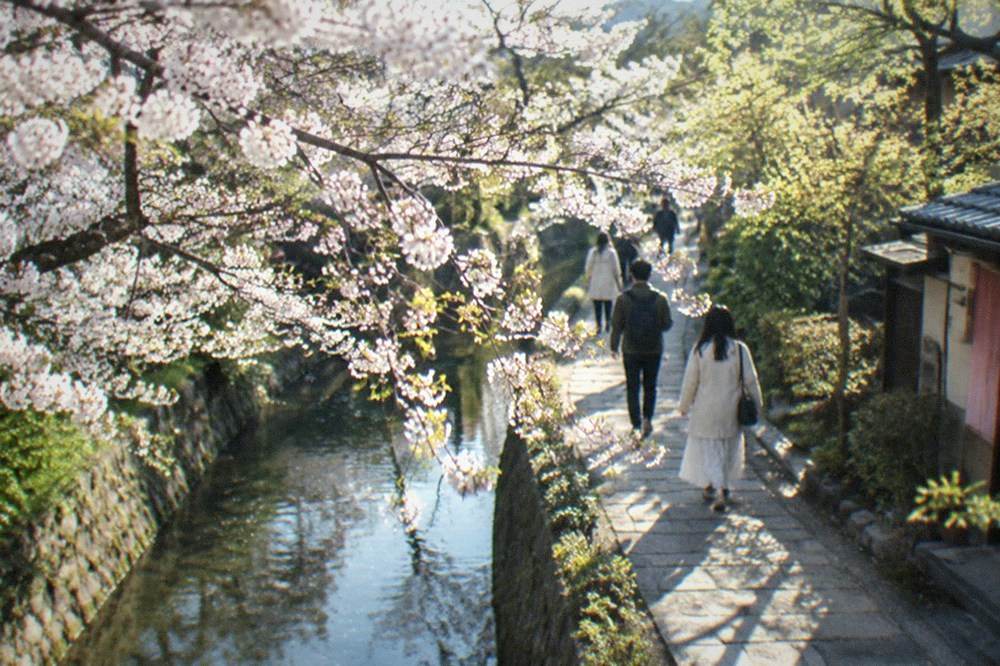
The path's stops, north to south, are Ginkaku-ji with its Silver Pavilion and moss garden, the quiet temple of Honen-in, the animal-guardian shrines of Otoyo-jinja, the approach to Eikan-do, and finally Nanzen-ji with its brick aqueduct and massive Sanmon gate. Of these, only Ginkaku-ji and Nanzen-ji's two ticketed areas charge admission.
Ginkaku-ji, formally Jisho-ji, is the anchor at the north end. The pavilion itself has never actually been covered in silver; the name came later, echoing its northern cousin. What the 1,000 yen ticket buys is the dry sand mound called the Sea of Silver Sand, the garden that climbs the hill behind it, and the view back over the city. The temple's hours run 8:30 to 17:00 in season. The wider set of guides lives on Kyoto Travel Guide.
Honen-in, a few minutes south, is the connoisseur's stop. Its thatched gate over a moss bank and its raked sand garden change with the seasons, and the grounds are free. It is small, quiet and, in cherry season, framed by a handful of trees that hold their petals longer than the canal's.
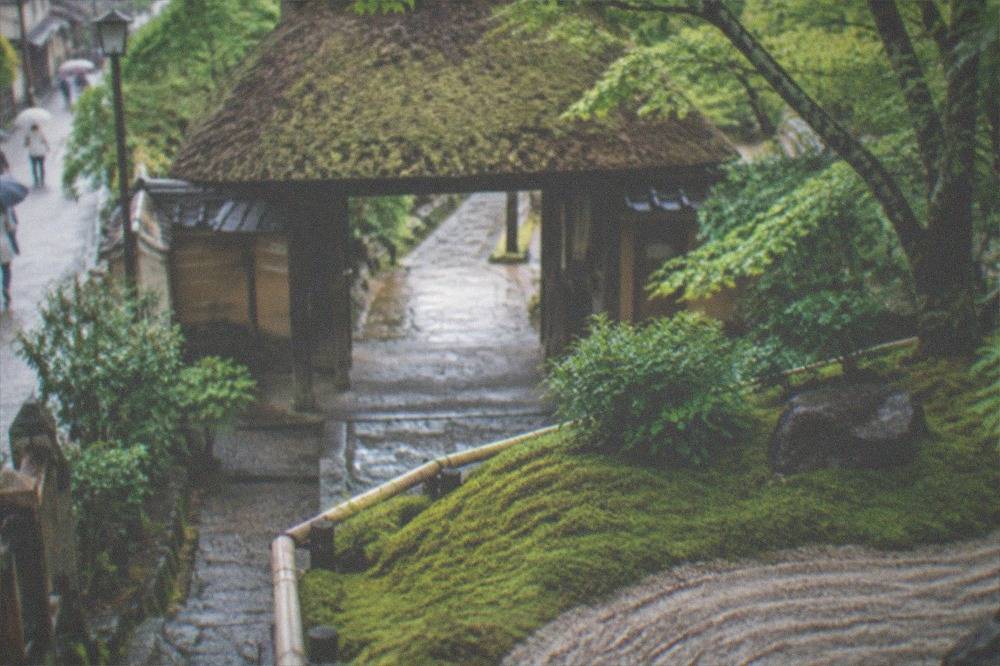
Otoyo-jinja, tucked against the hillside, is famous for its guardian statues of a mouse and a monkey rather than the usual foxes, and it is one of the few shrines in the city where the guardians are the whole point of the visit. South of it the path passes a run of small shops and cafes, several in converted machiya townhouses, which make a natural coffee stop halfway.
At the south end, Nanzen-ji is one of Kyoto's most important Zen temples, and its grounds are free to wander. The brick aqueduct carrying the Lake Biwa Canal over the temple's valley is the most photographed industrial structure in the city, and it is exactly the same canal the path has followed all the way from the top. The Hojo garden and the Sanmon gate each charge 600 yen separately, and the gate's upper balcony is worth the steep stairs on a clear day. The temple sits at the edge of Okazaki, where the museums and Heian Shrine's giant torii close out a full day.
For visitors who want the same temple-and-water combination with a guide doing the navigation, a small-group walking tour of the Arashiyama district covers the bamboo grove, the monkey park and Tenryu-ji with the same unhurried pacing.
A rainy afternoon on the path is not a lost afternoon either. The stone banks and the temple gardens hold up in drizzle better than almost anywhere else in the city, and the museums a few streets south at Okazaki are the standard wet-weather fallback for this whole district.
How Do You Get To The Philosopher's Path in Kyoto?
The nearest subway stations are Higashiyama and Keage on the Tozai Line at the Nanzen-ji end, both a 10 to 15 minute walk from the path's southern end. The Ginkaku-ji end has no station nearby; buses from Kyoto Station serve it, and the city's flat bus fare is 230 yen for adults and 120 yen for children aged 6 to 11.
The Tozai Line is the practical spine for this walk. Keage Station sits closest to Nanzen-ji, and Higashiyama Station serves the Okazaki side. From either, the walk to the aqueduct is short and signposted. At the northern end, the nearest rail access is Demachiyanagi on the Eizan and Keihan lines, still a 20 minute walk from Ginkaku-ji, so most visitors arrive by bus.
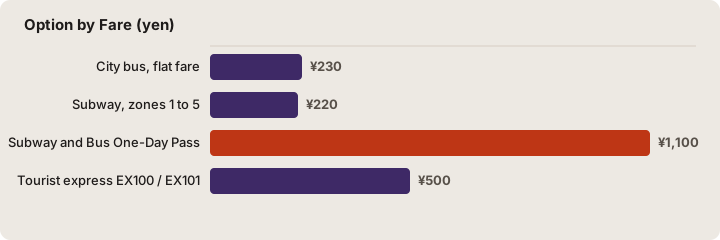
| Option | Fare | Notes |
|---|---|---|
| City bus, flat fare | 230 yen adult, 120 yen child | Children 6 to 11 |
| Subway, zones 1 to 5 | 220 to 360 yen adult | Tozai Line serves the south end |
| Subway and Bus One-Day Pass | 1,100 yen adult, 550 yen child | Bus-only pass no longer exists |
| Tourist express EX100 / EX101 | 500 yen adult, 250 yen child | Kyoto Station to Gion and Ginkaku-ji direction |
The pass question comes up constantly, and the answer changed. The bus-only one-day pass was abolished: sales ended in September 2023 and the last day of use was 31 March 2024, because the transport bureau found that roughly 90 per cent of buyers were visitors and the pass concentrated them on the buses. The product now is the Subway and Bus One-Day Pass at 1,100 yen, which covers both networks and pays for itself after about three bus rides. The EX100 and EX101 tourist expresses, which run from Kyoto Station toward the Gion and Ginkaku-ji side with fewer stops, cost 500 yen a ride and are covered by that same day pass.
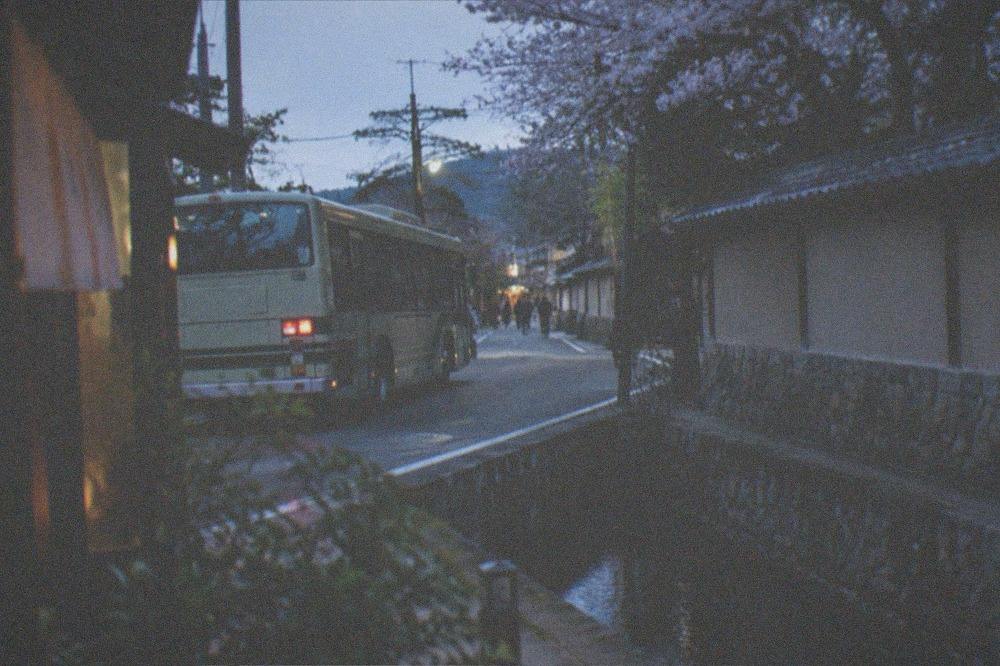
One honest caveat: the buses along the eastern hills are the most crowded in the city, and the transport bureau has spent 2025 and 2026 adding express services and promoting luggage delivery specifically to thin them out. Large bags can be refused on a packed bus, and the city's hands-free program, with station counters and delivery to hotels, exists for exactly this reason. Our Kyoto buses guide covers the routes in detail.
Where Should You Eat Near The Philosopher's Path in Kyoto?
The eating options along the path itself are small and cafe-scale: machiya coffee shops, a famous tofu restaurant beside the canal, and sweets shops near Ginkaku-ji. Nanzen-ji at the south end is one of the city's historic centres of shojin ryori, the Buddhist vegetarian cuisine that grew up around the Zen temples, and the Okazaki district beyond it adds museums and casual lunch spots.
Tofu is the local tradition here. The Nanzen-ji area has been associated with yudofu, simmered tofu, since the temple's Zen kitchens made it their staple, and the restaurants around the aqueduct have served it for generations. Our Kyoto tofu and shojin ryori guide explains what to order and what a fair price looks like. For the specific question of what a full kaiseki bill looks like in this city, the honest anchor is Hyotei near Nanzen-ji, whose own site prints kaiseki from 31,625 yen at lunch and 37,950 yen at dinner, while the same house's annex serves a morning rice porridge at 5,445 yen and a bento from 7,260 yen. Those are Hyotei's prices, not a city norm, but they show how wide the range runs within a single kitchen.
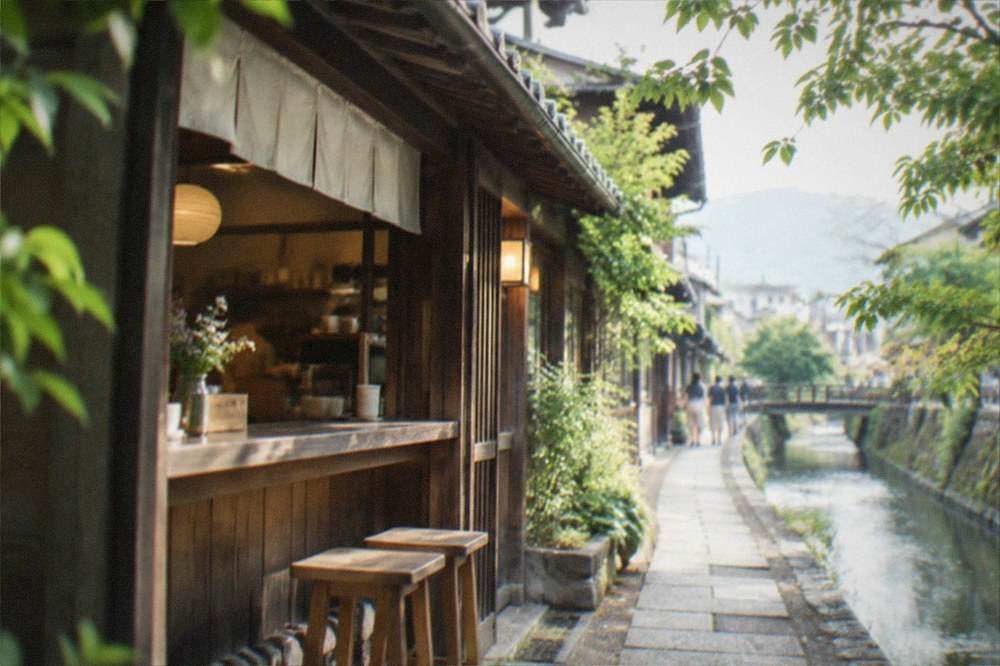
The cafes along the canal itself are the mid-point reward. Several occupy old townhouses with canal-side seating, and in April the combination of a coffee, a stone bank and falling petals is the reason people remember the walk. Portions are small and prices are what you would expect from a tourist street; the Kyoto on a budget guide has cheaper alternatives a few streets east.
Can You Extend The Philosopher's Path Into A Longer Kyoto Walk?
Yes, and the natural extension is south from Nanzen-ji through the Okazaki museum district to Heian Shrine and the Kamo River, adding about 30 minutes of walking. Northward, the path connects toward Ginkaku-ji's hillside trails and the Kurama and Kibune mountains further out, which need a separate half day and an Eizan Line train from Demachiyanagi.
The southern extension is the easy one. Nanzen-ji to Heian Shrine's giant torii is a level 10 minute walk through Okazaki, past the Kyoto City Zoo and the National Museum of Modern Art, and from there the grounds of the shrine are free to enter. Continuing west brings you down to the Kamo River, where the riverside paths run for kilometres and the evening crowd spills out of Pontocho.
The northern extension is the ambitious one. The mountains beyond the city, at Kurama and Kibune, hold one of the region's best temple-to-village hikes, a train ride out on the Eizan Line from Demachiyanagi, and a route that ends at a shrine by a river famous for its summer dining platforms over the water. A guided version handles the transport and the trail-finding, which matters because the trail's signage thins out above the temple.
For travellers who prefer their temple time to their trail time, the Zen garden circuit is the other natural pairing: Ryoan-ji's rock garden at 600 yen and the dry landscapes inside Ginkaku-ji itself are covered in our Kyoto Zen gardens guide, and the two ends of the Philosopher's Path sit at the centre of that tradition.
Common Questions About The Philosopher's Path in Kyoto
How Long Is The Philosopher's Path From Ginkaku-ji To Nanzen-ji?
The path is commonly described as about two kilometres from the Ginkaku-ji end to Nanzen-ji, taking 30 to 45 minutes of continuous walking. With stops at Honen-in, Otoyo-jinja and the temples at either end, plan on two to three hours, or half a day if you enter every ticketed area.
Is The Philosopher's Path Free?
Yes, the path itself is a public street with no gate, ticket or closing time. The charges sit at the ends and beside it: Ginkaku-ji costs 1,000 yen for adults from 1 April 2026, and Nanzen-ji's Hojo garden and Sanmon gate each cost 600 yen, ticketed separately.
When Do The Cherry Trees Bloom On The Philosopher's Path?
The JMA 1991-2020 normals for Kyoto put cherry full bloom at 4 April. In 2026 the JMA recorded full bloom on 30 March, and in 2025 on 5 April, so the first week of April is the reliable window. The path is at its most crowded then, and early morning is the quietest time to walk it.
Which Direction Should You Walk The Philosopher's Path?
North to south, from Ginkaku-ji down to Nanzen-ji, is the easier direction because the route runs level or gently downhill, and it finishes next to the Tozai Line subway stations and the Okazaki museum district. Walking it uphill from Nanzen-ji is perfectly possible but noticeably harder in summer heat.
Is The Philosopher's Path Open At Night?
Yes, it is a public street with no closing time, and the canal after dark is quiet and largely empty. The temples along it close in the late afternoon, Ginkaku-ji at 17:00 in season and Nanzen-ji's grounds to visitors by 17:00 or 16:30 in winter, so a night walk is about the path itself rather than the sights.
How Do You Get To The Start Of The Philosopher's Path?
For the Ginkaku-ji end, take a city bus from Kyoto Station or elsewhere toward the Ginkaku-ji stop; the flat fare is 230 yen for adults. For the Nanzen-ji end, take the Tozai Line subway to Keage or Higashiyama Station, at 220 to 360 yen depending on zone. The Subway and Bus One-Day Pass at 1,100 yen covers both networks.
The Philosopher's Path remains one of the few flagship Kyoto experiences that costs nothing at the door, pairs two of the city's great temples at its ends, and rewards an early start more than any ticket ever could. Walk it north to south, give it a morning, and let the aqueduct at the far end tell you where the water beside your feet has been all along.