How Do You Reserve The Katsura Imperial Villa Tour And How Far Ahead?
Katsura Imperial Villa in western Kyoto is one of Japan's most celebrated gardens, and you cannot simply buy a ticket at the gate. Entry is by guided tour only, booked through the Imperial Household Agency, and the rules around who may enter and when catch out a lot of visitors. Here is exactly how the reservation system works.
Short answer
Reserve through the Imperial Household Agency's sankan site, the same system that covers Shugakuin and the Sento Imperial Palace. Tours run about 60 minutes, cost 1,000 yen for visitors 18 and over, are free for ages 12 to 17, and the villa is closed Mondays. Apply online in advance, or take a chance on a same-day numbered ticket at the villa office with photo ID.
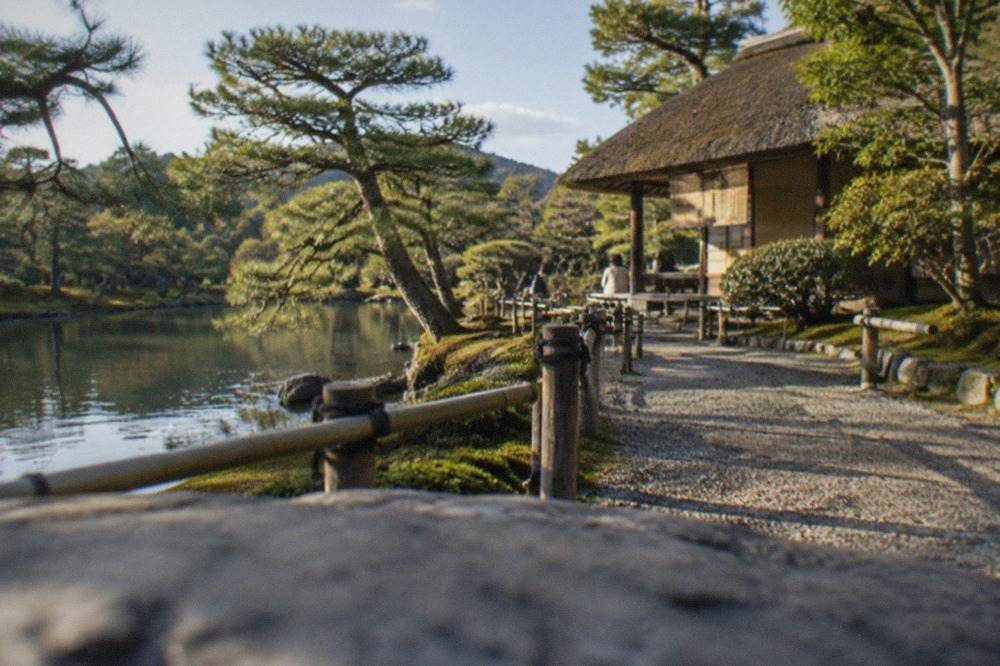
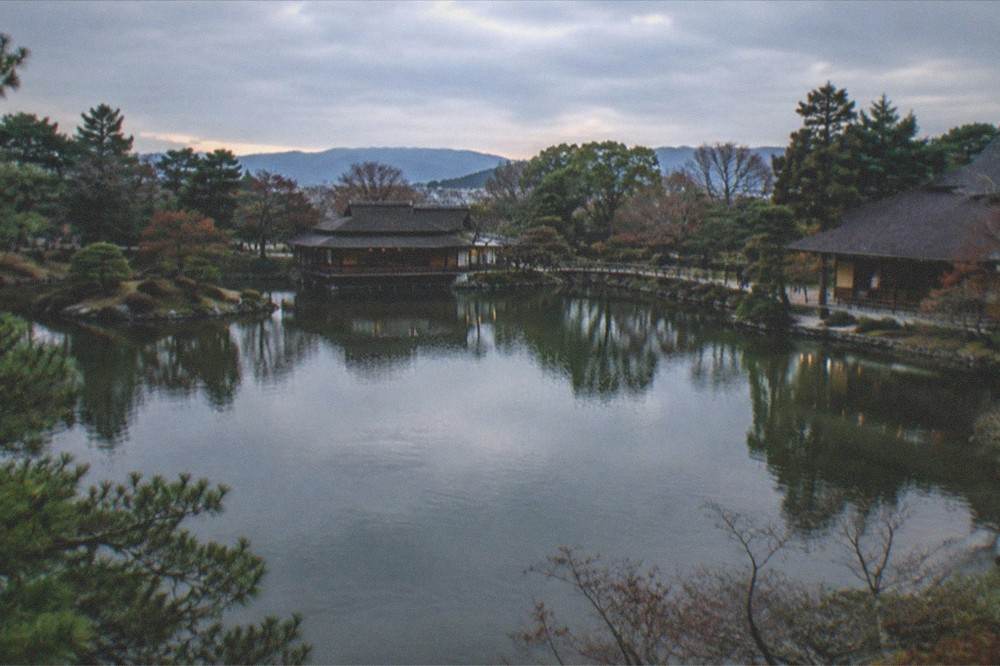
Katsura Imperial Villa sits on the western edge of Kyoto, and it is not a place you can wander into on impulse. The villa and its garden are viewed on a guided tour only, booked through the Imperial Household Agency, and the agency controls the numbers tightly. The garden itself is widely regarded as one of the finest ever laid out in Japan: a stroll garden built for the Hachijo-no-miya family in the early seventeenth century, with teahouses, a large pond and borrowed scenery from the hills behind Arashiyama. The Imperial Household Agency's English-language sankan site is the single place where bookings live, and understanding its quirks before you plan your Kyoto days will save you a wasted trip to the city's far west.
This page on Kyoto Travel Guide covers the reservation system end to end: what it costs, who is allowed in, how far ahead to apply, what the tour actually shows you, and how Katsura compares with the other two imperial properties in the city.
How Do You Reserve The Katsura Imperial Villa Tour And How Far Ahead?
You reserve through the Imperial Household Agency's online sankan application system, which opens a set window before each tour date, or in person at the Kyoto office. Tours last about 60 minutes, cost 1,000 yen for visitors 18 and over and are free for ages 12 to 17, and the villa is closed Mondays, or Tuesday when Monday is a public holiday. Apply as early as the window allows for spring and autumn dates, which go fastest.
The agency runs a single reservation portal for all three of its Kyoto properties: Katsura Imperial Villa, Shugakuin Imperial Villa and the Sento Imperial Palace. You create an account, choose a property, a date and a time slot, and receive a confirmation you bring with photo identification. The same portal also handles the small number of same-day places. The agency also keeps an office in Kyoto where applications can be made in person, and Katsura itself holds back numbered tickets for same-day visitors, issued at the villa entrance on a first come, first served basis to anyone with ID. That same-day pool is the fallback, not the plan: on busy days it can run out early.
How far ahead matters more than most guides admit. The agency opens each month's calendar a fixed period in advance, and the desirable slots, weekend mornings in cherry season and late November, are claimed quickly. For an ordinary weekday outside peak season, applying a few weeks ahead is usually enough. For April or late autumn, treat the opening day of the application window as the day to act. If you miss it, the same-day numbered tickets at the villa entrance are your remaining route, and arriving before the first tour of the day gives you the best odds.
| Booking route | How it works | Best for |
|---|---|---|
| Online advance application | Imperial Household Agency sankan site, account required, choose date and slot | Peak-season dates, weekend mornings |
| In-person advance application | At the agency's Kyoto office during opening hours | Visitors already in Kyoto planning ahead |
| Same-day numbered ticket | Issued at the villa entrance with photo ID, first come first served | Flexible travellers, off-peak weekdays |
One structural point worth knowing: because the tours are guided and timed, you cannot linger. The 60-minute circuit moves at the guide's pace, and the garden's teahouses are viewed from outside unless a special interior viewing is running. If you want a Kyoto garden you can sit inside all afternoon, Ryoan-ji or Saiho-ji, the moss temple are the better fits, and Saiho-ji has its own reservation system worth reading about separately.
What Does The Katsura Imperial Villa Tour Cost And Who Can Enter?
The Katsura Imperial Villa tour costs 1,000 yen for visitors aged 18 and over, and children aged 12 to 17 enter free of charge. A disability certificate holder plus one companion also enter free. There is no self-guided option at any price: every visitor joins a guided tour of about 60 minutes, and the villa is closed Mondays, opening Tuesday instead when Monday is a national holiday.
The age rule is the one that surprises families. Katsura admits children from 12 up, but the two other agency properties in Kyoto are stricter: Shugakuin Imperial Villa and the Sento Imperial Palace admit visitors 18 and over only, with under-18s, including infants, not admitted at all. That restriction matters enough to state plainly, because a family that books Shugakuin expecting to bring a teenager will be turned away. Katsura is the family-friendly one of the three, and at 1,000 yen for adults with 12 to 17 year olds free, it is also priced gently next to Kyoto's major temples.
Compare that with the rest of the city's entry fees and Katsura sits mid-table. The Kyoto Imperial Palace nearby is free and, per the Imperial Household Agency, open to all visitors with no advance application necessary. Kinkaku-ji charges 500 yen, Ginkaku-ji doubled to 1,000 yen in April 2026, and Nijo-jo Castle starts at 800 yen before you add the palace interiors. Katsura's 1,000 yen buys the rarest commodity in Kyoto: a garden kept at museum density, with visitor numbers capped by a government agency rather than by how many people fit through a gate.
| Property | Adult fee | Age policy | Booking |
|---|---|---|---|
| Katsura Imperial Villa | 1,000 yen (18 and over) | Free for 12 to 17 | Advance application or same-day ticket, closed Mondays |
| Shugakuin Imperial Villa | Free | 18 and over only | Advance application or same-day ticket, closed Mondays |
| Sento Imperial Palace | Free | 18 and over only | Advance application, closed Mondays |
| Kyoto Imperial Palace | Free | Open to all | No application necessary |
Payment at the villa itself is handled at the office when you check in for your tour, so bring identification matching your application and cash for the fee. The tours are conducted in Japanese, with the agency lending audio guides in several foreign languages, so check the sankan site for the current language list before assuming an English-language guide.
What Do You See On The Katsura Imperial Villa Garden Tour?
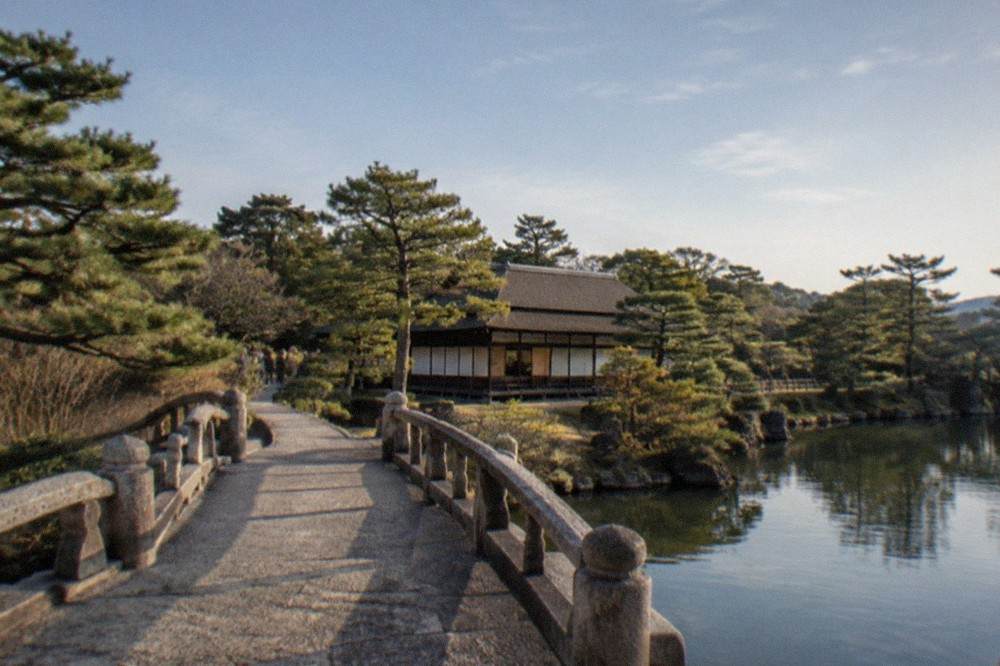
The tour follows a roughly 60-minute circuit around the villa's pond garden, passing the outer teahouses, the Shokin-tei tea house, the Shoka-tei and the Onrindo pavilion, with the garden's paths deliberately hiding and revealing views of the water. The villa buildings themselves are seen from the garden, and the famous borrowed scenery pulls the hills of Arashiyama into the composition.
Katsura's garden is built as a stroll garden, a form where the path itself is the design instrument. The route circles the large central pond, crossing stone bridges and passing through pine groves, and each teahouse was placed to be approached, not just seen. The Shokin-tei, the main teahouse, sits on a small island reached by a stone bridge, and its interiors are studied by architects worldwide. The villa was constructed for Prince Toshihito of the Hachijo family in the early seventeenth century and refined by his son Toshitada, and the garden's reputation has drawn designers from Bruno Taut onward ever since.
What makes the circuit unusual is the sequencing. The paths are laid out so the pond appears and disappears: you walk a stretch of gravel with no water in sight, round a planting, and the whole expanse opens at once. The designers also framed the distant hills of the western mountains so they read as part of the garden, a technique called borrowed scenery that Katsura uses more confidently than almost anywhere in Japan. Because the tour moves in one direction with a guide, you get each of these reveals exactly once, which is a good reason to walk near the front of the group.
The teahouse interiors are generally closed, and the villa's main buildings are viewed from outside. Photography is permitted in the garden on the standard tour, but the agency's rules on where you may step and what you may touch are strict, and the guide's instructions govern the visit. If a special interior viewing of the Shokin-tei is offered during your dates, it is announced by the agency and is worth rearranging a day for.
How Do You Get To The Katsura Imperial Villa In Kyoto?
The nearest station is Katsura on the Hankyu Kyoto Line, about 15 minutes on foot from the villa entrance, and the villa is roughly 20 minutes by train from Kyoto's Karasuma central district. From Kyoto Station, take the JR Nara Line one stop to Tofuku-ji and transfer to the Keihan Line, or use the subway and Hankyu combination via Karasuma station. Arrive 20 to 30 minutes before your tour time for check-in.
Katsura's location in the city's southwest is the practical catch. Most visitors stay in the Karasuma or Kawaramachi area or near Kyoto Station, and all of those require a transfer to reach the villa, so budget 40 to 60 minutes of travel from central Kyoto and do not book a tour slot that fights your morning. The walk from Hankyu Katsura station runs through a quiet residential district, flat and straightforward, and there is little in the way of food or coffee near the gate, so eat before you leave.
The return journey is where the geography pays off. Katsura station is the transfer point for the Hankyu Arashiyama Line, which puts you a short walk from the Arashiyama bamboo grove in about 20 minutes. A natural day pairs the morning Katsura tour with an afternoon in Arashiyama, and that combination is one of the better uses of a Kyoto day that avoids the eastern temple crowds entirely. The Fushimi Inari shrine is on the opposite side of the city, so do not try to chain all three before lunch.
| Route | From | Approximate time |
|---|---|---|
| Hankyu Kyoto Line | Karasuma (central Kyoto) to Katsura, then walk | 15 minutes train plus 15 minutes on foot |
| JR Nara Line plus Keihan | Kyoto Station to Tofuku-ji, transfer to Katsura | about 35 minutes plus the walk |
| Subway plus Hankyu | Kyoto Station, Karasuma Line to Karasuma, transfer | about 40 minutes plus the walk |
| Taxi | Anywhere in central Kyoto | 25 to 35 minutes depending on traffic |
When Is The Best Time Of Year To Visit The Katsura Imperial Villa?
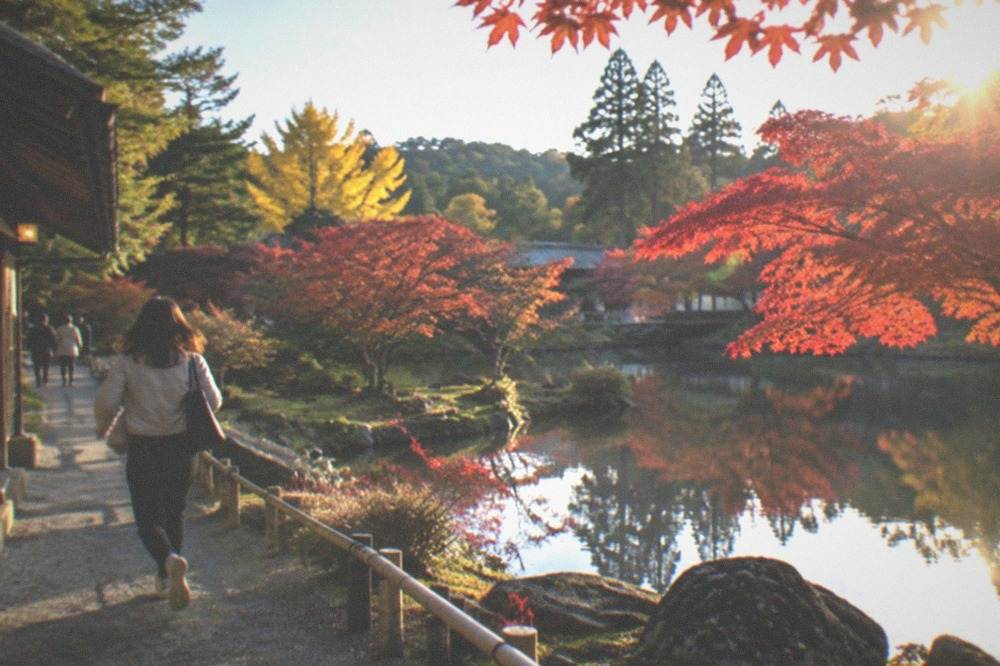
Late November is the strongest time to see Katsura, when the garden's maples turn and the pond reflects the colour, followed by early April for cherry blossom along the water. The JMA 1991-2020 normals put Kyoto's maple red leaves at 5 December and full cherry bloom at 4 April, so aim for the last week of November or the first week of April, and book the application window the day it opens.
The phenology record kept by the Japan Meteorological Agency at its Kyoto observatory gives the honest calendar. Cherry flowering has come early in recent years: 23 March in 2026 against a normal of 26 March, with full bloom on 30 March against a normal of 4 April. The maple marker is later than most guides claim, because the JMA date is the observatory's own specimen tree turning, not the garden peak, and Kyoto's best garden colour usually runs the second half of November. The 2026 foliage outlooks for the Arashiyama area, the hills Katsura borrows for its scenery, clustered around late November.
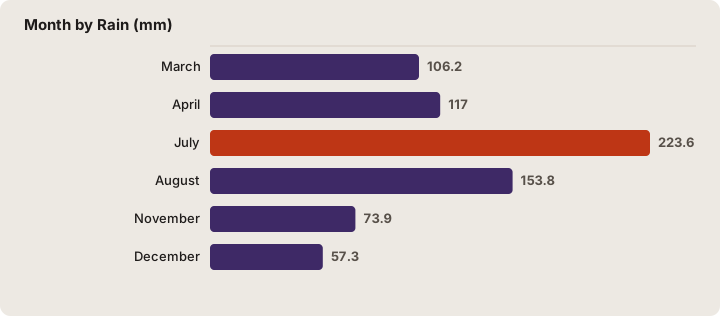
Rain is the other planning variable, and it is not the one most visitors expect. The JMA 1991-2020 normals show July, not June, as Kyoto's wettest month, 223.6 mm against 199.7 mm. Summer tours run hot as well: the mean daily maximum in August is 33.7 C, and three of Kyoto's six hottest days on record fell in the summers of 2024, 2025 and 2026. A morning tour slot in July or August is markedly more comfortable than an afternoon one, and the garden offers little shade on the gravel stretches.
| Month | Mean temperature | Mean daily maximum | Rain |
|---|---|---|---|
| March | 8.8 C | 14.1 C | 106.2 mm |
| April | 14.4 C | 20.1 C | 117.0 mm |
| July | 27.3 C | 32.0 C | 223.6 mm |
| August | 28.5 C | 33.7 C | 153.8 mm |
| November | 12.5 C | 17.3 C | 73.9 mm |
| December | 7.2 C | 11.6 C | 57.3 mm |
Winter has its own case. The garden's pines and structure carry the composition when the deciduous trees are bare, December brings only 57.3 mm of rain on the normals, and the same-day ticket pool is far less contested. The villa closes Mondays year round and shuts for the year-end period, so check the agency calendar for late December before planning a winter visit.
How Does Katsura Compare With Shugakuin And The Kyoto Imperial Palace?
Katsura charges 1,000 yen and admits visitors from age 12, while Shugakuin and the Sento Palace are free but admit only visitors 18 and over, and the Kyoto Imperial Palace is free and open to all with no application needed. Katsura's tour runs about 60 minutes on flat garden paths; Shugakuin's tour is longer and hillier with a famous panorama over its own lower garden from the upper villa.
The three agency properties split neatly by what you want. Katsura is the designed garden, the one architects and garden historians cross the world for, compact and flat and built around a single pond. Shugakuin, on the city's northeast edge, is the grander landscape: a sprawling villa complex built by Prince Toshitada's contemporary Emperor Gomizuno-o, with a famous upper garden view over a pond that reads like a miniature of Lake Biwa. The Sento Palace, inside the Kyoto Gyoen park, is the quiet one, a garden attached to a retired emperor's residence, free and 18-plus only like Shugakuin.
The Kyoto Imperial Palace is the odd one out because it dropped its booking requirement entirely: the agency states it is open to all visitors with no advance application necessary. That makes it the spontaneous choice, and its park, the Gyoen, is a pleasant free walk in its own right. If your Kyoto itinerary is short, the practical pairing is Katsura plus Arashiyama in the west on one day, and the palace plus the northern temple belt on another.
| Property | Garden style | Tour length | Terrain |
|---|---|---|---|
| Katsura Imperial Villa | Stroll garden around a pond with teahouses | about 60 minutes | Flat, gravel paths |
| Shugakuin Imperial Villa | Hillside villa gardens with a panorama | about 60 to 90 minutes | Slopes and steps |
| Sento Imperial Palace | Intimate palace garden | about 60 minutes | Mostly flat |
| Kyoto Imperial Palace | Palace buildings and park | self-guided | Flat, open park |
Families should note the age split again, because it decides the itinerary: with children under 12, Katsura and the Imperial Palace are your only agency options. With teenagers, all four work, and Shugakuin being free makes it an easy add-on. Solo adults travelling in peak season should apply for Katsura and Shugakuin on the same application-window day and take whichever confirms first.
What Should You Know Before The Katsura Imperial Villa Visit?
Bring photo identification matching your application, cash for the 1,000 yen fee, and arrive 20 to 30 minutes before your slot because check-in closes before the tour starts. Wear comfortable walking shoes for gravel paths, expect no food, drink or shops inside the villa grounds, and note that the tour is guided in Japanese with the agency lending foreign-language audio guides. Photography in the garden is permitted on the standard tour.
The check-in procedure is the part people underestimate. Your confirmation, whether from the online application or the same-day numbered ticket, is exchanged at the villa office near the entrance, and the process takes a few minutes per group. Arriving 20 minutes early is comfortable; arriving at your tour time is late. The office is also where the fee is paid and where the audio guides are issued, so the front of the queue for check-in is also the front of the queue for the tour.
There is nothing to buy near the villa. The surrounding Katsura district is residential, and the walk from the station passes no convenience store of note, so carry water in summer especially. The garden has no benches for lingering on the tour route, and the agency's conduct rules, staying with the group, keeping to the path, no touching the plantings or structures, are enforced by the guide rather than by signage. Visitors who need a slower pace should tell the office at check-in, and the guides are generally accommodating when asked in advance.
A few practical extras make the day smoother. The villa's Monday closure is absolute except when Monday is a holiday, in which case Tuesday closes instead. Late autumn tours end earlier in the afternoon than summer ones, so an afternoon slot in November can mean arriving in near dusk. And if the forecast turns to rain, the tour runs regardless: the garden in rain, with wet stone and mist over the borrowed hills, is a well-known pleasure of Japanese gardens, so a rainy forecast is a reason to keep the booking, not cancel it.
Can You Visit The Katsura Imperial Villa Without A Reservation?
Yes, but only through the same-day numbered tickets issued at the villa entrance with photo identification, first come first served, and only for as long as the day's allocation lasts. There is no walk-up ticket you can buy at any time of day, and in cherry season and late November the same-day pool can be exhausted before the morning tours leave. Treat the same-day route as a backup, not a plan.
The same-day system exists because the agency holds back a portion of each tour's capacity for visitors who could not apply in advance, including those who did not know they needed to. The mechanics are simple: go to the villa office on the day, present ID, and if places remain you receive a numbered ticket for a later tour that day. The office's opening time and the day's tour schedule are on the agency's sankan site, and on quiet weekdays in, say, late January, the same-day route works reliably. In April or the last week of November it is a gamble.
If you do arrive without a booking and the pool is empty, the district is not a write-off. The villa's exterior wall and the Katsura river district have their own quiet charm, and the Hankyu line puts both downtown Kyoto and Arashiyama within half an hour. The stronger move is to apply for a later date on the agency site the same evening, from your hotel, and restructure the day around Nishiki Market or the eastern temple belt while you wait for a slot.
The lesson most visitors take away is that Katsura rewards planners. The garden is the same 60 minutes whether you booked it three weeks out or secured a same-day ticket early in the morning, but the planner is the one standing at the Shokin-tei bridge at the hour they chose, in the season they chose, with the day built around it.
If you would rather leave the logistics to someone else for the rest of your Kyoto days, a guided day tour covers the headline sights without you having to plan a single transfer, and the options above are the ones that consistently earn the strongest traveller ratings.
Common Questions About The Katsura Imperial Villa
How Do You Reserve The Katsura Imperial Villa Tour And How Far Ahead?
Apply through the Imperial Household Agency's sankan site, which opens each month's calendar a set period in advance, or in person at the agency's Kyoto office. For spring and late autumn dates, apply on the day the window opens; for off-peak weekdays a few weeks ahead is usually enough. Same-day numbered tickets with photo ID are the fallback.
How Much Does The Katsura Imperial Villa Tour Cost?
The tour costs 1,000 yen for visitors 18 and over. Children aged 12 to 17 enter free, and a disability certificate holder plus one companion also enter free.
Can Children Visit The Katsura Imperial Villa?
Yes, from age 12. Visitors aged 12 to 17 are admitted free. Shugakuin Imperial Villa and the Sento Imperial Palace are stricter: both admit visitors 18 and over only, and under-18s including infants are not admitted at those two properties.
Is The Katsura Imperial Villa Closed On Mondays?
Yes, the villa is closed every Monday, and when Monday is a national holiday the closure moves to Tuesday. The agency's calendar also lists the year-end closure period.
How Long Is The Katsura Imperial Villa Tour?
About 60 minutes. The circuit is guided, moves at the guide's pace, and covers the garden path around the central pond.
What Is The Nearest Station To The Katsura Imperial Villa?
Hankyu Katsura station on the Kyoto Line, about 15 minutes on foot from the villa entrance. From central Kyoto the trip takes roughly 40 to 60 minutes including transfers.
Katsura Imperial Villa is the most controlled garden experience in Kyoto, and that control is exactly why it stays worth the effort. Book through the agency the moment the window opens for your dates, bring ID and cash, arrive early, and give the garden the hour it was designed to be seen in.